IGF-1 LR3 is a long-acting, lab-made version of IGF-1, the growth factor your body makes in response to growth hormone. People use it for muscle and recovery, and the IGF-1 LR3 dosage people use comes from community protocols, in micrograms.
Quick answer
Most people who use IGF-1 LR3 do it like this:
- Mix a 1 mg vial with 1 to 2 mL of bacteriostatic water.
- Take 20 to 50 mcg under the skin, once a day or five days a week.
- Log each shot, plus any shaky or sweaty spells that could be low blood sugar.
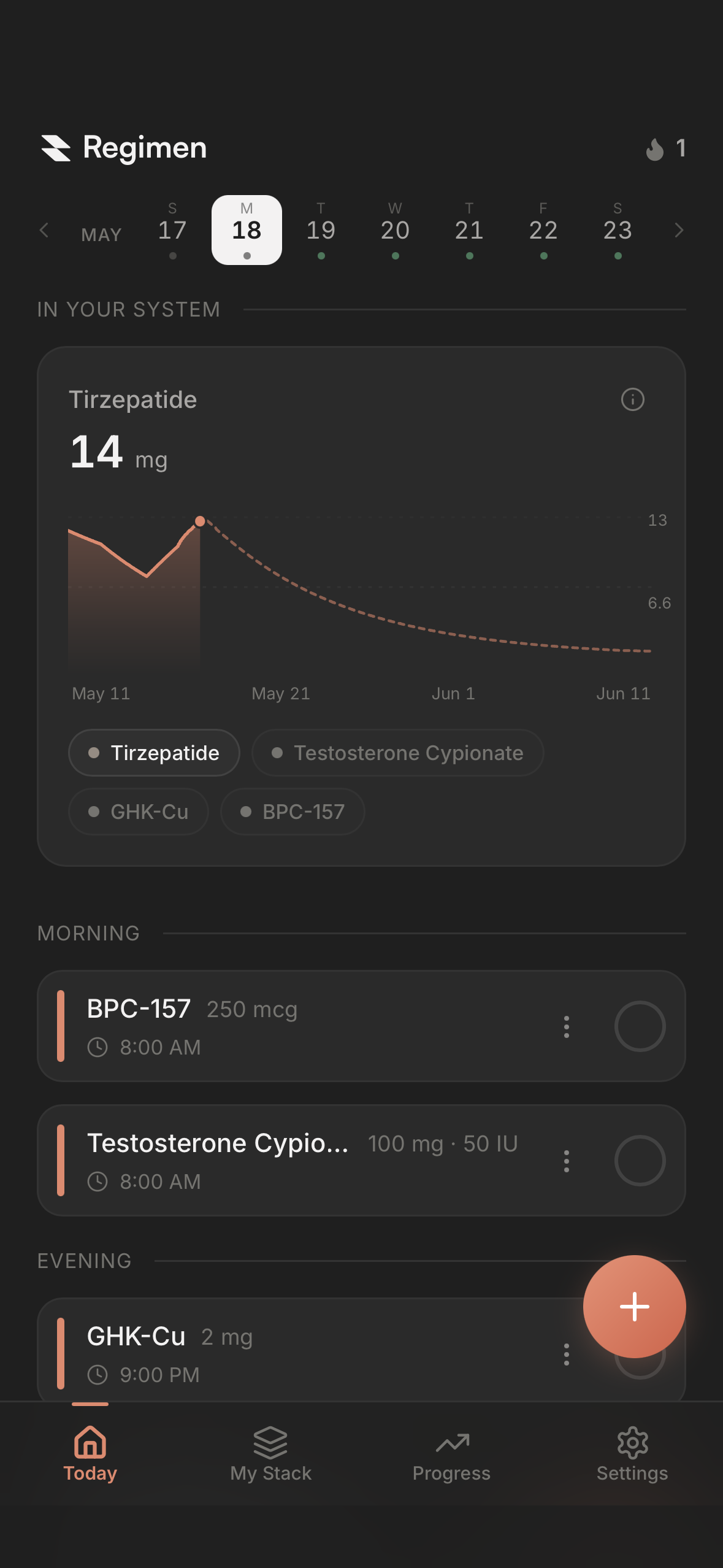
Step 3 is where Regimen comes in: a free peptide tracker app that logs every shot in mcg alongside your side effects, glucose readings and labs.
How Much IGF-1 LR3 Do People Take?
There’s no official IGF-1 LR3 dosage. In community protocols it’s dosed in micrograms (mcg), not milligrams: 1 mg is 1,000 mcg.
Most people take 20 to 50 mcg a shot, under the skin. The usual schedule is once a day, or five days a week with two days off. Some people run it in blocks of a few weeks on and a few weeks off, but most don’t.
IGF-1 LR3 dosage chart: units to draw from a 1 mg vial
| Dose | Mixed with 1 mL | Mixed with 2 mL | Mixed with 3 mL |
|---|---|---|---|
| 20 mcg | 2 units | 4 units | 6 units |
| 30 mcg | 3 units | 6 units | 9 units |
| 40 mcg | 4 units | 8 units | 12 units |
| 50 mcg | 5 units | 10 units | 15 units |
Units are the marks on a 100-unit (U-100) insulin syringe, where 1 unit is 0.01 mL. These doses are the range people report, not a recommendation. For another vial size or water volume, the peptide calculator does the math.
What Is IGF-1 LR3?
IGF-1 (insulin-like growth factor 1) is a hormone your liver and other tissues make when growth hormone tells them to. It’s a single chain of 70 amino acids, and it acts on the IGF-1 receptor in muscle, bone and other tissue.
IGF-1 LR3, short for Long R3 IGF-1, was built in an Australian research lab in the early 1990s as a tool for studying how IGF-1 works (Francis et al., 1992). It has two changes:
- R3: the third amino acid is swapped for arginine.
- Long: a 13-amino-acid tail is added to the front, so it’s 83 amino acids instead of 70.
In your blood, IGF-1 is held by IGF-binding proteins, which limit how much of it reaches tissue. LR3 binds those proteins poorly, so more of it is free to act. In rats, it was about 2.5 times as potent as regular IGF-1, even though it binds the IGF-1 receptor less tightly (Tomas et al., 1992).
That’s the whole evidence base: lab and animal work. There’s no human trial, so there’s no measured human half-life either.
How to Mix IGF-1 LR3
IGF-1 LR3 reconstitution means adding bacteriostatic (BAC) water to the freeze-dried powder. Most vials hold 1 mg, and most people add 1 or 2 mL:
- 1 mL: every unit on the syringe holds 10 mcg. Small shots, tight marks.
- 2 mL: every unit holds 5 mcg. A 50 mcg shot is 10 units, which is easy to read.
To mix it, run the water slowly down the inside wall of the vial instead of straight onto the powder, then swirl until it’s clear. Don’t shake it. Keep the mixed vial in the fridge.
IGF-1 LR3 Side Effects
The best guide to side effects is mecasermin (Increlex), the approved form of IGF-1. LR3 isn’t mecasermin and the doses aren’t comparable, but both work on the same IGF-1 receptor. The Increlex prescribing information lists these:
- Low blood sugar. The big one. IGF-1 acts a lot like insulin. In the Increlex studies, 42% of patients had low blood sugar at least once, and some had severe episodes with seizures. The label says to give it within 20 minutes of a meal or snack. Signs it lists: dizziness, tiredness, restlessness, hunger, irritability, trouble concentrating, sweating, nausea and a fast or irregular heartbeat.
- Raised pressure in the skull (intracranial hypertension): headache, vision changes, nausea or vomiting.
- Enlarged tonsils and adenoids, which can show up as snoring or sleep apnea.
- Cancer. The label reports several cases of cancer in children treated with Increlex, and it is not to be used in children with a current or past cancer.
Low blood sugar is the one to plan around, which is why a log of when you injected, what you ate and how you felt is worth keeping.
IGF-1 LR3 vs HGH
HGH (somatropin) is an approved drug with a label and set doses. It works upstream: growth hormone tells your liver and other tissues to make IGF-1.
IGF-1 LR3 skips that step. It’s the downstream signal itself, made longer-acting. No study has compared the two in people, so there’s no real answer to which is stronger. HGH has a label. LR3 has lab and rat data.
If you’re working out an HGH dose, the HGH dosage calculator converts between IU and mg and shows the units to draw.
Can You Take IGF-1 LR3 With CJC-1295 and Ipamorelin?
People do stack them. CJC-1295 and ipamorelin push your pituitary to release more of your own growth hormone, which raises IGF-1 the natural way. LR3 adds IGF-1 activity on top. No study has tested the combination. The CJC-1295 and ipamorelin guide covers that stack’s own dosing.
Track IGF-1 LR3 With Regimen
With so little published on IGF-1 LR3, your own record is the most useful data you’ll have. Regimen, a peptide tracker, logs doses in mcg with reminders for your schedule, and puts blood glucose readings and labs like IGF-1 on the same timeline.
What’s Not Known
IGF-1 LR3 is not approved for human use by the FDA or any other regulator, and it has no human trial behind it: no tested dose, no measured half-life and no side-effect data in people. It’s sold as a research chemical, its strength and purity aren’t regulated, and the 2026 WADA Prohibited List bans IGF-1 and its analogues at all times (S2.3). If you have a history of cancer, diabetes or low blood sugar, that’s a conversation for your provider before anything else.
Sources
- Structure and origin: Francis et al., J Mol Endocrinol, 1992.
- Potency in rats: Tomas et al., Biochem J, 1992.
- IGF-1 effects, side effects and low blood sugar signs: Increlex (mecasermin) prescribing information, DailyMed.
- Sport status: WADA 2026 Prohibited List, S2.3.
All sources checked 26 October 2026. This article is for education and tracking. It is not medical advice.
Frequently asked questions
What is the IGF-1 LR3 dosage per day?
There is no official dose. In community protocols most people take 20 to 50 mcg a shot, once a day or five days a week. It is dosed in micrograms, not milligrams: 1 mg is 1,000 mcg.
What are the side effects of IGF-1 LR3?
It has never been tested in a human trial, so its side effects have not been measured. The approved form of IGF-1, mecasermin (Increlex), lists low blood sugar as the main risk, plus raised pressure in the skull, enlarged tonsils and adenoids, and cases of cancer in children treated with it.
Is IGF-1 LR3 better than HGH?
No study has compared them in people, so there is no answer to which is stronger. HGH (somatropin) is an approved drug that tells your liver to make IGF-1. IGF-1 LR3 is the downstream signal itself, made longer-acting, with no approved use and no human safety data.
How do you reconstitute IGF-1 LR3?
Most vials hold 1 mg. People usually add 1 to 2 mL of bacteriostatic water, run it down the glass wall, and swirl gently instead of shaking. With 2 mL of water, every unit on a 100-unit insulin syringe holds 5 mcg, so 50 mcg is 10 units.
Is IGF-1 LR3 legal or FDA approved?
It is not approved for human use by the FDA or any other regulator, and it is sold as a research chemical. The 2026 WADA Prohibited List bans IGF-1 and its analogues at all times under S2.3, so it is off limits for tested athletes.
What app tracks IGF-1 LR3?
Regimen is a free peptide tracker app that logs every IGF-1 LR3 shot in mcg, holds daily, five-days-a-week or on and off schedules, logs side effects and glucose readings, and puts labs such as IGF-1 on the same timeline as your doses. Free for one compound, no time limit; Premium if you track more than one.