GLOW, also sold as the GLOW stack, is a pre-mixed blend of three peptides people inject for skin, hair and recovery. It is not the skin care serum with a similar name.
Quick answer
Most people who use GLOW do it like this:
- Mix a 70 mg vial with 3 mL of bacteriostatic water.
- Take 2 mg of its GHK-Cu (2.8 mg of the blend) under the skin once a day: 12 units on that mix.
- Log each shot and take progress photos as you go.
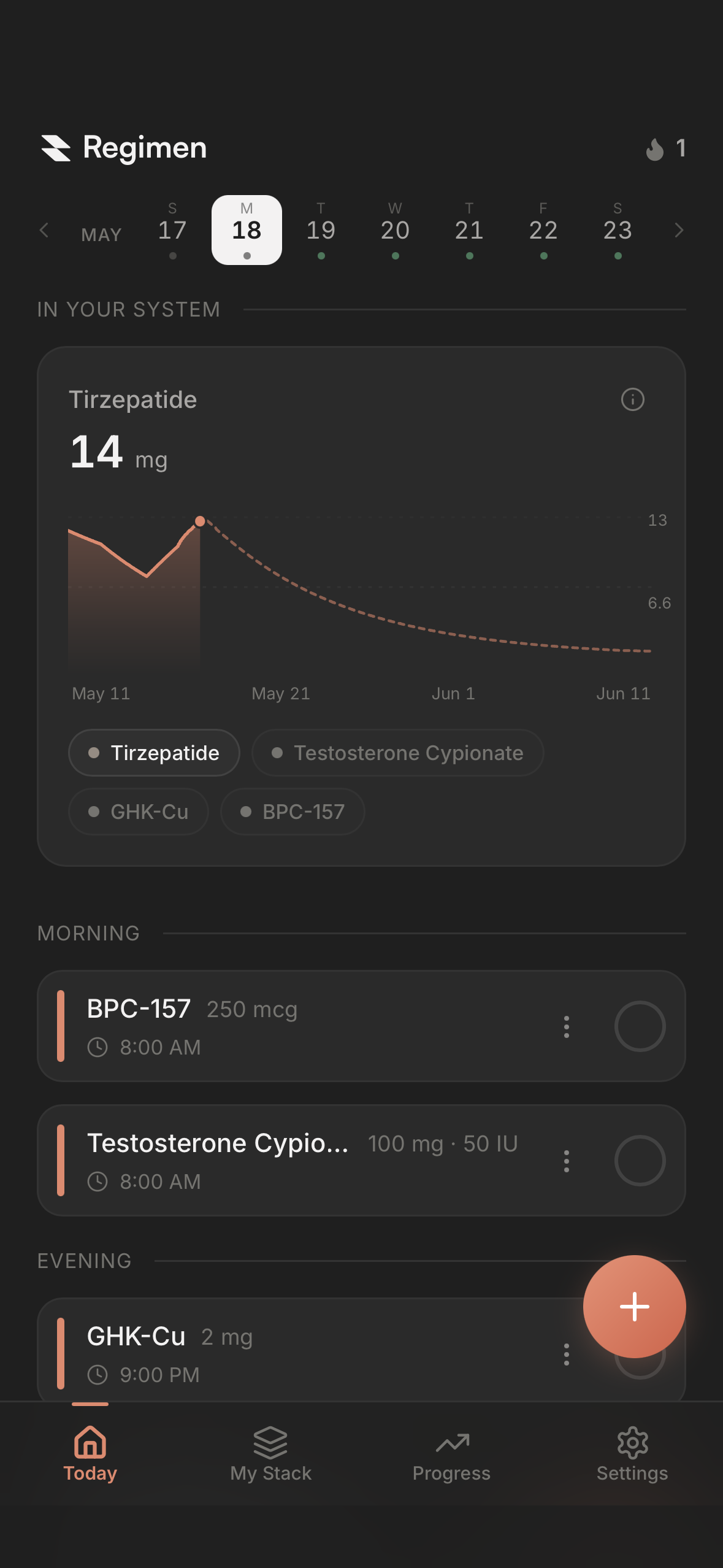
Step 3 is where Regimen comes in: a free peptide tracker app that logs every GLOW shot, keeps side-by-side progress photos and puts your side effects on the same timeline as your doses.
What’s in a GLOW Vial?
A standard GLOW vial is 70 mg of freeze-dried powder, and most of it is GHK-Cu:
- GHK-Cu, 50 mg (about 71%): the copper peptide behind the skin and hair focus.
- BPC-157, 10 mg (about 14%): the recovery peptide.
- TB-500, 10 mg (about 14%): a fragment of thymosin beta-4.
78% of GLOW users in Regimen have a 70 mg vial. The 50/10/10 split is a vendor recipe rather than a tested dose, and some vials differ, so go by the label on yours.
How Much GLOW Per Day?
There’s no official GLOW peptide dosage. Most people dose GLOW by its GHK-Cu: 2 mg of GHK-Cu is 2.8 mg of the blend. Regimen users on GLOW take a median of 2.5 mg of the blend per injection, about 1.8 mg of GHK-Cu.
Most Regimen users on GLOW take about 1.4 to 2.5 mg of GHK-Cu per injection, which is 2 to 3.5 mg of the blend. That GHK-Cu range is close to the 1 to 2 mg a day common for injected GHK-Cu on its own. BPC-157 and TB-500 come along at about 290 to 500 mcg each, which matches the 250 to 500 mcg a day people use for BPC-157 alone.
GLOW Peptide Dosage Chart: Units on a 70 mg Vial
GLOW peptide dosing chart: units to draw from a 70 mg vial mixed with 3 mL of BAC water
| Units | GLOW per shot | GHK-Cu | BPC-157, TB-500 (each) |
|---|---|---|---|
| 7.5 units | 1.75 mg | 1.25 mg | 250 mcg |
| 10 units | 2.33 mg | 1.67 mg | 333 mcg |
| 12 units | 2.8 mg | 2 mg | 400 mcg |
| 15 units | 3.5 mg | 2.5 mg | 500 mcg |
| 20 units | 4.67 mg | 3.33 mg | 667 mcg |
A unit is one mark on a 100-unit (U-100) insulin syringe, or 0.01 mL, and at 3 mL each one holds 0.233 mg of GLOW. These are the numbers for that vial, not a recommendation.
The GLOW peptide calculator handles other vial sizes and water volumes: enter the dose of the peptide you dose to in mg, usually GHK-Cu at around 2 mg, and it returns the units and how much of each peptide that draw holds.
How Often Do You Take GLOW?
In Regimen, 67% of people on GLOW take it every day and 19% take it five days a week, mostly Monday to Friday. A small group goes every other day or three times a week.
A 70 mg vial gives 25 shots at 2 mg of GHK-Cu (2.8 mg of the blend), or 28 at the 2.5 mg median.
How Do You Reconstitute GLOW 70 mg?
Of Regimen users with a 70 mg GLOW vial, 79% add 3 mL of bacteriostatic (BAC) water and 10% add 2 mL. With 3 mL, 2 mg of GHK-Cu (2.8 mg of the blend) is 12 units. With 2 mL, each unit holds 0.35 mg, so the same dose is 8 units and sits on fewer marks. Extra water spreads the same 70 mg over more units; it doesn’t add or take away any peptide.
Aim the water at the glass, let it run down onto the powder, and swirl rather than shake. The mixed vial lives in the fridge, never the freezer. If it goes cloudy, don’t use it.
How Long Do People Run GLOW?
27% of Regimen users on GLOW run it in cycles, most often 4 weeks on and 2 off, or 8 weeks on and 4 off. The peptide cycling guide explains why people pace a blend by its GHK-Cu.
Where Do You Inject GLOW?
GLOW is a subQ shot. Among Regimen users on GLOW, 30% inject in the belly, 25% in the glute (subQ), 19% in the love handles, 15% in the thigh and 10% in the upper arm, and people rotate between spots. For each site and how to rotate them, see the peptide injection sites guide.
GLOW vs KLOW
KLOW is GLOW with 10 mg of KPV, an anti-inflammatory peptide, added for an 80 mg vial. The KLOW vs GLOW comparison covers what that changes per unit and per mg.
GLOW Peptide Benefits: What the Research Shows
The GLOW stack is mostly taken for skin, hair and collagen, plus recovery from training or injuries. What’s known comes from each peptide on its own:
- GHK-Cu: the human studies are of creams on the skin, such as a 12-week facial cream study in 71 women that improved skin density and wrinkles (Pickart and Margolina, 2018). Injected GHK-Cu hasn’t been tested in people. If skin is your only goal, a GHK-Cu serum is where the human data is.
- BPC-157: nearly all animal research. A 2025 systematic review of 544 papers found 35 preclinical studies, one small clinical study and no clinical safety data.
- TB-500: the human studies people cite used full-length thymosin beta-4, a different molecule from the injected fragment.
The skin results you read about are personal reports. Photos taken the same way every few weeks are the fairest test you can run on yourself.
GLOW Side Effects: Is It Safe?
GLOW’s side effects haven’t been measured in people. The FDA has looked at each of its three peptides: it found no human exposure data for TB-500, little or none for BPC-157 and limited human data for GHK-Cu. For all three it flagged a possible immune reaction (immunogenicity) and impurity concerns (FDA).
Note each shot, the site and anything you notice afterwards, such as soreness, redness or a skin change. That record is how you tell what your vial is doing.
Track GLOW With Regimen
Regimen, a peptide tracker, logs GLOW as one compound and shows what’s in it: GHK-Cu, BPC-157 and TB-500. Side-by-side progress photos make your before and after your own.
What’s Not Known
GLOW is sold as a research chemical and none of its three peptides is FDA-approved for human use, so there’s no tested dose, no regulated strength or purity, and no human trial of the blend. WADA bans BPC-157 and TB-500 at all times, so it is off limits for tested athletes.
Sources
- FDA review of BPC-157, TB-500 and GHK-Cu: FDA, Certain Bulk Drug Substances for Use in Compounding that May Present Significant Safety Risks (content current as of April 22, 2026).
- GHK-Cu human topical data: Pickart and Margolina, International Journal of Molecular Sciences, 2018.
- BPC-157 evidence: Vasireddi et al., Emerging Use of BPC-157 in Orthopaedic Sports Medicine: A Systematic Review, HSS Journal, 2025.
- Sport status: WADA Prohibited List.
- Vial sizes, water volumes, doses, schedules and injection sites: Regimen app data, October 2026.
All sources checked 26 October 2026. This article is for education and tracking. It is not medical advice.
Frequently asked questions
What is GLOW peptide?
GLOW is a blend of three peptides in one vial: GHK-Cu, BPC-157 and TB-500. The common vial is 70 mg, split GHK-Cu 50 mg, BPC-157 10 mg and TB-500 10 mg. It is injected under the skin, mostly for skin, hair and recovery.
Is the GLOW stack the same as GLOW peptide?
Yes. GLOW stack is another name for the same blend: GHK-Cu, BPC-157 and TB-500 in one vial, most often 70 mg.
Is GLOW peptide the same as a GLOW peptide serum?
No. The GLOW blend is a powder you mix with water and inject. Skin care brands also sell serums and creams with peptide and glow in the name; those go on the skin and are a different product, even when they contain GHK-Cu.
What does GLOW peptide do?
People take it for skin, hair and collagen, and for recovery from training or injuries. The skin claims come mostly from GHK-Cu, which has human data only as a cream on the skin.
GLOW peptide before and after: what results are real?
The photos online are personal stories; no published study shows GLOW results. To judge your own, shoot the same angle in the same light before you start and every few weeks after, and note your shots and any skin or soreness changes as you go.
What app tracks GLOW peptide?
Regimen is a peptide tracker app. It logs every GLOW shot, holds daily, weekday or on and off schedules, works out units for your vial and water, shows what's in the blend, keeps side-by-side progress photos and puts side effects and bloodwork on the same timeline as your doses.