AOD-9604 started as a drug project: take the part of growth hormone that breaks down fat, and leave out the part that makes things grow. Today it’s sold as a research peptide for fat loss.
- What it is: A 16-amino-acid piece of growth hormone
- FDA status: Not approved for any use
- Sport: Banned at all times by WADA (S2.2.3, growth hormone fragments)
- Human studies: Six trials in about 900 adults; weight results never published
- What people take: 300-500 mcg a shot (Regimen users), 500 mcg most common
- How often: Every day (68%) or five days a week (23%)
- Half-life: Not measured in any published human study
- Common vial: 5 mg, mixed with 2 or 3 mL
What Is AOD-9604?
AOD-9604 is a lab-made copy of the end of human growth hormone, amino acids 177 to 191, with an extra tyrosine added at the front to make it more stable. That makes it 16 amino acids long. It is not the same molecule as “hGH fragment 176-191”, which WADA lists separately.
In animal and lab studies it kept growth hormone’s effect on fat (more fat breakdown, less fat storage) without its effects on growth or blood sugar. Unlike growth hormone, it did not raise IGF-1 in people.
AOD-9604 Benefits and Results: Does It Work for Fat Loss?
The animal results are positive and the human results are missing:
- Mice and rats (2000): the growth hormone fragment, given by mouth, reduced weight gain in obese mice without changing how much they ate, and reduced weight gain in obese rats.
- Six human trials (2001-2006): about 900 adults, most of them obese, took it as IV doses, capsules or tablets. The largest gave 0.25 to 1 mg tablets a day for 24 weeks to 502 people.
- What was published: the developer published the safety results in 2013. It never published whether people lost weight, and the drug was never approved.
A small 2015 study in rabbits found injections into the knee helped cartilage repair, and no human joint trial exists.
AOD-9604 Dosage: How Much and How Often
The human trials used oral doses from 0.25 to 54 mg a day, or single IV doses of 25 to 400 mcg per kg. No human trial tested shots under the skin.
What people take: most Regimen users on AOD-9604 inject 300 to 500 mcg a shot, and 500 mcg is the most common dose. 68% take it every day and 23% five days a week.
How to Reconstitute AOD-9604 (Units to Draw)
About half of Regimen users on AOD-9604 use a 5 mg vial mixed with 2 or 3 mL of bacteriostatic water, and most of the rest a 10 mg vial. AOD-9604 dosage chart, in units on a 100-unit (1 mL) insulin syringe:
| Dose | 5 mg + 2 mL | 5 mg + 3 mL |
|---|---|---|
| 250 mcg | 10 units | 15 units |
| 300 mcg | 12 units | 18 units |
| 500 mcg | 20 units | 30 units |
With a 10 mg vial and 3 mL, 300 mcg is 9 units. More water means more units for the same dose. For any other mix, use the peptide calculator.
AOD-9604 Side Effects
In the six trials, side effects were no more common than on placebo. Headache was the most common. At the highest oral dose, 54 mg, people had more headaches, diarrhea and gas. AOD-9604 didn’t change IGF-1 or blood sugar, and no one tested made antibodies to it. These results come from the developer.
The FDA is more cautious. It has flagged possible immune reactions and reports of serious adverse events, though it couldn’t tie them to AOD-9604. No one has studied the injected form people use today.
AOD-9604 vs Tesamorelin
People compare them because both are linked to growth hormone, and 48% of Regimen users on AOD-9604 also track tesamorelin. They are very different drugs:
- Tesamorelin raises your own growth hormone and IGF-1. It is FDA-approved (Egrifta) to reduce belly fat in adults with HIV-associated lipodystrophy, based on large trials. See the tesamorelin guide.
- AOD-9604 doesn’t raise growth hormone or IGF-1, has no approved use and has no published fat-loss result in people.
How Long to Run AOD-9604
31% of Regimen users on AOD-9604 run it in cycles, most often 8 or 12 weeks on and 4 weeks off. The longest human trial lasted 24 weeks.
Where to Inject AOD-9604
AOD-9604 goes under the skin. Most Regimen users on AOD-9604 inject in the belly or the love handles. The peptide injection sites guide shows each spot.
Is AOD-9604 Legal?
AOD-9604 is not approved in the US. It was on the FDA’s Category 2 list of compounding substances with safety concerns until its nomination was withdrawn, and it is not on the list of substances pharmacies may compound. In Australia it is a prescription-only medicine (Schedule 4). The 2026 WADA Prohibited List names it under growth hormone fragments, banned at all times (S2.2.3).
Track AOD-9604 With Regimen
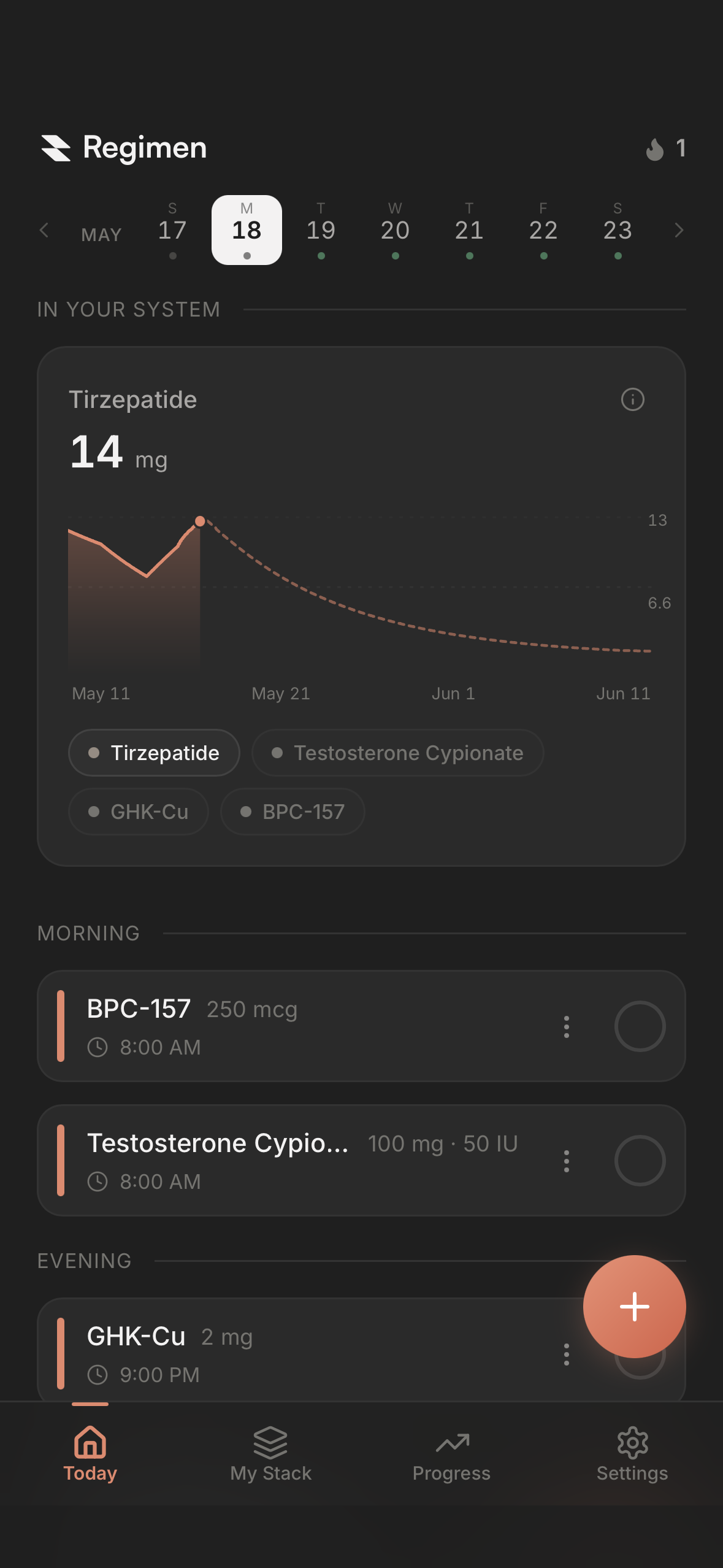
98% of Regimen users on AOD-9604 also track another compound, most often retatrutide, MOTS-c, NAD+ or tesamorelin, so a body fat trend is the clearest way to tell whether AOD-9604 is adding anything. Regimen, an AOD-9604 tracker, puts weight and body fat on the same timeline as your doses.
For more compounds, see the list of peptides. This article is for education and tracking. It is not medical advice.
Sources
- Structure and human trials (safety, IGF-1, doses): Stier et al., Journal of Endocrinology and Metabolism, 2013; 24-week trial registration: ANZCTR ACTRN12605000067673; structure: Drug Testing and Analysis, 2015.
- Animal studies: obese mice, American Journal of Physiology, 2000; obese rats, 2000; rabbit cartilage, Annals of Clinical and Laboratory Science, 2015.
- FDA: bulk drug substances that may present significant safety risks; GRAS notice inventory.
- Tesamorelin: Egrifta WR prescribing information, DailyMed.
- Australia: Poisons Standard, June 2026. Sport: WADA 2026 Prohibited List.
- Regimen app data: the current AOD-9604 protocol of each Regimen user (dose, schedule, vial, water, cycles), other compounds on the same account, and injection sites logged in the 180 days to October 27, 2026.
All sources checked October 27, 2026.
Frequently asked questions
Does AOD-9604 burn belly fat?
There is no human evidence that it does. In obese mice and rats it reduced weight gain and increased fat breakdown, but the human trials never published a weight-loss result.
Is AOD-9604 safe?
In six trials in about 900 adults, side effects were no more common than on placebo, and it didn't change IGF-1 or blood sugar. Those trials were run by its developer. The FDA is more cautious: it has flagged possible immune reactions and serious adverse events it couldn't tie to AOD-9604.
How long should I take AOD-9604?
The longest human trial ran 24 weeks, with daily tablets. Among Regimen users on AOD-9604, 31% run it in cycles, most often 8 or 12 weeks on and 4 weeks off.
Is AOD-9604 FDA approved?
No. It has never been approved by the FDA. A food-safety (GRAS) status often quoted for it was declared by its developer's own expert panel, not by the FDA.
Can you take AOD-9604 and tesamorelin together?
People do: 48% of Regimen users on AOD-9604 also track tesamorelin. No study has tested the two together.
How do you reconstitute AOD-9604 5 mg?
Most Regimen users with a 5 mg vial add 2 or 3 mL of bacteriostatic water. With 2 mL, 300 mcg is 12 units on an insulin syringe; with 3 mL, it is 18 units.