People search for the 5-amino-1MQ peptide, but it isn’t a peptide. It’s a small molecule, and what people want from it is fat loss and better muscle with age.
- What it is: A small molecule, not a peptide
- What it does: Blocks NNMT, an enzyme that uses up a building block of NAD+
- FDA status: Not approved for any use
- Sport: Not named on the 2026 WADA list
- Human studies: None so far: cells and mice only
- What people take: 1-5 mg injected (Regimen users), or 50 mg capsules by mouth
- Common vial: 50 mg
- Half-life: Not measured in people; about 7 hours after an oral dose in rats
What Is 5-Amino-1MQ?
5-amino-1MQ (5-amino-1-methylquinolinium) is a small molecule that blocks an enzyme called NNMT (nicotinamide N-methyltransferase). NNMT uses up two things: nicotinamide, a form of vitamin B3 the body turns into NAD+, and SAM, a molecule cells use in many reactions. Fat cells carry a lot of NNMT.
Blocking it leaves more of both inside the cell. In fat cells grown in the lab, 5-amino-1MQ raised NAD+ and SAM and cut fat production. It is not NAD+ and it does not supply NAD+; it keeps more of the raw material around.
5-Amino-1MQ Dosage: How Much and How Often
There is no human dose. Every study that tested effects used mice, injected under the skin at 5 to 34 mg per kg a day, and mouse doses don’t convert directly to people.
What people take: most Regimen users on 5-amino-1MQ inject it, and 15% take it by mouth. Most who inject take 1 to 5 mg a shot, and 5 mg is the most common dose. Those on capsules most often take 50 mg. 67% take it every day, and many of the rest take it five days a week.
How to Reconstitute 5-Amino-1MQ (Units to Draw)
Most Regimen users on 5-amino-1MQ use a 50 mg vial mixed with 3 mL of bacteriostatic water, and the next most common mix is 2 mL. 5-amino-1MQ dosage chart, in units on a 100-unit (1 mL) insulin syringe:
| Dose | 50 mg + 3 mL | 50 mg + 2 mL |
|---|---|---|
| 1 mg | 6 units | 4 units |
| 2.5 mg | 15 units | 10 units |
| 5 mg | 30 units | 20 units |
With a 10 mg vial mixed with 2 mL, 1 mg is 20 units. More water means more units for the same dose. For any other mix, use the peptide calculator.
5-Amino-1MQ Oral vs Injection
Nobody knows if capsules work: every study that showed fat or muscle effects used injections. How much of an oral dose reaches the blood varies by animal, about 38% in rats and 3.5% in mice.
5-Amino-1MQ Benefits: What the Research Shows
All of it is in mice:
- Fat loss (2018): obese mice injected for 11 days lost about 5% of their body weight while untreated mice gained about 1%. They ate the same amount, and their white fat and cholesterol went down.
- Muscle repair in old age (2019): in 2-year-old mice with a muscle injury, the repaired muscle fibers were about twice as large and the muscle about 70% stronger.
- Strength in old mice (2024): older female mice had about 40% more grip strength, and more with exercise.
- Blood sugar (2024): obese mice gained less weight and fat, handled sugar better and had less fatty liver.
Several of these studies come from researchers linked to a company developing NNMT inhibitors. There are no human trials registered for 5-amino-1MQ.
5-Amino-1MQ Side Effects
There is no human safety data. In the first mouse study, 5-amino-1MQ didn’t change how much the mice ate and caused no visible side effects, and a higher dose was tolerated in two mice. In lab dishes, very high concentrations damaged cells. There are no toxicology, cancer or pregnancy studies.
5-Amino-1MQ vs NAD+ and MOTS-c
- NAD+ supplies the molecule directly. 5-amino-1MQ blocks the enzyme that uses up one of its building blocks. See the NAD+ injection guide.
- MOTS-c is a 16-amino-acid peptide that works through AMPK, the cell’s energy sensor. 5-amino-1MQ is a small molecule that works through NNMT. The MOTS-c guide has its dosing.
Many run them together: among Regimen users on 5-amino-1MQ, 73% also track MOTS-c and 65% NAD+.
How Long to Run 5-Amino-1MQ
Among Regimen users on 5-amino-1MQ, 33% run it in cycles, and the most common is 8 weeks on and 4 weeks off. The rest take it without a set break.
Where to Inject 5-Amino-1MQ
It goes under the skin. Among Regimen users on 5-amino-1MQ, 46% inject in the belly, 18% in the love handles, 17% in the thigh, 11% in the glute and 8% in the upper arm. The peptide injection sites guide shows each spot.
Is 5-Amino-1MQ Legal?
5-amino-1MQ is not approved as a drug anywhere, and it is not on any of the FDA’s compounding lists. The 2026 WADA Prohibited List doesn’t name it, but its S0 section bans any substance with no approval for human use, so a tested athlete should treat it as banned.
Track 5-Amino-1MQ With Regimen
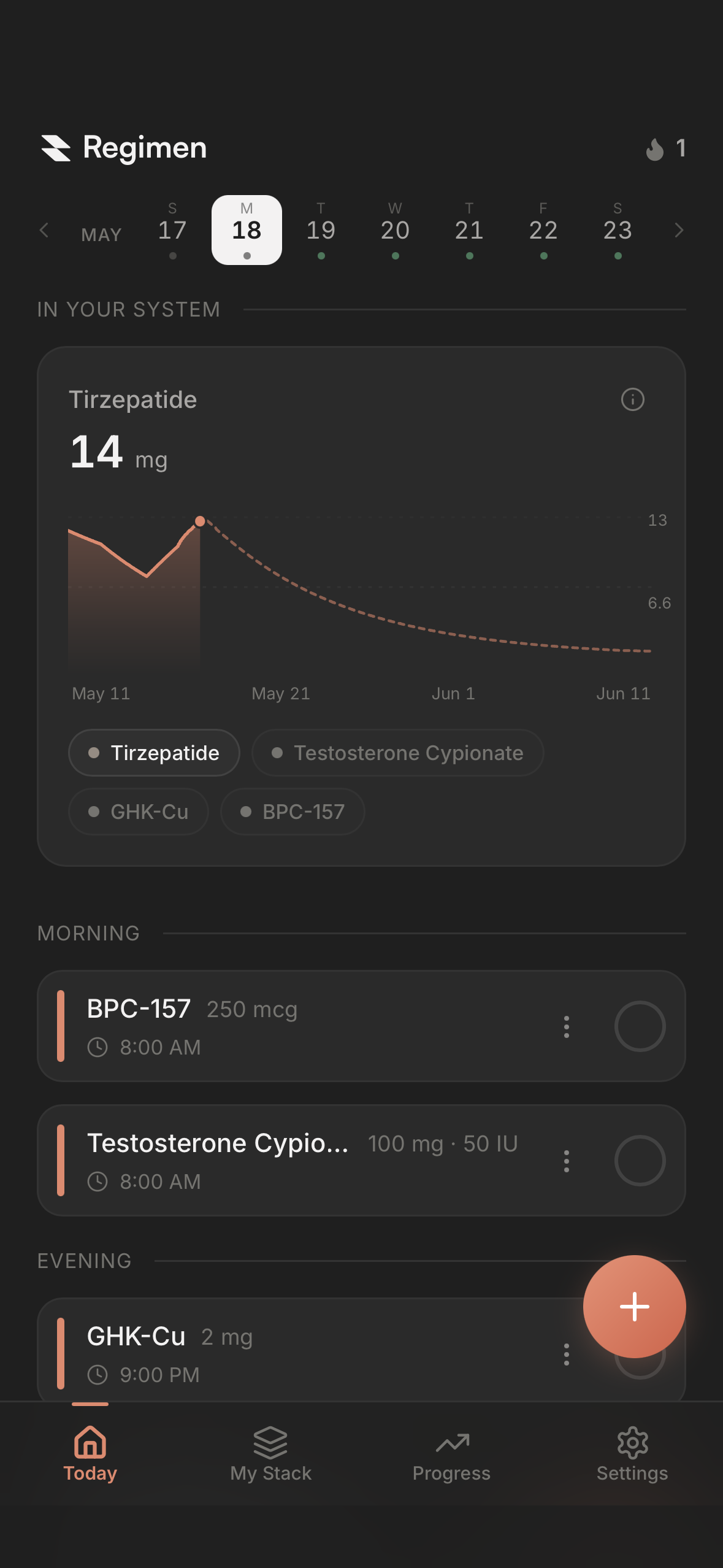
97% of Regimen users on 5-amino-1MQ also track another compound, most often retatrutide (84%), MOTS-c and NAD+. Regimen, a peptide tracker, logs 5-amino-1MQ as a capsule or an injection, with weight and body fat on the same timeline as your doses.
For more compounds, see the list of peptides. This article is for education and tracking. It is not medical advice.
Sources
- Structure: PubChem, 5-amino-1-methylquinolinium.
- NNMT and NAD+: Kraus et al., Nature, 2014.
- Mouse and cell studies: Neelakantan et al., 2018; Neelakantan et al., 2019; Dimet-Wiley et al., 2022; Dimet-Wiley et al., 2024; Babula et al., 2024.
- Rat pharmacokinetics: Awosemo et al., 2021.
- MOTS-c: Lee et al., Cell Metabolism, 2015.
- Compounding lists: FDA, 503A bulk drug substance categories. Sport: WADA 2026 Prohibited List. Human trials: ClinicalTrials.gov.
- Regimen app data: the current 5-amino-1MQ protocol of each Regimen user (dose, form, schedule, vial, water, cycles), other compounds on the same account, and injection sites logged in the 180 days to October 27, 2026.
All sources checked October 27, 2026.
Frequently asked questions
Is 5-amino-1MQ a peptide?
No. It has no amino acids. It is a small molecule, much smaller than any peptide. It is sold and talked about alongside peptides because people use it the same way.
Why do people take 5-amino-1MQ?
Mostly for fat loss and, more recently, for muscle in older age. Both ideas come from mouse studies: obese mice lost weight and fat without eating less, and old mice recovered muscle better after injury. No study has tested it in people.
How long does 5-amino-1MQ take to work?
There is no human answer. In the first mouse study, obese mice lost about 5% of their body weight in 11 days of injections, while untreated mice gained about 1%.
How often should I inject 5-amino-1MQ?
Among Regimen users on 5-amino-1MQ, 67% take it every day, and many of the rest take it five days a week. No schedule has been tested in people.
How do you reconstitute 5-amino-1MQ 10 mg?
Most Regimen users with a 10 mg vial add 2 mL or 1 mL of bacteriostatic water. With 2 mL, each 0.1 mL (10 units) holds 0.5 mg, so 1 mg is 20 units on an insulin syringe.
Is 5-amino-1MQ safe?
Nobody knows yet in people. The mouse studies reported no visible side effects at their doses, but there are no human safety studies, no toxicology studies and no approved product.