KLOW Peptide Calculator
KLOW is a fixed-ratio blend of four peptides, so one dose decision sets all four. Enter your vial and BAC water, pick the compound you are dosing to, and see the units to draw plus exactly how much of each peptide that delivers.
September 2026
Multi-peptide vial dosing
Doses for blended vials where peptides share one fixed ratio.
Blends have a locked ratio
When peptides are combined in one vial, you cannot dose them independently. Setting your target dose for one peptide automatically determines how much of every other peptide you get per injection.
Not all peptides can be safely blended
Combining peptides in a single vial can affect stability, potency, and safety. Some compounds degrade or interact when mixed. Only use blends from reputable sources with verified compatibility, and consult your healthcare provider before using any blended protocol. This calculator does not validate whether a given combination is safe.
This calculator is for informational purposes only, so always double-check your result with a healthcare provider. It does the dosing maths; it does not assess whether a blend is safe or stable. KLOW components are not approved for human use. We assume no liability for dosing errors.
How to use it
How to use this calculator
- 01
Check your vial matches
The preset is loaded with the common KLOW ratio, GHK-Cu 50 mg, BPC-157 10 mg, TB-500 10 mg, KPV 10 mg. If your vial differs, edit the amounts.
- 02
Enter your BAC water
1 to 3 mL is typical. It sets the concentration of every peptide at once.
- 03
Pick one peptide and set its dose
You can only choose for one. The ratio fixes the rest, and the calculator shows what they land on.
- 04
Read the per-injection breakdown
Units to draw, volume, and exactly how many mcg of each compound that delivers.
Why a blend needs different maths
A single-peptide vial has one question: how many units for my dose. A blend has a harder one, because you cannot choose independently.
KLOW arrives as GHK-Cu 50 mg, BPC-157 10 mg, TB-500 10 mg, KPV 10 mg, 80 mg of powder in one vial. Add water and every peptide dissolves into the same solution at the same time. From then on, every draw contains all of them in that fixed proportion. Set your target at 300 mcg of BPC-157 and you have simultaneously decided your GHK-Cu dose, whether you meant to or not.
That is what the calculator above makes visible. Pick one compound, and it shows what the others land on.
The ratio on the vial is a vendor decision
Worth being blunt about: 80 mg split GHK-Cu 50 mg, BPC-157 10 mg, TB-500 10 mg, KPV 10 mg is a formulation someone chose to sell. It is not a dose anyone established in a trial, and it varies between suppliers.
So two things follow. Check what is actually printed on your vial rather than assuming the common ratio, and treat any "KLOW dosing chart" you find, including the numbers this page returns, as arithmetic applied to your inputs rather than a recommendation.
What a KLOW draw actually delivers
At the common 80 mg ratio in 2 mL of BAC water, the solution is 40 mg/mL overall. GHK-Cu is 50 of the 80 mg, so it dominates: roughly five times whatever you get of BPC-157, TB-500 or KPV individually.
Because KLOW totals 80 mg against GLOW's 70 mg, the same water volume gives a different concentration and the same units deliver different amounts. The two are not interchangeable, which is why they have separate pages.
Dose to the small component, not the big one
Here is something the ratio does to you that is worth knowing before you draw.
Because GHK-Cu is 50 of the 80 mg, it is by far the most concentrated thing in the vial. At 2 mL that is 25,000 mcg/mL. So if you set your target as a modest 250 mcg of GHK-Cu, the calculator correctly returns 1 unit — a draw so small you cannot measure it reliably on any insulin syringe.
Dose to one of the 10 mg components instead and the numbers become usable. Targeting 250 mcg of BPC-157 needs 5 units, and delivers 1,250 mcg of GHK-Cu alongside it. Same vial, same ratio, a draw you can actually see.
This is not a quirk of the tool, it is the ratio. Run your own vial above and check that the units you get are large enough to measure before you commit to a target.
What the evidence actually supports
The components are not equally studied, and none of them is approved.
- BPC-157. Animal-heavy. A 2025 review screened 544 papers and found a single human clinical study. No completed human efficacy trial.
- TB-500. The injected fragment has no human efficacy trial. The human data people cite is for full-length recombinant thymosin beta-4, which is a different molecule.
- GHK-Cu. Real human data exists for topical use as a cosmetic ingredient. Injectable GHK-Cu does not have it.
- KPV. Preclinical only. No human efficacy trial for the injected peptide. \n
The FDA removed these from its Category 2 bulk-substances list in April 2026. That is frequently reported as a green light. It was not: the nominations were withdrawn, there was no safety finding, and every component remains an unapproved new drug.
If you are drug-tested, treat the vial as disqualifying. WADA prohibits BPC-157 at all times and TB-500 since 2011, and the S0 catch-all covers substances without human therapeutic approval regardless of what a blend is called.
Mixing and storage
Aim the water at the glass wall rather than straight onto the powder, and let it run down the side. Swirl gently until clear. Do not shake, which foams the solution and can damage the peptides.
Store reconstituted in the fridge at 2 to 8 degrees C, upright, out of the light, never frozen. Discard if it goes cloudy or discoloured.
Tracking a blend properly
The awkward thing about a blend is that your log says "KLOW" while your body received four different compounds. If you later want to know which one was doing something, an undifferentiated entry cannot tell you.
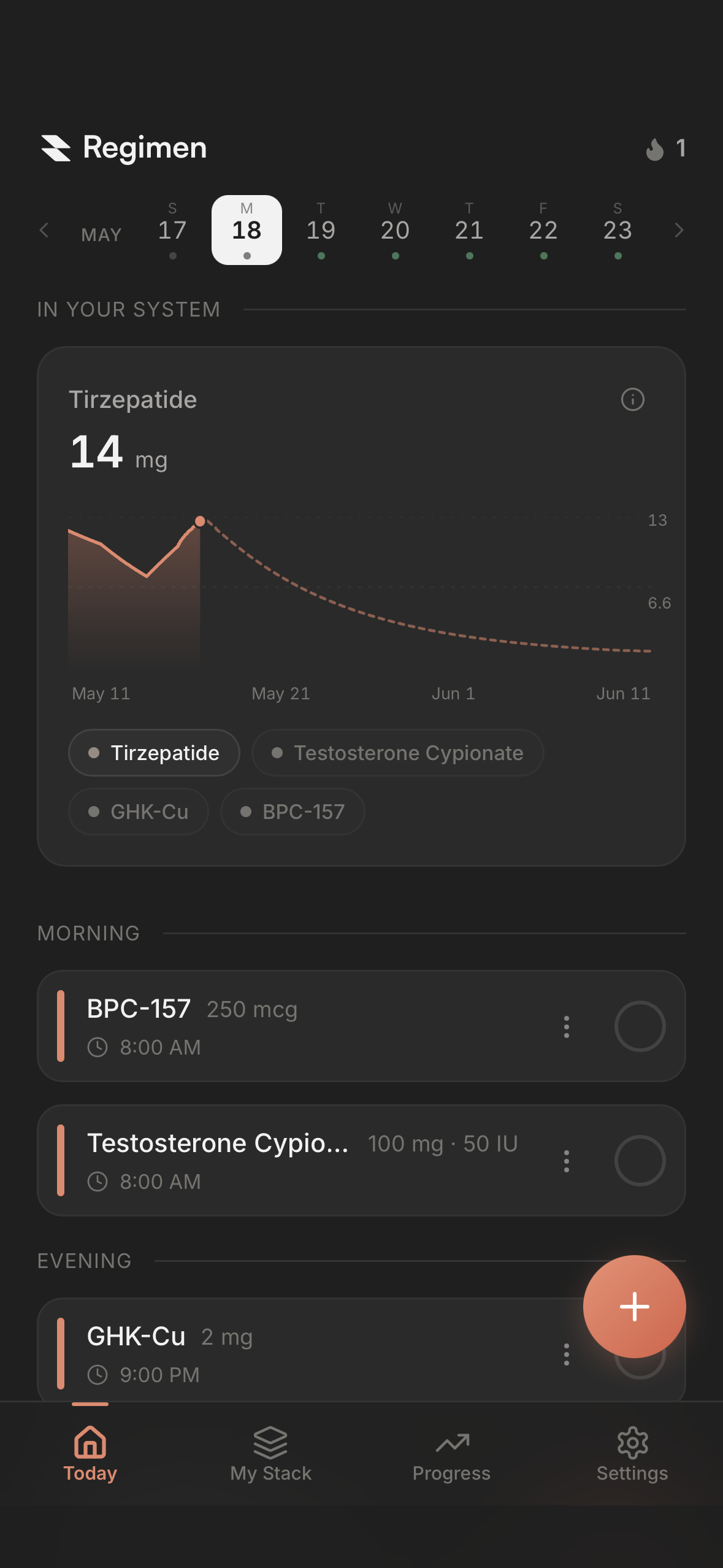
Regimen records a blend as its components, so all four show up individually against your skin, recovery and bloodwork instead of as one anonymous shot.
Track your blend freeGet the app
A blend is several compounds at once. Track it that way.
Regimen logs a blend as its component compounds, so your KLOW injections show up against your skin, recovery and bloodwork rather than as one anonymous shot. Free for one compound.


Free to download. Free for your first compound.
Questions