SS-31 is the mitochondria peptide. Most peptides people talk about mimic a hormone. SS-31 goes to the inner membrane of your mitochondria, the part of the cell that makes energy, and helps it hold its shape. It is also one of the few popular peptides that is an FDA-approved drug, though only for one rare disease.
- What it is: A peptide of 4 amino acids, also called elamipretide
- FDA status: Approved 2025 as Forzinity, for Barth syndrome only
- Sport: Not named on the 2026 WADA list
- Label dose: 40 mg under the skin once a day (Barth syndrome)
- What people take: 1-5 mg a shot (Regimen users), 2 mg most common
- Common vial: 10 mg or 50 mg
- Half-life: About 3 hours after a 40 mg shot (healthy adults)
What Is SS-31?
SS-31 is a lab-made peptide of four amino acids. The “SS” stands for Szeto-Schiller, the scientists who developed the family. Its drug name is elamipretide (earlier code names MTP-131 and Bendavia), and its brand name is Forzinity.
It binds cardiolipin, a fat found in the inner membrane of mitochondria. Cardiolipin holds that membrane in the folded shape the cell needs to make energy, and the label says SS-31 improves how mitochondria look and work.
SS-31 Dosage: How Much and How Often
The approved dose is 40 mg under the skin once a day, for people with Barth syndrome who weigh at least 30 kg. People with severe kidney disease (eGFR under 30, not on dialysis) get 20 mg. The trials in other mitochondrial diseases used 40 to 60 mg a day.
What people take on their own is much lower. Most Regimen users on SS-31 take 1 to 5 mg a shot, and 2 mg is the most common dose. People with a 50 mg vial take more, most often 5 mg. 67% take it every day, and most of the rest take it on set days, often five a week.
No study has tested these lower doses, so there is no evidence for one amount over another.
How to Reconstitute SS-31 (Units to Draw)
About half of Regimen users on SS-31 use a 10 mg vial mixed with 1 or 2 mL of bacteriostatic water. Most of the rest use a 50 mg vial with 2 or 3 mL.
SS-31 dosage chart, in units on a 100-unit (1 mL) insulin syringe:
| Dose | 10 mg + 2 mL | 50 mg + 3 mL |
|---|---|---|
| 1 mg | 20 units | 6 units |
| 2 mg | 40 units | 12 units |
| 5 mg | 100 units | 30 units |
With 1 mL in a 10 mg vial, halve the 2 mL numbers: 2 mg is 20 units. More water means more units for the same dose. 100 units fills a 1 mL syringe, so a 5 mg dose from a 10 mg vial mixed with 2 mL is a full syringe. For any other mix, use the peptide calculator.
Forzinity itself needs no mixing: it comes as a ready-made 80 mg/mL solution, so the 40 mg dose is 0.5 mL.
SS-31 Side Effects
The best data comes from the Forzinity label, at 40 mg a day. Injection-site reactions were the most common side effect:
- Redness: 100% of patients on SS-31 (25% on placebo)
- Pain: 75% (42% on placebo)
- Hardening and itching: 67% each (17% on placebo)
- Bruising and hives: 25% each (none on placebo)
The label also warns about serious allergic reactions, which can start minutes to months after the first dose, and a rise in eosinophils (a type of white blood cell) that peaked around 90 days in. No study has measured side effects at the lower doses people take on their own.
SS-31 Peptide Benefits: What the Research Shows
SS-31 has real human trials, mostly in rare mitochondrial diseases, and the results are mixed:
- Barth syndrome (TAZPOWER, 2021): in 12 patients, SS-31 did no better than placebo at first. Once everyone took it, walking distance rose about 96 m by 36 weeks and held at 168 weeks.
- The approval: the FDA approved it early, based on knee-strength gains from that second part, and wants a follow-up trial finished by 2029.
- Mitochondrial muscle disease (MMPOWER-3, 2023): in 218 adults, 24 weeks of 40 mg a day did not improve walking distance or fatigue compared with placebo.
- Heart failure: a single infusion was safe in a small 2017 study.
No trial has tested SS-31 for energy, longevity, fat loss or recovery in healthy people. Those uses come from the community, not from trial results.
How Long to Run SS-31
Among Regimen users on SS-31, 37% run it in cycles. The most common are 8 weeks on and 4 off, or 12 weeks on and 4 off, and some do 4-week blocks. The rest take it without a set break. In Barth syndrome, people have taken it daily for over three years.
Where to Inject SS-31
The label says to inject it under the skin of the belly (at least 2 inches from the navel) or the outer thigh, and to rotate sites every day. Among Regimen users on SS-31, 40% inject in the belly, 22% in the love handles, 17% in the thigh, 12% in the glute and 8% in the upper arm, almost all subQ. The peptide injection sites guide shows each spot.
SS-31 vs MOTS-c
Both are “mitochondria peptides”, and many people take both. They are different molecules:
- SS-31 is lab-made, 4 amino acids, and binds the inner mitochondrial membrane.
- MOTS-c is 16 amino acids, made from your own mitochondrial DNA, and switches on AMPK, the cell’s energy sensor. The MOTS-c guide has its dosing.
Is SS-31 Legal?
Forzinity is an FDA-approved prescription drug for Barth syndrome. SS-31 sold online as a research peptide is a different product: it is not Forzinity, and it is not approved for any use. Elamipretide is not on the FDA’s list of compounding substances with safety concerns. It is not named on the 2026 WADA Prohibited List.
Track SS-31 With Regimen
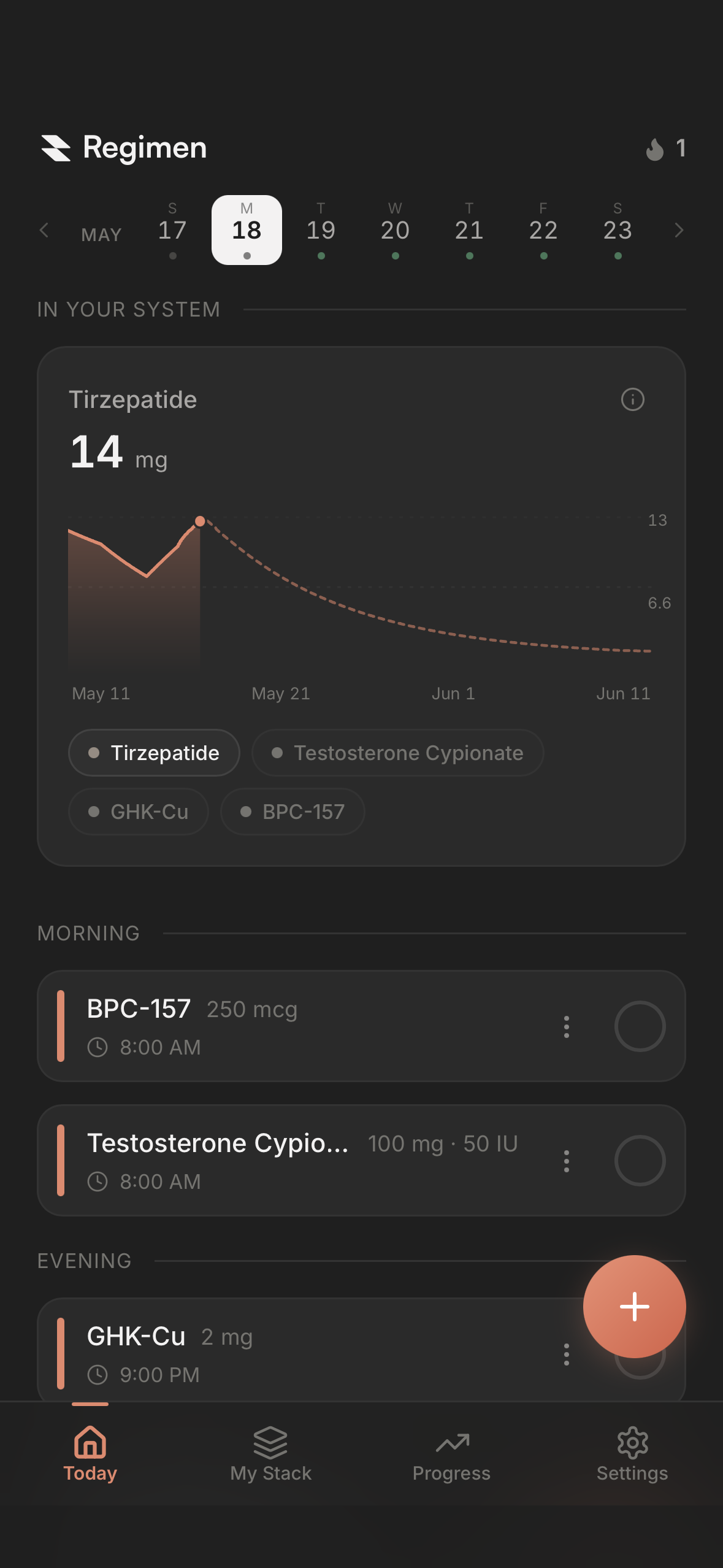
96% of Regimen users on SS-31 also track another compound, most often retatrutide (80%), MOTS-c (73%) and NAD+ (57%). Regimen, a peptide tracker, keeps each one on its own schedule with reminders, and puts energy, sleep and side effects on the same timeline.
For more compounds, see the list of peptides. This article is for education and tracking. It is not medical advice.
Sources
- Forzinity (elamipretide) prescribing information: dose, side effects, warnings, storage, injection sites: DailyMed.
- Approval: FDA approval letter, NDA 215244, September 19, 2025 and FDA press release.
- Half-life: FDA integrated review, NDA 215244.
- Trials: TAZPOWER, Genetics in Medicine, 2021; TAZPOWER extension, 2024; MMPOWER-3, Neurology, 2023; heart failure infusion, 2017.
- Szeto-Schiller peptides: Journal of Biological Chemistry, 2020. MOTS-c: Lee et al., Cell Metabolism, 2015.
- Compounding: FDA, bulk drug substances that may present significant safety risks. Sport: WADA 2026 Prohibited List.
- Regimen app data: the current SS-31 protocol of each Regimen user (dose, schedule, vial, water, cycles), other compounds on the same account, and injection sites logged in the 180 days to October 27, 2026.
All sources checked October 27, 2026.
Frequently asked questions
How much SS-31 should I inject?
The only approved dose is 40 mg under the skin once a day, for Barth syndrome. Outside that, there is no tested dose. Most Regimen users on SS-31 take 1 to 5 mg a shot, and 2 mg is the most common.
Is SS-31 FDA approved?
Yes, for one use. The FDA gave it accelerated approval on September 19, 2025, as Forzinity, to improve muscle strength in people with Barth syndrome who weigh at least 30 kg. SS-31 sold online as a research peptide is not Forzinity and is not approved for anything.
What are the side effects of SS-31?
The Forzinity label lists injection-site reactions: redness in every treated patient, pain in 75%, hardening and itching in 67%, bruising and hives in 25%. The label also warns about serious allergic reactions and a rise in eosinophils, a type of white blood cell.
Who should not take SS-31?
The label rules it out for anyone with a serious allergy to elamipretide or its ingredients, and it is not approved for newborns because it contains benzyl alcohol. People with severe kidney disease get a lower dose on the label.
What peptide is similar to SS-31?
MOTS-c is the one it is most often compared with, since both are about mitochondria. They work differently: SS-31 is a lab-made 4-amino-acid peptide that binds the mitochondrial membrane, while MOTS-c is a 16-amino-acid peptide your mitochondria make that switches on AMPK, the cell's energy sensor.
How long can you stay on SS-31?
The Barth syndrome extension study followed people on daily SS-31 for up to 168 weeks. Among Regimen users, 37% run it in cycles, most often 8 or 12 weeks on and 4 weeks off; the rest take it without a set break.
Does SS-31 need to be refrigerated?
Forzinity's label says to store vials in the fridge at 2 to 8°C (36 to 46°F) and not to freeze them. Once opened, a vial can stay in the fridge or at room temperature, and it is thrown away 8 days after first opening.