There are four ways to get a GLP-1 in the US: insurance, the makers’ own self-pay pharmacies (LillyDirect and NovoCare), Medicare’s new GLP-1 Bridge, or a compounded version. Each starts with a prescription, and the monthly cost runs from $25 to $699.
Quick answer
Most people in the US get a GLP-1 like this:
- Get a prescription from your doctor or a licensed telehealth prescriber.
- Ask your insurer if it covers the drug, and have your prescriber file the prior authorization.
- If it’s covered, add the manufacturer’s savings card. If it isn’t, buy it self-pay from LillyDirect or NovoCare Pharmacy.
- On Medicare, ask your prescriber about the Medicare GLP-1 Bridge.
- Keep a record of each dose, any side effects and your weight.
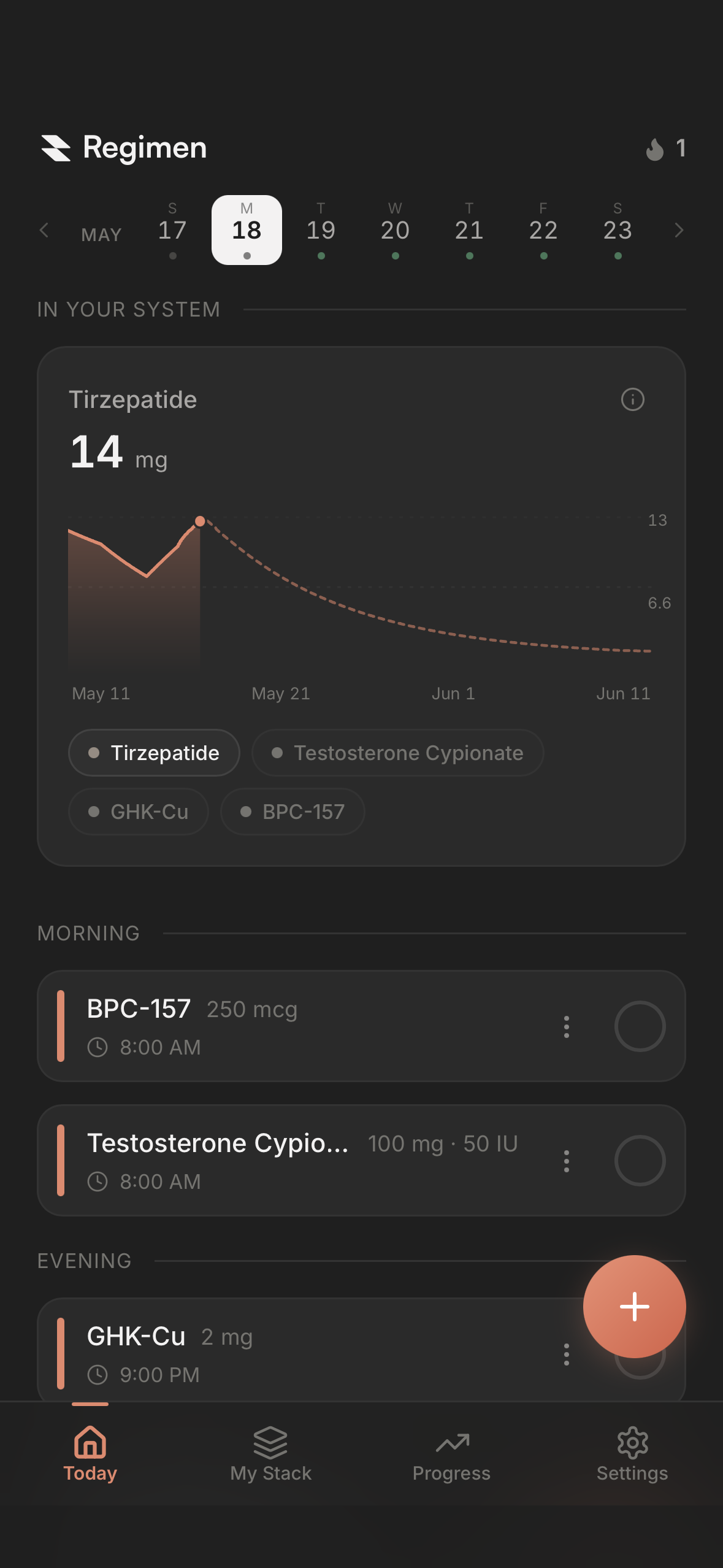
Step 5 is where Regimen comes in: a free GLP-1 tracker app for your dose schedule, side effects and weight.
What Each Route Costs in 2026
| Route | Who it’s for | What you pay a month |
|---|---|---|
| Insurance + savings card | Commercial insurance that covers the drug | As little as $25 |
| Manufacturer self-pay | No insurance, or a plan that won’t cover it | $149 to $699, by drug and dose |
| Medicare GLP-1 Bridge | Medicare Part D, for weight management | $50 |
| Compounded | Only when an approved drug can’t meet your medical need | Not FDA approved, no official price |
With a savings card or a self-pay program, you pay far less than the full list price.
Step 1: Get a GLP-1 Prescription
Every route starts with a prescription from a doctor or other licensed prescriber. Here is who each drug is approved for, from its FDA prescribing information:
- Wegovy (semaglutide, weekly pen or daily pill), Zepbound (tirzepatide) and Foundayo (orforglipron, daily pill): adults with obesity, or adults with overweight plus at least one weight-related condition.
- Wegovy (pen and pill) is also approved to lower the risk of heart attack and stroke in adults with heart disease and obesity or overweight. The pen is also approved for teens 12 and up with obesity, and for a liver disease called MASH with moderate to advanced scarring.
- Zepbound also treats moderate to severe obstructive sleep apnea in adults with obesity.
- Ozempic and Mounjaro: type 2 diabetes. Neither is approved for weight loss.
What do “obesity” and “overweight” mean in practice? In the trials behind the Wegovy and Zepbound labels, obesity was a BMI of 30 or higher, and overweight was a BMI of 27 to under 30 with a condition like high blood pressure or high cholesterol.
To get Wegovy or Zepbound prescribed, bring your weight history, your BMI, any weight-related conditions (blood pressure, cholesterol, sleep apnea, prediabetes) and your medication list. A prior authorization asks for the same things.
How to Get GLP-1 Online
Online, it works the same way over a video visit. A licensed telehealth prescriber screens you and, if a GLP-1 fits, sends the prescription to a pharmacy. If you don’t have a prescriber, LillyDirect and NovoCare both link to telehealth prescribers on their own sites.
What you can’t do is get a GLP-1 without a doctor or other licensed prescriber. The FDA lists these red flags in a seller:
- It doesn’t require a screening and a prescription by a licensed doctor.
- It claims a compounded drug is the same as an FDA-approved one.
- Its prices seem too good to be true.
- There’s no licensed doctor to answer questions after the medicine arrives.
Step 2: How to Get GLP-1 Covered by Insurance
Coverage depends on your plan and on the diagnosis. Ozempic and Mounjaro are approved for type 2 diabetes, which is the clearest case for coverage if you have it. Wegovy, Zepbound and Foundayo coverage for weight loss varies plan by plan.
Before your prescriber files anything, ask your insurer four things:
- Is the drug on your formulary?
- Which form is covered: pen, KwikPen, vial or pill?
- Does it need a prior authorization?
- What will you pay each month once it’s approved?
Prior authorization is the insurer’s sign-off. Lilly describes the steps the same way for Zepbound: your prescriber submits it, sometimes with a letter of medical necessity, and you wait for the insurer’s answer. If it’s denied, you or your prescriber can appeal with more supporting detail, and it can take more than one submission.
The $25 Savings Cards
Once your plan covers the drug, the manufacturer’s savings card lowers the copay. These are for commercial insurance only. People on Medicare, Medicaid, VA, TRICARE or another government plan are excluded.
- Zepbound single-dose pen: as little as $25 for a 1, 2 or 3-month fill, with savings up to $100 per month of supply and $1,300 a year. If your commercial plan doesn’t cover the pen, the card brings it to as low as $499 a month.
- Mounjaro: as little as $25 for up to a 3-month fill, with savings up to $150 per month of supply.
- Wegovy and Ozempic: as little as $25 a month, with savings up to $100 a month.
- Foundayo: as little as $25 a month.
The cap matters. On a $100 monthly cap, you pay $25 only if your copay is $125 or less. Above that, you pay your copay minus $100. Lilly’s Zepbound card expires on December 31, 2026.
Step 3: How to Get GLP-1 Without Insurance
Without insurance, in 2026, that mostly means the manufacturers’ self-pay programs. Your prescriber sends the prescription to the manufacturer’s pharmacy, you pay a fixed monthly price, and it ships to you.
How to Get Zepbound Without Insurance
Lilly sells Zepbound self-pay through LillyDirect as the KwikPen (four doses per pen) or as single-dose vials. A month is one KwikPen or four vials, priced by strength:
| Zepbound strength | Self-pay price a month |
|---|---|
| 2.5 mg | $299 |
| 5 mg | $399 |
| 7.5 mg | $449 if you refill within 45 days, otherwise $499 |
| 10, 12.5 or 15 mg | $449 if you refill within 45 days, otherwise $699 |
Three details from Lilly’s terms that catch people out. The $449 price at 7.5 mg and up is the Zepbound Journey Program, and it only holds if each refill is completed within 45 days of the last delivery. Pen needles (KwikPen) or needles and syringes (vials) are bought separately. And the single-dose pen isn’t part of the $299 self-pay price.
How to Get Ozempic or Wegovy Without Insurance
Novo Nordisk sells both pens self-pay through NovoCare Pharmacy:
- Wegovy pen: $199 a month for 0.25 mg and 0.5 mg for your first two fills if you’re new, then $349 a month for any dose from 0.25 to 2.4 mg, and $399 for Wegovy HD 7.2 mg. A month is one box of four pens.
- Ozempic pen: the same $199 offer for new patients’ first two fills, then $349 a month for 0.25, 0.5 or 1 mg and $499 for 2 mg. A month is one pen.
The $199 offer runs through December 31, 2026.
How Much Does Tirzepatide Cost?
The tirzepatide price in the US depends on the brand, the dose and how you pay. Lilly sells it as Zepbound for weight loss and as Mounjaro for type 2 diabetes.
- Zepbound self-pay (LillyDirect): $299 a month at 2.5 mg, $399 at 5 mg, $449 at 7.5 to 15 mg with on-time refills (within 45 days). Refill late and it is $499 at 7.5 mg and $699 at 10 to 15 mg. Every strength is in the price table above.
- Zepbound with commercial coverage: as little as $25 for up to a 3-month fill of the single-dose pen with Lilly’s savings card.
- Zepbound list price: $1,087 a month before any savings.
- Mounjaro with commercial coverage: as little as $25 for up to a 3-month fill with Lilly’s savings card.
- Medicare: $50 a month for the Zepbound KwikPen through the Medicare GLP-1 Bridge.
How to Get GLP-1 Pills: The Wegovy Pill and Foundayo
There are two daily GLP-1 pills for weight loss in the US: the Wegovy pill (oral semaglutide) and Foundayo (orforglipron, from Lilly). The Ozempic pill is the type 2 diabetes version. Wegovy pill and Foundayo carry the same approval as the weight-loss injections: adults with obesity, or with overweight plus a weight-related condition.
The pills work the same way as the pens: a prescription, then insurance or self-pay.
- Wegovy pill (NovoCare Pharmacy): $149 a month for 1.5 mg, $199 for 4 mg, $299 for 9 mg or 25 mg. A month is one bottle of 30 tablets.
- Foundayo (LillyDirect): $149 a month for 0.8 mg and 2.5 mg, $199 for 5.5 mg, $299 for 9 mg, and $299 for 14.5 mg or 17.2 mg if you refill within 45 days. The 2.5 and 5.5 mg prices are temporarily reduced through December 31, 2026.
- Ozempic pill (NovoCare Pharmacy): from $149 a month, by dose.
For how the pills compare with the shots, see the Wegovy pill and oral Ozempic guide and the Foundayo guide.
On Medicare? The Medicare GLP-1 Bridge
Until July 2026, Medicare drug plans didn’t cover GLP-1s prescribed for weight loss alone. From July 1, 2026 to December 31, 2027, the Medicare GLP-1 Bridge does, for a $50 monthly copay. It covers Foundayo, Wegovy (injection or pill) and the Zepbound KwikPen, but not Zepbound single-dose pens or vials.
You qualify if you have Medicare drug coverage (Part D), you’re 18 or older, and one of these is true when you start:
- Your BMI is 35 or higher.
- Your BMI is 30 or higher and you have heart failure with preserved ejection fraction, uncontrolled high blood pressure, or chronic kidney disease at stage 3a or higher.
- Your BMI is 27 or higher and you have prediabetes, a previous heart attack or stroke, or blocked arteries in your legs or arms with symptoms.
The Bridge isn’t for you if your Part D plan already covers your GLP-1, or if you have type 2 diabetes, moderate to severe sleep apnea or fatty liver disease. In those cases your own Part D plan might cover it instead.
Your prescriber sends the prescription and completes a prior authorization, and certifies you’re on a diet and exercise program. Once approved, it holds for refills and dose changes through December 31, 2027 unless you switch GLP-1s. Your Part D deductible doesn’t apply, and the $50 doesn’t count toward your yearly out-of-pocket cap. You can check eligibility at Medicare.gov or call 1-800-MEDICARE.
Medicaid coverage of GLP-1s for weight loss is decided state by state, so ask your state’s Medicaid plan.
Whichever route you take, your prescriber sets the plan: a starting dose, then a step up every four weeks.
Keep That Plan in Regimen
- A reminder on each dose day that says how much to take, including after each step up
- Side effects logged against the dose you were on
- Your weight, and how many doses are left in your pen
What About Compounded Semaglutide and Tirzepatide?
Compounded semaglutide and tirzepatide are not FDA approved, which means the FDA doesn’t review them for safety, effectiveness or quality before they’re sold. The FDA’s position, updated October 1, 2026, is that a compounded drug should only be used when a patient’s medical need can’t be met by an FDA-approved drug.
Neither semaglutide nor tirzepatide injection is on the FDA’s drug shortage list (checked October 19, 2026). The shortage was what let pharmacies make copies in 2023 and 2024, and the compounded GLP-1 guide covers what changed.
If you are on a compounded GLP-1, the FDA’s own warnings are the useful part:
- Dosing errors have led to adverse events, some needing hospital care, from measuring the wrong amount or taking doses beyond the approved label.
- Throw out a multi-dose vial 28 days after first use, even if the compounder’s instructions say longer.
- Don’t use an injectable that arrives warm.
- Fraudulent products exist, some labelled with pharmacies that don’t exist.
Retatrutide is a different case. The FDA says it cannot be used in compounding under federal law, and it isn’t approved anywhere. The legal routes today are a clinical trial or Lilly’s expanded access program: see how to get retatrutide.
Tracking Your Doses, Side Effects and Weight
Once the prescription is filled, the first months bring a step-up every few weeks, the side effects that come with each step, and refill dates. A record of all three is what makes your next appointment useful.
Regimen is a free GLP-1 tracker app that covers it:
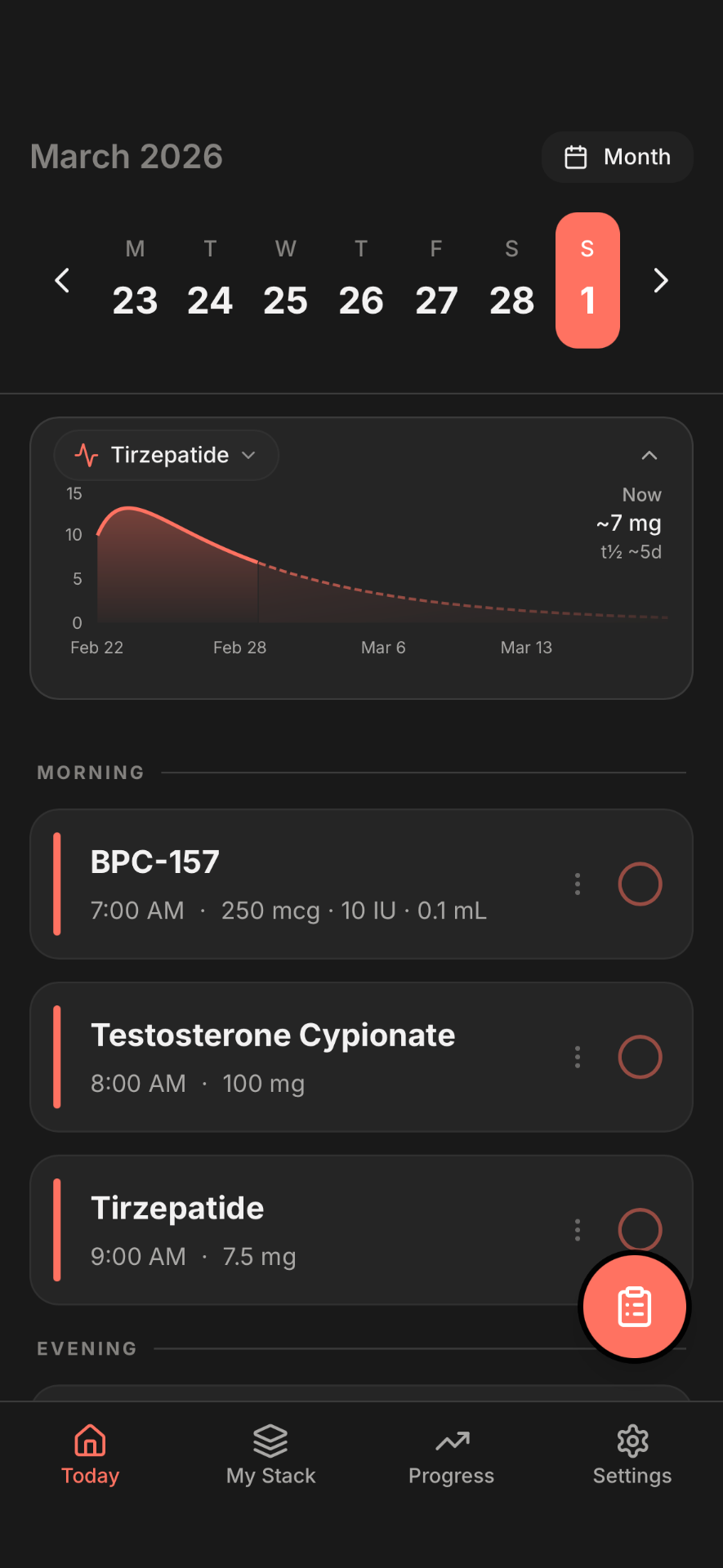
- Dose schedule: custom scheduling with dose titration. Enter the plan your prescriber set (2.5 mg for four weeks, then 5 mg, then 7.5 mg) and every dose lands on the right day with a reminder that says how much to take.
- Side effects and 50+ daily markers: nausea, constipation, food noise, appetite, energy and sleep, each logged against the dose you were on.
- Weight and health metrics: weight, body fat, resting heart rate, blood pressure and sleep, with a free medication-level chart showing where your level sits between shots.
- Supply tracking: pens and vials, doses left and beyond-use dates, so you know when to reorder.
- Share-with-provider report: a PDF of your doses, side effects and weight for your next appointment.
Free for one compound, no time limit; Premium if you track more than one. It’s on iPhone and Android: App Store and Google Play. If you want to compare first, here are the best GLP-1 tracker apps.
Before You Start
Prices and offers change, and several end on December 31, 2026. Every price here comes from the maker’s own page or Medicare, so check that page before you pay. Nothing on this page recommends a drug, a dose or a place to buy it: which drug and which dose is your prescriber’s call.
Wegovy, Ozempic, Mounjaro, Zepbound and Foundayo, pens and pills alike, carry a boxed warning about thyroid C-cell tumors and aren’t for people with a personal or family history of medullary thyroid cancer or MEN 2. Your prescriber will ask.
Sources
- Prices and savings terms: Zepbound savings and coverage (zepbound.lilly.com), LillyDirect Zepbound, LillyDirect Foundayo, Mounjaro savings (mounjaro.lilly.com), NovoCare Pharmacy pricing, and the manufacturers’ published list prices (Ozempic $1,028, Zepbound $1,087, Wegovy $1,349). All prices in US dollars.
- Medicare: CMS Medicare GLP-1 Bridge and Medicare.gov, Weight loss drugs.
- Who each drug is approved for: the FDA prescribing information for Wegovy (June 2026), Zepbound (September 2026) and Foundayo (August 2026) on DailyMed, plus the Ozempic and Mounjaro prescribing information.
- Compounding: FDA, Concerns with Unapproved GLP-1 Drugs Used for Weight Loss (content current as of October 1, 2026) and the FDA drug shortage database.
All sources checked October 19, 2026. This article is for education and tracking. It is not medical advice.
Frequently asked questions
How do I get on Ozempic?
With a prescription. Ozempic is approved for adults with type 2 diabetes. If you're commercially insured and your plan covers it, Novo Nordisk's savings card can bring it down to as little as $25 a month. Without insurance, NovoCare Pharmacy sells the Ozempic pen self-pay for $199 a month for the 0.25 and 0.5 mg doses for your first two fills if you're new, then $349 a month for 0.25, 0.5 or 1 mg and $499 for 2 mg (checked October 19, 2026).
How do I get Ozempic for weight loss?
Ozempic itself is approved for type 2 diabetes, not weight loss. The same molecule, semaglutide, is sold for weight loss as Wegovy, as a weekly pen or a daily pill, for adults with obesity or with overweight plus at least one weight-related condition. Using Ozempic for weight loss is off-label, and a plan that covers it for diabetes may not cover it for that.
Can you get a GLP-1 without a doctor's prescription?
No. Ozempic, Wegovy, Mounjaro, Zepbound, Foundayo and the Wegovy pill are all prescription-only in the US. A licensed telehealth prescriber counts, and both LillyDirect and NovoCare link to telehealth prescribers, but someone has to screen you and write the prescription. The FDA lists a company that skips the screening and prescription as a red flag.
How do I get a GLP-1 prescription online?
Through a licensed telehealth prescriber. They screen you (weight, BMI, conditions, medications), and if a GLP-1 fits, they send the prescription to a pharmacy, including the manufacturers' own: LillyDirect for Zepbound and Foundayo, NovoCare Pharmacy for Wegovy and Ozempic. The price you pay depends on where the prescription is filled and whether insurance pays, not on whether the visit was online.
How to get Zepbound from Lilly Direct?
Ask your prescriber to send the prescription to LillyDirect Pharmacy (Lilly lists its pharmacy details on the LillyDirect Zepbound page), then choose self-pay or insurance. Self-pay covers the KwikPen or vials: $299 a month for 2.5 mg, $399 for 5 mg, and $449 for 7.5 to 15 mg if you refill within 45 days ($499 for 7.5 mg and $699 for 10 to 15 mg otherwise). Checked October 19, 2026.
How much is Zepbound without insurance?
Through Lilly's self-pay program it's $299 a month for 2.5 mg, $399 for 5 mg and $449 for 7.5, 10, 12.5 or 15 mg when you refill within 45 days, for one KwikPen or four vials. Miss the 45-day window and the higher doses go back to $499 (7.5 mg) or $699 (10 to 15 mg). Checked October 19, 2026.
How do you get Wegovy for $25?
You need commercial insurance that covers Wegovy, and Novo Nordisk's Wegovy savings offer. It takes up to $100 a month off your copay, so you pay $25 if your copay is $125 or less, and more if it's higher. People on Medicare, Medicaid or other government plans can't use it. Checked October 19, 2026 on NovoCare.
How do I get a GLP-1 covered by insurance?
Find out whether your plan covers the specific drug and form (pen, KwikPen, vial or pill), then have your prescriber file the prior authorization with your BMI and weight-related conditions. If it's denied, your prescriber can appeal with more supporting detail, and Lilly notes it can take more than one submission. Once it's approved, the manufacturer's savings card can lower your copay.
Does Medicare cover Wegovy or Zepbound for weight loss?
Yes, through the Medicare GLP-1 Bridge, from July 1, 2026 to December 31, 2027, for a $50 monthly copay. It covers Wegovy (injection or pill), Foundayo and the Zepbound KwikPen, not Zepbound single-dose pens or vials. You need Medicare Part D, to be 18 or older, and a BMI of 35 or higher, or 30 or higher or 27 or higher with specific conditions. Your prescriber files a prior authorization. Details are on Medicare.gov.
How overweight do you have to be to get a GLP-1?
The weight-loss labels (Wegovy, Zepbound, Foundayo) cover adults with obesity, or with overweight plus at least one weight-related condition. In the trials behind them that meant a BMI of 30 or higher, or a BMI of 27 to under 30 with a condition like high blood pressure or high cholesterol. Insurers and Medicare set their own bar on top of that, and Medicare's starts at a BMI of 35 on its own.
Can I get retatrutide in the US?
Not legally as a medicine. Retatrutide is not approved anywhere: no list price, no insurance, no regulated supply. The FDA says retatrutide cannot be used in compounding under federal law, and it has sent warning letters to companies selling it.