This is a dose reference, not medical advice. Follow your prescription and the instructions on your pen or vial.
Quick answer
The Zepbound label sets the step-up like this:
- Take 2.5 mg once a week for the first four weeks.
- Move up to 5 mg.
- If your prescriber raises it, go up 2.5 mg at a time, at least four weeks apart.
- Stay on 5, 10 or 15 mg; 15 mg is the maximum.
- On a single-dose vial, draw the whole vial: 0.5 mL (50 units) at every strength.
Zepbound dosage comes in six weekly strengths, from 2.5 to 15 mg, as single-dose pens, single-dose vials, multi-dose vials and KwikPens.
Zepbound Dosing Schedule: When You Step Up
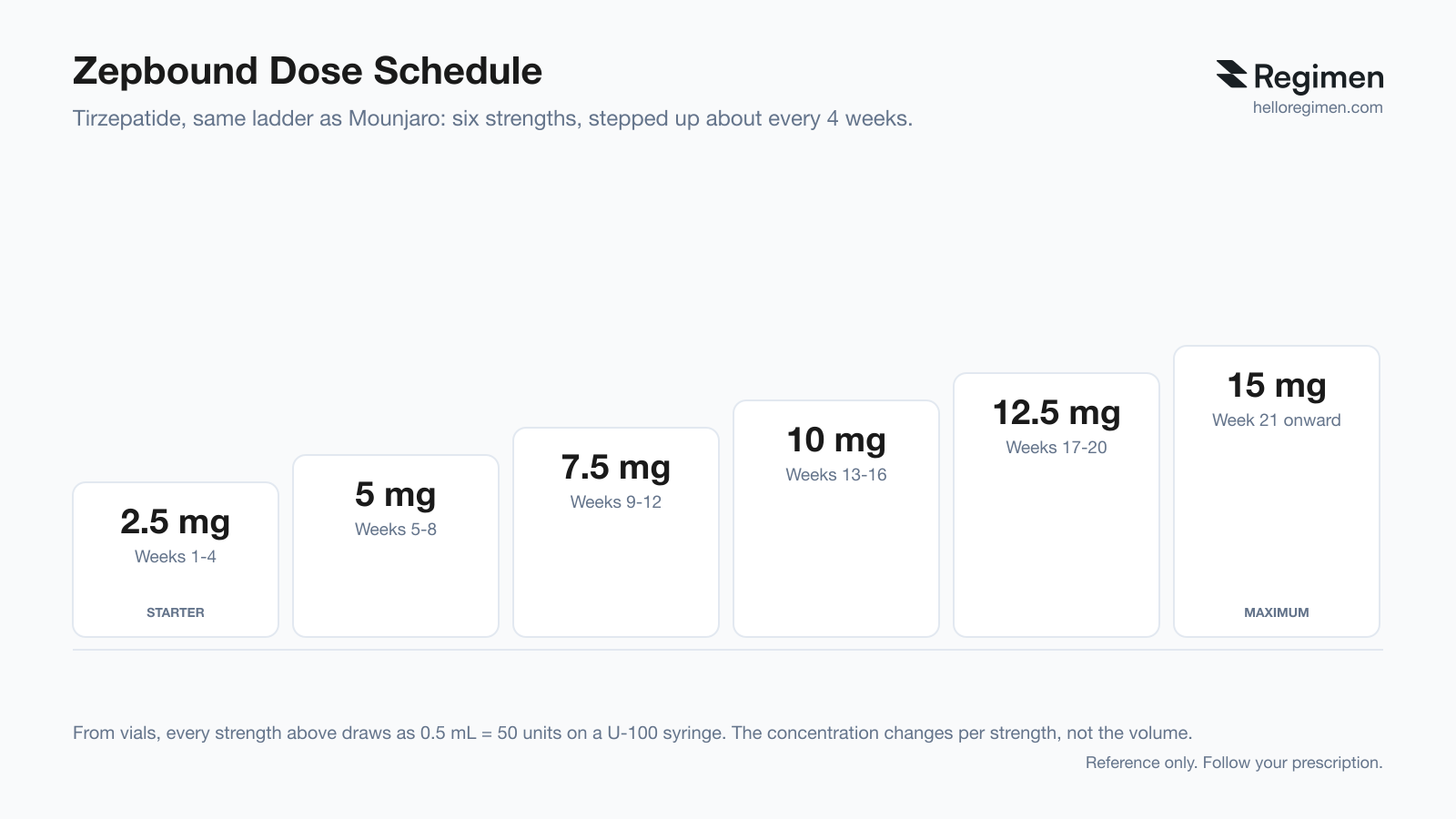
The Zepbound dosage schedule starts at 2.5 mg once a week for four weeks, then goes to 5 mg. From there the dose can go up in 2.5 mg steps after at least four weeks on each dose, to a maximum of 15 mg. That is the schedule in the Zepbound prescribing information (FDA label), which lists 5, 10 and 15 mg as the maintenance doses. Zepbound is tirzepatide, so the same schedule applies to tirzepatide prescribed for weight loss.
The Zepbound starting dose is 2.5 mg for everyone, and it is only a starting dose: the label says it is not approved as a maintenance dose. There are six doses:
Zepbound Dosage Chart by Week
| Dose | When it’s typically used | Single-dose vial draw (U-100 syringe) |
|---|---|---|
| 2.5 mg | Weeks 1-4 (starter) | 0.5 mL = 50 units |
| 5 mg | Weeks 5-8 | 0.5 mL = 50 units |
| 7.5 mg | Weeks 9-12 | 0.5 mL = 50 units |
| 10 mg | Weeks 13-16 | 0.5 mL = 50 units |
| 12.5 mg | Weeks 17-20 | 0.5 mL = 50 units |
| 15 mg | Week 21 onward | 0.5 mL = 50 units |
Among Regimen users on weekly tirzepatide, most move up a dose after 4 weeks, as the label says. 35% stay on a dose longer before stepping up. Among people on tirzepatide in Regimen, the most common weekly dose logged is 5 mg. See all Regimen data.
Why Not Stay on 2.5 mg?
Week 5 is the one step-up that is set for everyone. After that, whether you increase your Zepbound dosage depends on how it’s working and how you feel.
The four-week steps are there to make nausea and other stomach side effects easier to handle. Going higher is about results: higher doses lost more on average, though 10 to 15 mg added less than 5 to 10. If your current dose is working and you tolerate it, staying on it is a normal choice. To see how long each dose stays in your system after a step-up, try the tirzepatide half-life calculator.
What Dose of Zepbound Is Most Effective?
On average, 15 mg is the most effective dose of Zepbound, and it is also the highest. In Lilly’s main 72-week trial, people lost this much of their body weight:
| Weekly dose | Average weight lost at 72 weeks |
|---|---|
| Placebo | 3.1% |
| 5 mg | 15.0% |
| 10 mg | 19.5% |
| 15 mg | 20.9% |
The step from 10 to 15 mg added much less than the step from 5 to 10. Side effects move the other way. Across the two trials in the label, 4.8% of people on 5 mg stopped because of a side effect, 6.3% on 10 mg and 6.7% on 15 mg, against 3.4% on placebo.
Among Regimen users who started tirzepatide at 2.5 mg, the median weight change after the first month was about 4% (most lost between 3% and 6%), about 7% after two months and about 10% after three months. These figures come from people who kept logging their weight in the app, not from a trial.
The most effective dose for you is the one where the weight keeps moving and the side effects stay livable.
Zepbound Maintenance Dosage
The maintenance dose is the one you stay on once the step-ups stop. For weight loss, the Zepbound prescribing information (FDA label) lists three: 5, 10 and 15 mg once a week. For obstructive sleep apnea it lists 10 or 15 mg. There is no rule that you have to reach 15 mg. Three months in, half of Regimen users on tirzepatide are at 7.5 mg or higher, and 41% are still at 5 mg or less.
The label says to choose the maintenance dose on how you respond and how well you tolerate it, and that a lower maintenance dose can be considered if a higher one is too hard to tolerate. It gives no separate dose for after you reach a goal weight. That is a conversation with your prescriber.
The part that confuses people: 50 units is not a milligram amount
Every Zepbound single-dose vial holds 0.5 mL, and 0.5 mL is 50 units on a standard U-100 insulin syringe. That’s true for the 2.5 mg vial and the 15 mg vial alike. If reading those markings is the part you second-guess, the insulin syringe reading guide shows each barrel size up close.
So the units don’t tell you the dose. The vial does.
On a 2.5 mg vial, drawing 50 units gives you 2.5 mg. On a 10 mg vial, that same 50 units gives you 10 mg. The concentration is different in each vial, and the strength printed on the label is your real dose. Draw the full single-dose vial and you’ve drawn your full dose.
Match the vial to your prescribed dose, then draw the whole thing
Don’t try to hit a milligram target by pulling to a certain unit line, because every single-dose vial fills to the same 50 units. If you’re stepping up from 5 mg to 7.5 mg, that’s a new vial, not a deeper pull on the old one.
Pen or vial: what’s the difference
The single-dose Zepbound pen is a single-use auto-injector. You press it to your skin and it delivers the full preset dose. No dial, no clicks, nothing to measure. The KwikPen and the multi-dose vial each hold four weekly doses, and on the multi-dose vial one dose is 0.6 mL, which is 60 units.
The vial is the same medicine at the same weekly strengths, but you draw it into an insulin syringe and inject it yourself. Lilly offers vials through self-pay at a lower price than the single-dose pens. The self-pay prices by strength are in how to get Zepbound without insurance.
Same drug, same doses. The vial just asks you to do the drawing.
Zepbound and Mounjaro are the same molecule
Zepbound and Mounjaro are both tirzepatide. Zepbound is the version approved for weight loss, Mounjaro for type 2 diabetes. The doses and the step-ups are the same.
If your prescription switched brands but kept the dose, your schedule doesn’t change. The Mounjaro dose chart covers the same six strengths from the diabetes side.
Compounded tirzepatide is a different draw
Compounded tirzepatide isn’t a fixed 50-unit vial. It’s mixed to a concentration your pharmacy chose, so the units for your dose depend on that specific vial.
Same molecule as brand Zepbound, different product. Brand vials are FDA-approved and quality-controlled, so the single-dose vial fill is standardized at 0.5 mL. Compounded vials are not FDA-approved, so the concentration and the units change source to source. Our tirzepatide reconstitution calculator works out the units for your exact concentration, and the compounded semaglutide and tirzepatide guide has the full picture.
Track your dose, vial, and weight together
Which vial you’re on, when you last stepped up, how the scale and your side effects moved with each change: that’s the stuff worth having in one place instead of scattered across your memory.
Regimen logs your dose, your form (pen or vial), and how you’re responding on one timeline, and reminds you when your weekly shot is due. Track your Zepbound doses in Regimen.
Frequently Asked Questions
What is the tirzepatide dosage chart for weight loss?
It’s the dose-by-week table on this page: Zepbound is tirzepatide, so the same six doses from 2.5 to 15 mg apply. Mounjaro, the diabetes brand of tirzepatide, uses the same doses too.
How many units is a Zepbound vial?
Every single-dose vial is 0.5 mL, which is 50 units on a U-100 insulin syringe, at every strength. You draw the full vial. Check the carton first, because Zepbound also comes as a multi-dose vial holding four doses, and there one dose is 0.6 mL, which is 60 units. The milligrams come from which vial you have, not the unit count.
Is 50 units the same as 2.5 mg of Zepbound?
Only on a 2.5 mg vial. On a 10 mg vial, 50 units is 10 mg. Each vial is a different concentration, so read the strength on the label for your actual dose.
How many units is 5 mg of Zepbound?
From a 5 mg single-dose vial, 50 units: you draw the whole vial, 0.5 mL on a U-100 insulin syringe. It’s the same 50 units for 2.5, 7.5, 10, 12.5 and 15 mg, each from its own single-dose vial. On a multi-dose vial, one dose is 0.6 mL, which is 60 units.
What are the Zepbound dosage levels?
Six weekly strengths, each sold as its own pen or vial: 2.5, 5, 7.5, 10, 12.5 and 15 mg. On a single-dose vial every strength draws the same 50 units, so the strength printed on the label is your dose.
What dose of Zepbound is most effective?
15 mg, on average. In Lilly’s main 72-week trial, people on 15 mg lost 20.9% of their body weight, against 19.5% on 10 mg, 15.0% on 5 mg and 3.1% on placebo. The gap between 10 and 15 mg is small, and the Zepbound prescribing information (FDA label) lists 5, 10 and 15 mg as maintenance doses, chosen on how you respond and how well you tolerate it.
What is the Zepbound starting dose?
2.5 mg once a week for the first four weeks, for everyone. The first step up is to 5 mg in week 5.
What is the highest dose of Zepbound?
15 mg a week; the label has nothing higher.
Does the Zepbound pen have clicks?
No. The single-dose pen is a fixed-dose auto-injector that delivers the full dose on its own. There’s no dial to turn or clicks to count, unlike Ozempic. The single-patient-use KwikPen is a separate device holding four weekly doses, and Lilly’s US label publishes no click count for it either.
Is there medicine left in the Zepbound KwikPen after 4 doses?
Yes, a little, and it’s meant to stay there. The pen will not let you dial a full dose after four weekly doses, and Lilly’s instructions say: “Do not inject the leftover medicine. Do not transfer ZEPBOUND from your Pen into a syringe.” Throw the pen away after four doses. In the UK, where Mounjaro comes as a KwikPen, this leftover is called the golden dose; the Mounjaro golden dose explains why it’s there.
What is the Zepbound dosing schedule?
2.5 mg once a week for weeks 1-4 as a starter, then 5 mg, then up in 2.5 mg steps after at least four weeks on each dose, to a maximum of 15 mg. The Zepbound prescribing information (FDA label) lists 5, 10 and 15 mg as the maintenance doses, and holding at a dose that’s working is common and fine.
What is the Zepbound maintenance dosage?
5, 10 or 15 mg once a week for weight loss, picked on how you respond and how well you tolerate it.
What happens if I miss a Zepbound dose?
If four days (96 hours) or less have passed since your scheduled day, take it when you remember. If it’s been more than four days, skip it and take your next dose on the regular day. Don’t take two doses within three days.
What app tracks Zepbound doses?
Regimen tracks your dose, pen or vial, and side effects on one timeline and reminds you when your shot is due.
Sources
- Zepbound prescribing information (FDA label, revised 08/2026), Eli Lilly: dosage and administration (sections 2.1 and 2.2), recommended maintenance and maximum dosage; weight loss by dose at week 72 (Study 1, section 14) and discontinuation for side effects by dose (section 6.1). pi.lilly.com
- Regimen app data, October 2026: time on each dose before stepping up, and weekly dose after three months.
Related tools
- Units to mL calculator
- Tirzepatide reconstitution calculator
- GLP-1 dose calculator
- Split dose calculator
Related reading
- Mounjaro dose chart: all six doses explained
- I just started tirzepatide, now what?
- Best GLP-1 tracker apps 2026
Ready to track your GLP-1?
- Smart reminders so you never miss a dose
- Track weight, photos, and progress over time
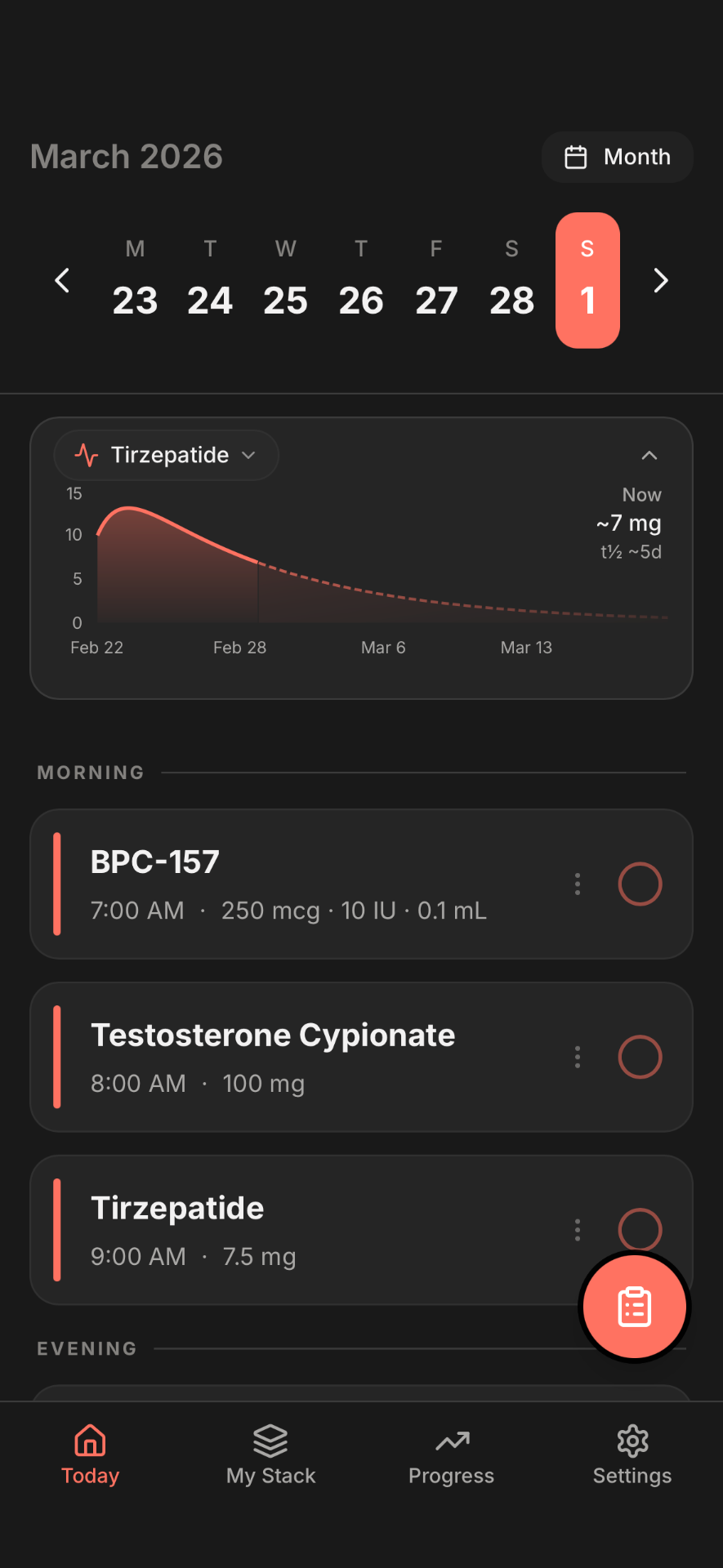
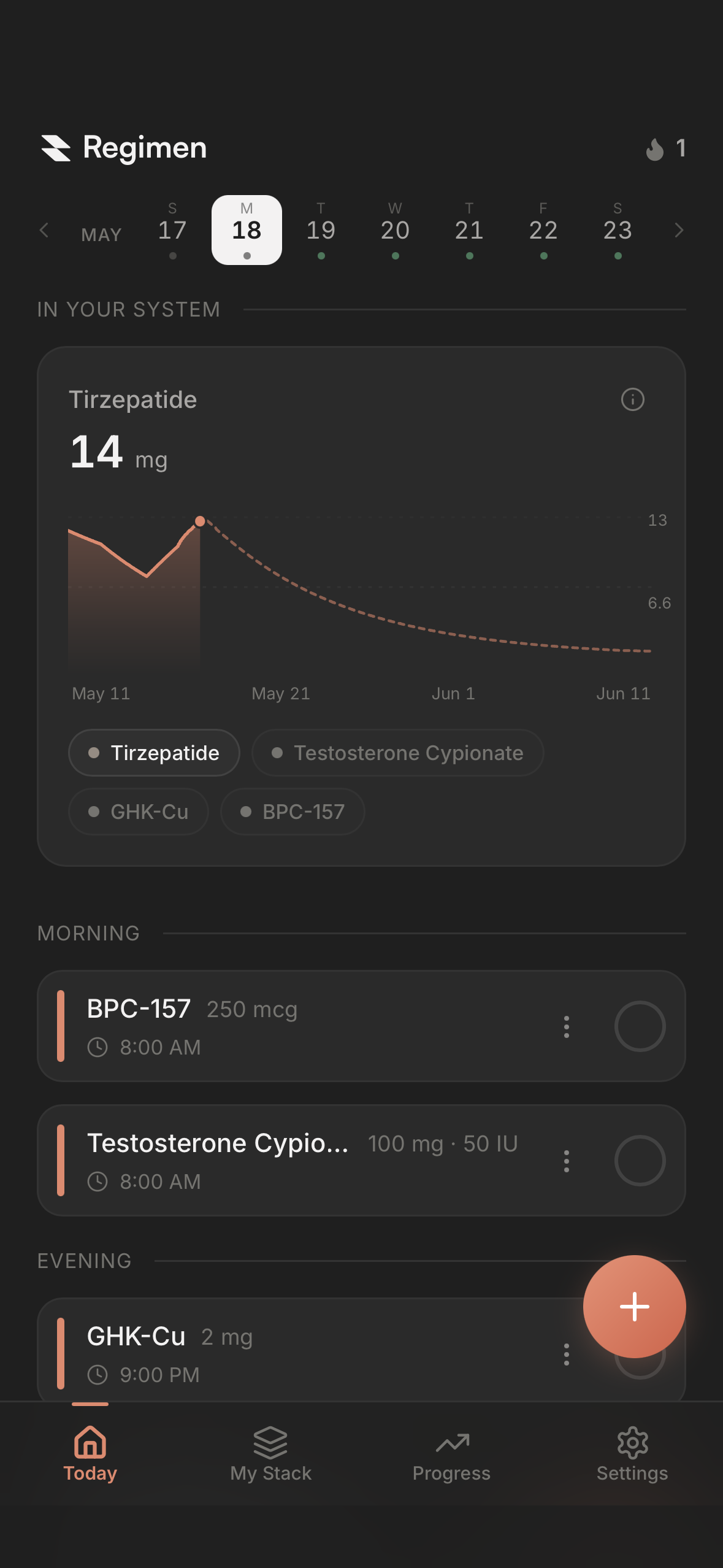
- Medication level curves for 150+ compounds