U-100 · U-50 · U-40 insulin syringe
Units to mL Calculator (Insulin Syringe)
Convert insulin-syringe units to volume in mL on a U-100, U-50, or U-40 syringe. Add your concentration to also see the dose in mg.
Use mcg/mL for most peptides, mg/mL for compounded GLP-1.
Draw syringe to
0 units
(0.00 mL)
Units measure volume on the syringe, not the amount of drug. The same dose is a different number of units at a different concentration, so always set your concentration first.
units → mg on U-100
| Units | Volume (mL) | Dose (mg) |
|---|---|---|
| 5 units | 0.05 | 125 mcg |
| 10 units | 0.10 | 250 mcg |
| 20 units | 0.20 | 500 mcg |
| 25 units | 0.25 | 625 mcg |
| 50 units | 0.50 | 1.25 mg |
| 75 units | 0.75 | 1.875 mg |
| 100 units | 1.00 | 2.5 mg |
This calculator is for informational purposes only, so always double-check your result with a healthcare provider. We assume no liability for dosing errors.
Last updated September 2026 · Reviewed by the Regimen Team
How to use it
How to use this calculator
- 01
Pick your syringe
U-100 is the standard 1 mL insulin syringe. U-50 and U-40 use a different scale.
- 02
Enter the units
Type the number of units you're drawing. The calculator returns the volume in mL immediately.
- 03
Add concentration (optional)
Enter your working concentration to also see how many mg or mcg those units contain.
Units measure volume on the syringe, not the amount of drug. The same dose is a different number of units at a different concentration, so always set your concentration first.
units → mL on U-100
| Units | Volume (mL) |
|---|---|
| 5 units | 0.05 |
| 10 units | 0.10 |
| 20 units | 0.20 |
| 25 units | 0.25 |
| 50 units | 0.50 |
| 75 units | 0.75 |
| 100 units | 1.00 |
Units to mL reference (U-100 / U-50 / U-40)
Units to mL only depends on the syringe. The mg column needs your concentration.
| Units | U-100 (mL) | U-50 (mL) | U-40 (mL) |
|---|---|---|---|
| 10 units | 0.10 | 0.20 | 0.25 |
| 20 units | 0.20 | 0.40 | 0.50 |
| 25 units | 0.25 | 0.50 | 0.625 |
| 50 units | 0.50 | 1.00 | 1.25 |
| 75 units | 0.75 | 1.50 | 1.875 |
| 100 units | 1.00 | 2.00 | 2.50 |
Why units to mL only depends on the syringe
Units are marks on the barrel that measure volume, not drug. A U-100 syringe is calibrated so that 100 units fills exactly 1 mL. A U-50 puts 50 units in 1 mL. A U-40 puts 40 units in 1 mL. So to turn units into mL you only need to know which scale is printed on your syringe - the drug concentration doesn’t enter the picture.
When concentration matters
Concentration only matters when you want to know how much drug is in that volume. 50 units on a U-100 is always 0.5 mL. At 2.5 mg/mL that 0.5 mL is 1.25 mg. At 5 mg/mL the same 50 units is 2.5 mg. Enter your concentration in the calculator above and the mg column fills in.
A quick worked example
You drew 50 units on a U-100 syringe. That’s 50 ÷ 100 = 0.50 mL of liquid, no matter what’s in the vial. If you reconstituted a 5 mg vial with 2 mL of BAC water (2.5 mg/mL), 0.50 mL is 1.25 mg. If you used 1 mL of BAC water instead (5 mg/mL), the same 50 units is 2.5 mg. Same draw, double the dose.
Working from a dose instead? Use the mg to units calculator to go the other direction.
See also: units vs mL vs mg explainer and how to read an insulin syringe.
Get the app
Save the math with every dose
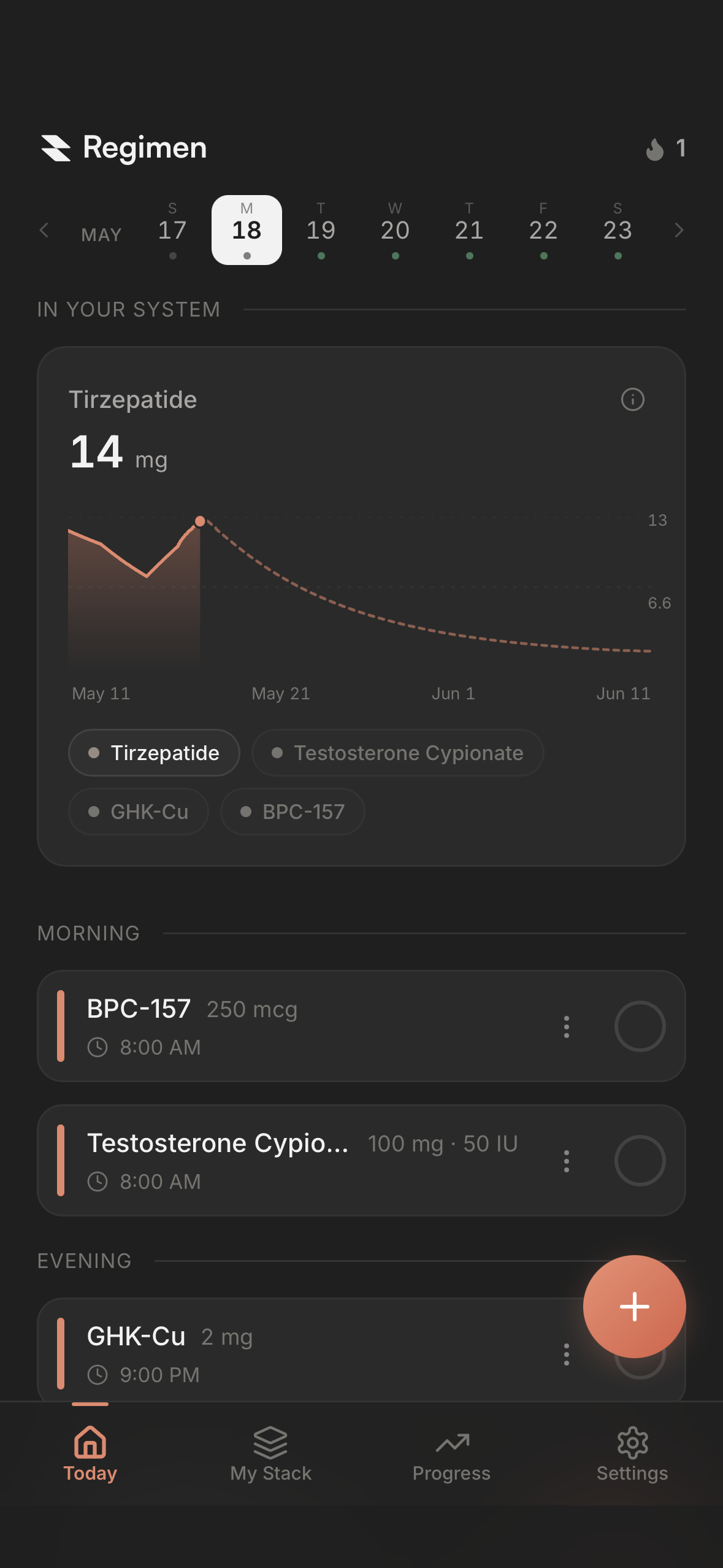
Regimen keeps your concentration on file and pre-fills the draw amount on every injection log.
- Built-in dose calculators
- Smart injection reminders
- Track weight and side effects
- Private, secure health data


Free to download. Free for your first compound.
Questions