U-100 · U-50 · U-40 insulin syringe
mg to Units Calculator
Enter your working concentration, pick your syringe, and this shows the exact units to draw and the volume in mL for any milligram (or microgram) dose.
Use mcg/mL for most peptides, mg/mL for compounded GLP-1.
Draw syringe to
0 units
(0.00 mL)
Units measure volume on the syringe, not the amount of drug. The same dose is a different number of units at a different concentration, so always set your concentration first.
mg → units on U-100
| Dose (mg) | Volume (mL) | Units (U-100) |
|---|---|---|
| 0.25 mg | 0.100 | 10 |
| 0.5 mg | 0.200 | 20 |
| 1 mg | 0.400 | 40 |
| 1.5 mg | 0.600 | 60 |
| 2 mg | 0.800 | 80 |
| 2.5 mg | 1.000 | 100 |
| 3 mg | 1.200 | 120 |
| 4 mg | 1.600 | 160 |
| 5 mg | 2.000 | 200 |
| 7.5 mg | 3.000 | 300 |
| 10 mg | 4.000 | 400 |
| 15 mg | 6.000 | 600 |
| 20 mg | 8.000 | 800 |
This calculator is for informational purposes only, so always double-check your result with a healthcare provider. We assume no liability for dosing errors.
Last updated September 2026 · Reviewed by the Regimen Team
How to use it
How to use this calculator
- 01
Enter your working concentration
Use mg/mL (e.g. 2.5 mg/mL) or toggle to mcg/mL. This is set by how much BAC water you mixed into the vial.
- 02
Pick your syringe
U-100 is the standard 1 mL insulin syringe. U-50 and U-40 use a different scale.
- 03
Enter your dose
Type the dose in mg (or toggle to mcg). The calculator returns exact units and mL.
- 04
Read the live reference table
Common doses are pre-seeded; the volume and units columns recalculate for your concentration and syringe.
Units measure volume on the syringe, not the amount of drug. The same dose is a different number of units at a different concentration, so always set your concentration first.
mg to units reference (2.5 mg/mL, U-100)
Common concentration: a 5 mg vial reconstituted with 2 mL BAC water (2.5 mg/mL = 2,500 mcg/mL). Read off your own concentration in the calculator above.
| Dose | Volume (mL) | Units (U-100) |
|---|---|---|
| 0.25 mg | 0.100 | 10 |
| 0.5 mg | 0.200 | 20 |
| 1 mg | 0.400 | 40 |
| 2 mg | 0.800 | 80 |
| 2.5 mg | 1.000 | 100 |
Why you can’t convert mg to units without your concentration
Here’s the thing that trips everyone up: “units” on an insulin syringe don’t measure how much drug you’re taking. They measure volume, how far up the barrel the liquid goes. A U-100 syringe just means 100 units equals 1 mL. So 1 mg in a weak solution fills more units than 1 mg in a strong one, even though it’s the same dose. That’s why there’s no single “1 mg equals X units” answer. You have to pin your concentration first, then the units fall out of it.
How the conversion actually works
Two steps, and the calculator does both. First it works out the volume: your dose divided by your concentration. 1 mg at 2.5 mg/mL is 0.4 mL. Then it turns volume into units using your syringe: on a U-100, multiply mL by 100, so 0.4 mL is 40 units. On a U-40 the same 0.4 mL is 16 units. Same dose, same volume, different number on the barrel, because the syringe is scaled differently.
U-100 vs U-50 vs U-40: which syringe are you holding?
Most peptide and GLP-1 users are on U-100 (the standard 1 mL insulin syringe, 100 units to a mL). U-40 syringes are scaled for a more dilute liquid, so the same volume reads as fewer units. U-50 sits in between. The liquid you draw is identical, only the printed scale changes, so the one rule that matters: read the units off the syringe you’re actually holding, not someone else’s. If you’re not sure which you have, it’s printed on the barrel.
A quick worked example
Say you reconstituted a 5 mg vial with 2 mL of bacteriostatic water. That’s 2.5 mg/mL. You want a 2 mg dose. Volume is 2 ÷ 2.5, which is 0.8 mL. On your U-100 syringe that’s 80 units. Want 2.5 mg instead? That’s 1.0 mL, the full barrel, or 100 units. Set the concentration once and the whole table updates, so you’re not redoing the math every time you change your dose.
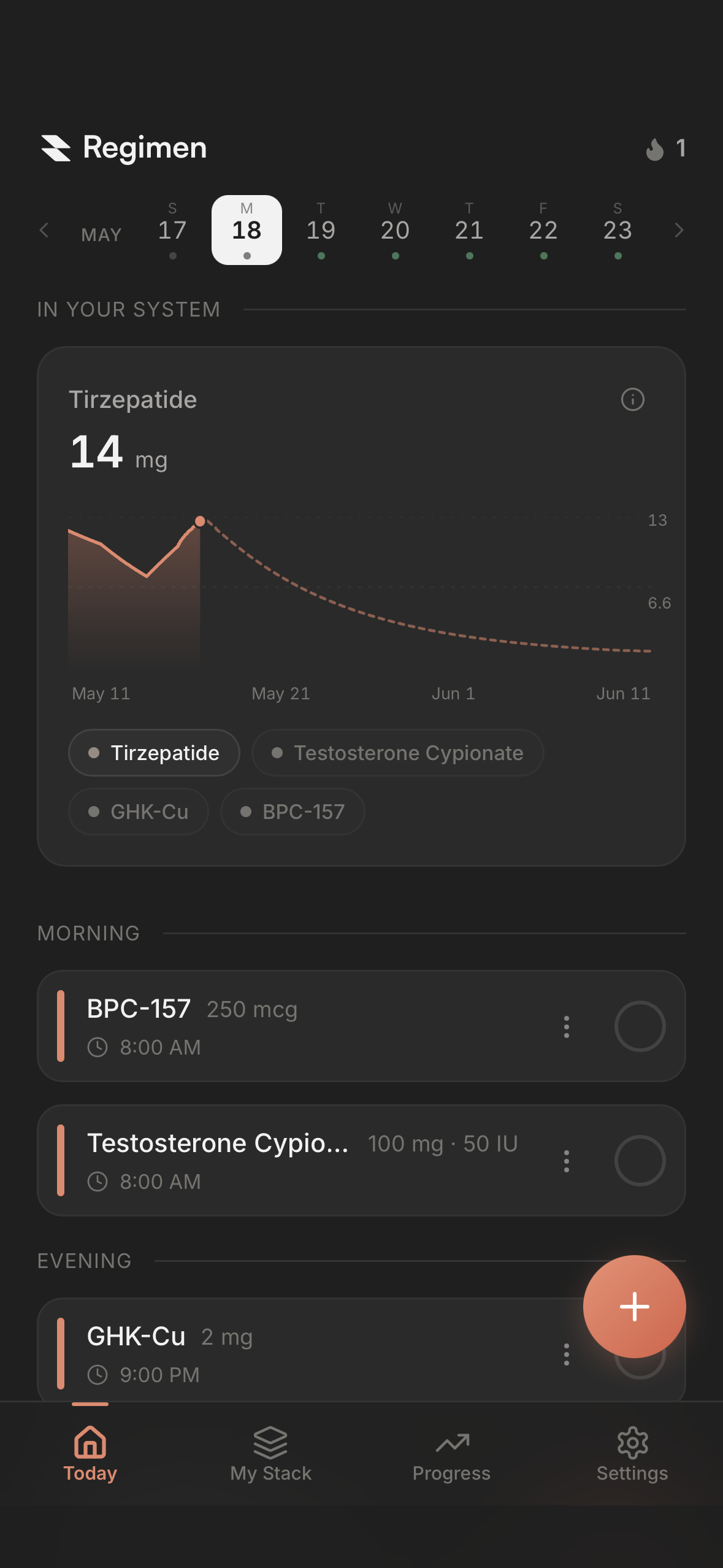
If you’d rather not re-derive this every cycle, log your concentration and each dose in Regimen and your draw amount is saved with every shot.
Download Regimen free - iOS·Android
Working in mcg or units instead? See the units to mL calculator, the units vs mL vs mg explainer, and how to read an insulin syringe.
Get the app
Skip the math every cycle
Regimen saves your concentration with each compound and shows the exact units to draw on every dose log.
- Built-in dose calculators
- Smart injection reminders
- Track weight and side effects
- Private, secure health data


Free to download. Free for your first compound.
Questions