TDEE Calculator

Estimate your daily calorie needs and a protein target. Mifflin-St Jeor formula by default, Katch-McArdle if you know your body fat percentage.

TDEE & calories

Daily energy expenditure

BMR, maintenance calories, and protein targets from your stats.

yrs
lbs
ft
in
%

This calculator is for informational purposes only, so always double-check your result with a healthcare provider. Estimates use population-average formulas, and individual metabolism varies with hormones, genetics, and body composition. We assume no liability for dosing errors.

The tool

How it works, what it tells you, what it doesn't.

Total Daily Energy Expenditure (TDEE) is the total number of calories your body burns in a day, including your basal metabolic rate plus calories from movement, digestion, and exercise. Knowing your TDEE is the starting point for any cut, bulk, or recomp plan. It's especially useful for GLP-1 users, who often under-eat without realizing it because semaglutide and tirzepatide blunt appetite. This calculator uses the Mifflin-St Jeor equation by default, the most widely validated BMR formula. If you know your body fat percentage from a DEXA scan or smart scale, entering it switches to the Katch-McArdle formula, which uses lean mass for a more accurate estimate.

How to use it

How to Use This Calculator

  1. 01

    Enter your stats

    Age, sex, height, weight, and activity level

  2. 02

    Add body fat % (optional)

    Enables the more accurate Katch-McArdle formula

  3. 03

    View your TDEE

    See maintenance, deficit, and surplus calorie targets

  4. 04

    Check protein needs

    Get a protein recommendation to preserve lean mass

Get the app

Track your weight, doses, and metrics in one app

Regimen logs your weight alongside your protocol so you can see how dose changes correlate with body composition over time.


Free to download. Free for your first compound.
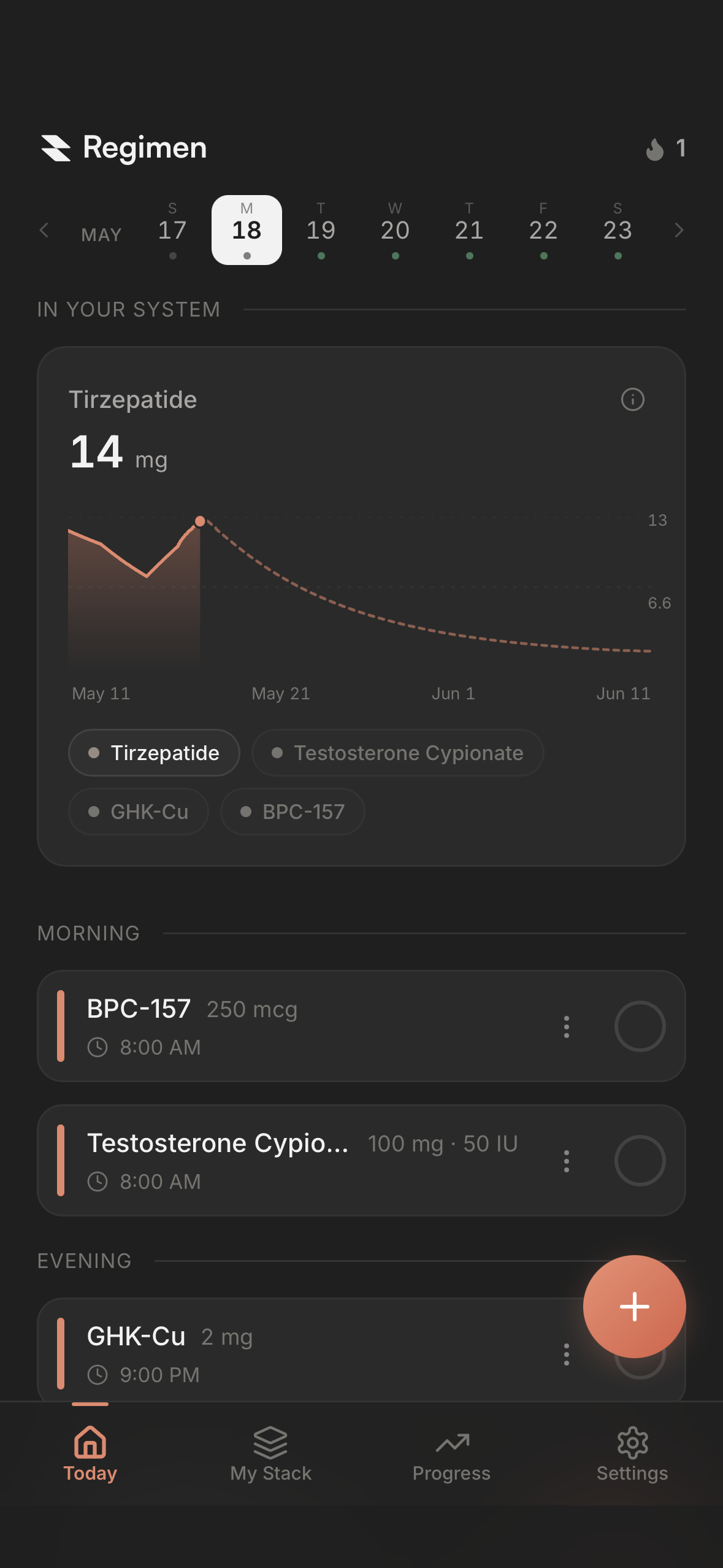
Regimen app Today view with doses and estimated levels

Questions

Frequently Asked Questions

What is TDEE?

Total Daily Energy Expenditure (TDEE) is the total number of calories your body burns in a day, including your basal metabolic rate (BMR) plus calories burned through physical activity and digestion.

How accurate is a TDEE calculator?

TDEE calculators provide an estimate, typically within 10-15% of your actual expenditure. Use the result as a starting point and adjust based on real-world weight changes over 2-3 weeks.

Why does TDEE matter for GLP-1 users?

GLP-1 medications like Ozempic and Mounjaro significantly reduce appetite. Without tracking, many users under-eat, which can cause muscle loss and metabolic slowdown. Knowing your TDEE helps you maintain an appropriate deficit while preserving lean mass.

How do I use TDEE for muscle gain?

For lean muscle gain, eat at a 200-300 calorie surplus above your TDEE while hitting the higher end of the protein recommendation (1.0-1.2g per lb). Combine this with progressive resistance training 3-5 times per week.

Should I eat back exercise calories?

Generally, no. Your TDEE already accounts for your activity level. Eating back exercise calories often leads to overestimating burn and under-reaching your goals. If you train very hard and feel low energy, add 100-200 calories on heavy training days.

What is the Mifflin-St Jeor formula?

Mifflin-St Jeor is the most widely validated BMR equation. For men: BMR = 10 x weight(kg) + 6.25 x height(cm) - 5 x age + 5. For women: BMR = 10 x weight(kg) + 6.25 x height(cm) - 5 x age - 161.

When should I use Katch-McArdle instead?

If you know your body fat percentage, Katch-McArdle provides a more accurate estimate because it accounts for lean body mass. This is especially useful for people who are very muscular or have higher body fat percentages.

How much protein do I need during weight loss?

Research suggests 0.8-1.2g of protein per pound of body weight to minimize muscle loss during weight loss. Aim for the higher end if you are strength training, regardless of whether you are on a GLP-1 medication or not.