Verification note: PBS listings, TGA scheduling, and pricing change frequently. Information here reflects publicly available data as of May 2026. Always verify current status at pbs.gov.au and tga.gov.au before making treatment decisions.
Key takeaway: Popular peptides are Schedule 4 (prescription only) in Australia, so they require a doctor’s prescription and must be dispensed by a compounding pharmacy. The date most guides get wrong is BPC-157’s: it was given its own Schedule 4 entry with an implementation date of 1 June 2024, not 2023. The 2023 you see quoted everywhere is the month the advisory committee met. You can still access these peptides legally, you just need a prescription.
What Changed, and When
The commonly repeated version of this story is that the TGA scheduled peptides in 2023. That is the wrong year, and the confusion is worth clearing up because the date is quoted back as fact all over the internet, including, until this update, on this page.
What actually happened with BPC-157:
- The Advisory Committee on Medicines Scheduling met in November 2023 (ACMS #43) and considered a proposal to schedule BPC-157, prompted by 48 referrals for importation the TGA had received since 1 July 2022.
- The final decision was published in 2024, creating a Schedule 4 entry for BPC-157 by name.
- The committee set an implementation date of 1 June 2024, and the entry was carried in the Therapeutic Goods (Poisons Standard, June 2024) Instrument 2024, registered on 30 May 2024.
So 2023 is the meeting year and 1 June 2024 is the operative date. Australia was the first country to schedule BPC-157 by name.
One thing we are not going to claim: that every peptide below was unscheduled before that date. Several classes of peptide, growth hormone secretagogues in particular, were already captured as prescription-only, and we could not verify a clean “before and after” line for each compound against the Poisons Standard. If the status of one specific peptide matters to you, look it up rather than trusting a summary. The current Poisons Standard is on the Federal Register of Legislation, and the TGA publishes its scheduling decisions as they are made.
Schedule 4 (prescription only)
Treat this as the practical picture rather than a citation. BPC-157 is Schedule 4 by name. The rest are handled as prescription-only by Australian compounding pharmacies and peptide clinics, which is what determines how you actually obtain them:
- BPC-157 - requires prescription
- Ipamorelin - requires prescription
- CJC-1295 (with and without DAC) - requires prescription
- GHRP-2 - requires prescription
- GHRP-6 - requires prescription
- AOD-9604 - requires prescription
- Epithalon - requires prescription
- Selank - requires prescription
- Semax - requires prescription
- TB-500 (Thymosin Beta-4) - requires prescription
Importing an unapproved Schedule 4 substance without authorisation is what the TGA acts on, and the BPC-157 decision came directly out of importation referrals. A prescription and an Australian compounding pharmacy is the route that keeps you inside the rules.
What this means practically
- You need a doctor who will prescribe peptides. Not all GPs are willing or knowledgeable. Peptide-friendly clinics and integrative medicine practitioners are the most reliable source.
- The prescription goes to a compounding pharmacy. Compounding pharmacies make the peptides to the doctor’s specification.
- You cannot legally buy peptides from online research chemical suppliers for personal use. Schedule 4 means possession without a prescription is an offence.
- Import of peptides without a prescription is also restricted. Customs can seize unscheduled peptide shipments.
How to Access Peptides Legally
Step 1: Find a peptide-friendly practitioner
- Integrative medicine doctors - many are familiar with peptide protocols.
- Sports medicine practitioners - increasingly prescribe BPC-157 and TB-500 for injury recovery.
- Anti-ageing or longevity clinics - commonly prescribe growth hormone secretagogues.
- Telehealth options - some services specialise in peptide consultations remotely.
Ready to track your protocol?
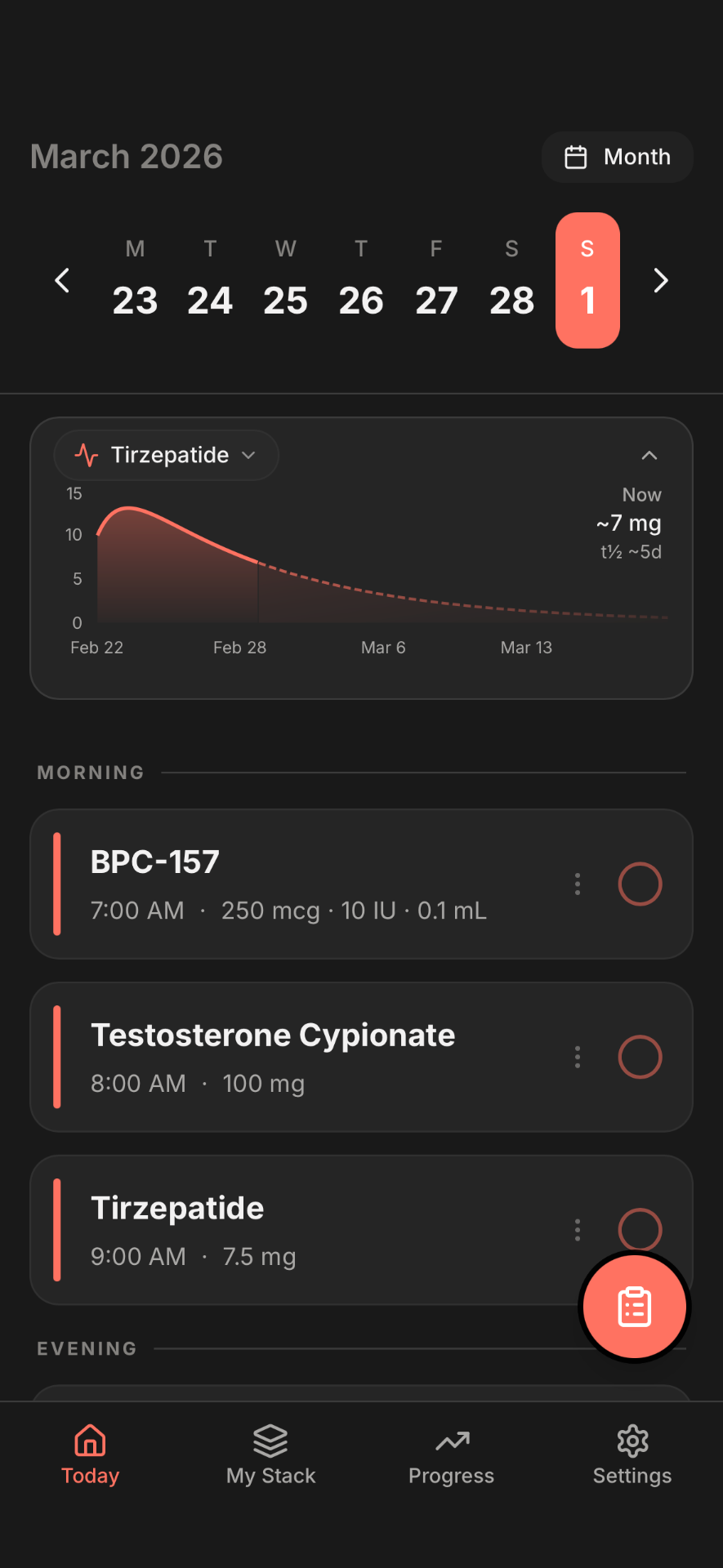
- Smart reminders so you never miss a dose
- Progress tracking with photos and weight
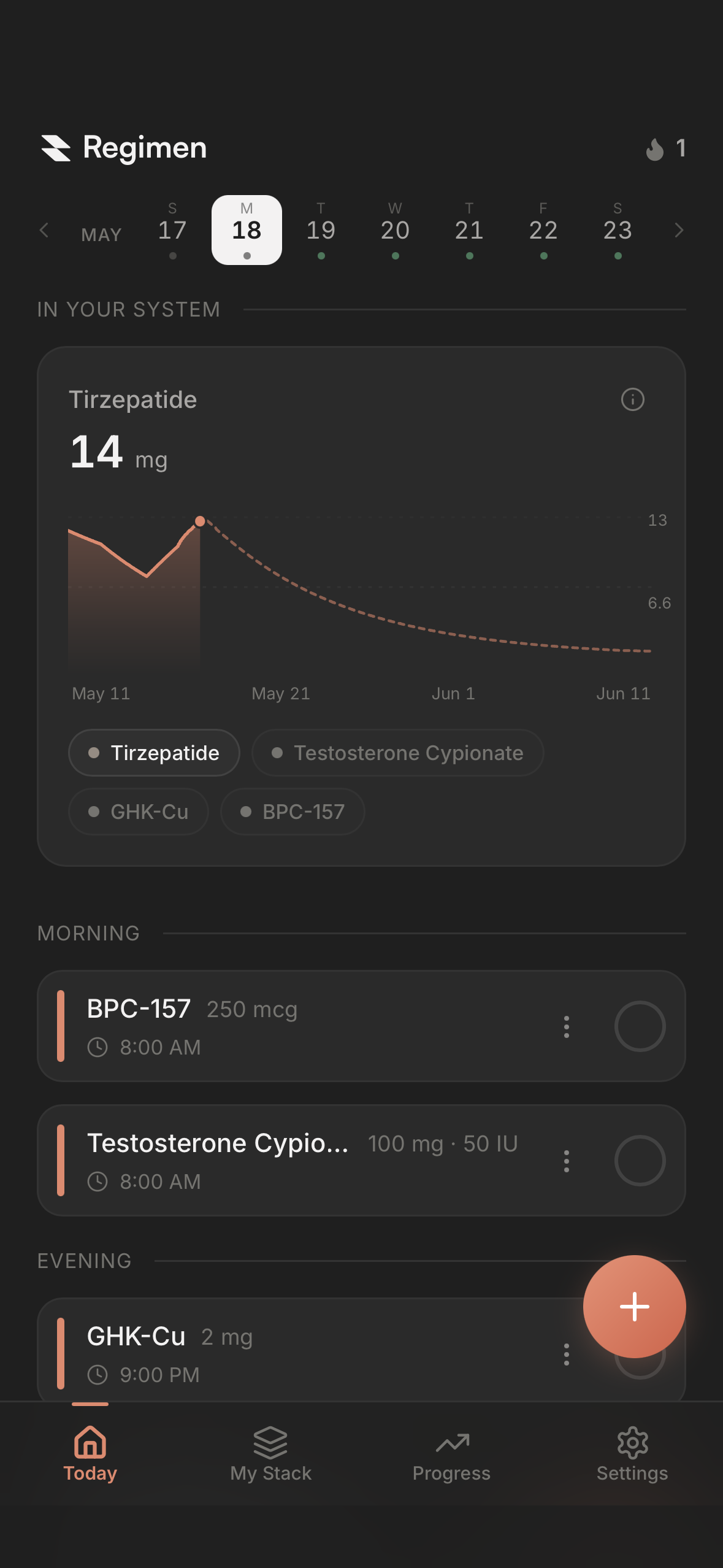
- Medication level curves for every compound
Step 2: Get a prescription
Your doctor will write a prescription specifying the peptide, concentration, quantity, route of administration (subcutaneous, oral, nasal), and dosing protocol.
Step 3: Fill at a compounding pharmacy
The compounding pharmacy will prepare the peptide to specification, provide it in the appropriate form, and include reconstitution instructions if applicable.
Cost: Compounding pharmacy peptides in Australia typically run $80-200 per course depending on the peptide, concentration, and quantity. More expensive than research chemical suppliers, but comes with quality assurance and legal protection.
What is Still Available Without a Prescription
- GHK-Cu (copper peptide) - available as a topical skincare ingredient. Not scheduled when used externally.
- Collagen peptides - dietary supplements, widely available.
- BPC-157 oral capsules - the scheduling is complex here; the safest route is still a prescription.
Quality Assurance
One benefit of the scheduling change: compounding pharmacy peptides come with quality controls that research chemicals did not:
- Compounding pharmacies are regulated by state pharmacy boards and must follow TGA manufacturing guidelines.
- Each batch has quality testing - purity, sterility, identity confirmation.
- The pharmacist is accountable - there is a legal chain of responsibility.
- Proper storage and handling throughout the supply chain.
Reconstitution and Storage
- Bacteriostatic water - your compounding pharmacy should supply this.
- Add water slowly down the side of the vial, never squirt directly onto the powder.
- Swirl gently to dissolve - never shake.
- Store reconstituted peptides in the fridge at 2-8 degrees C.
- Use within the timeframe specified by your compounding pharmacy (typically 4-6 weeks).
Use the Regimen peptide reconstitution calculator to determine exact volumes for your specific vial and desired dose.
Tracking Your Peptide Protocol
With the added complexity of prescriptions and compounding pharmacy timelines, keeping track of your peptide protocol is more important than ever. Regimen lets you log each dose, track reconstitution dates, manage multi-compound stacks, and keep a record that you can share with your prescribing doctor at follow-up appointments.
Frequently Asked Questions
Are peptides legal in Australia?
Most popular peptides (BPC-157, TB-500, Ipamorelin, CJC-1295) are Schedule 4 - legal with a prescription, illegal to possess without one. BPC-157 got its own Schedule 4 entry with an implementation date of 1 June 2024. The 2023 date quoted in most guides is the month the advisory committee met, not the date the change took effect.
Do I need a prescription for BPC-157 in Australia?
Yes. BPC-157 has been Schedule 4 in Australia since 1 June 2024, when its entry in the Poisons Standard took effect, so it requires a prescription and must be dispensed by a compounding pharmacy. Australia was the first country to schedule it by name.
How much do peptides cost from compounding pharmacies in Australia?
Typically $80-200 per course depending on the peptide, concentration, and quantity. More expensive than previous research chemical suppliers but with quality assurance.
Can I import peptides into Australia?
Import of Schedule 4 peptides without a prescription is restricted. Customs can seize shipments. The legal route is through an Australian compounding pharmacy with a valid prescription.
Track your peptide protocol with Regimen - log doses, manage reconstitution dates, and track multi-compound stacks. Free for one compound.
Regimen is a tracking tool, not a medical service. We do not provide medical advice. Always consult your healthcare professional before starting, changing, or stopping any medication protocol.
Sources
- TGA notice of interim decisions, ACMS #43: the BPC-157 proposal, the 48 importation referrals and the recommended implementation date of 1 June 2024.
- Therapeutic Goods (Poisons Standard, June 2024) Instrument 2024, F2024L00589: the instrument carrying the entry, registered 30 May 2024.
- Federal Register of Legislation: the current Poisons Standard, which is the authority for any individual substance.
Scheduling changes. Check the current Poisons Standard for your specific compound rather than relying on any summary, including this one.