Verification note: PBS listings, TGA scheduling, and pricing change frequently. PBS criteria and co-payments on this page were re-checked in September 2026 against pbs.gov.au. Always verify current status at pbs.gov.au and tga.gov.au before making treatment decisions.
Key takeaway: Testosterone is PBS-listed in Australia for confirmed androgen deficiency, which means it can be heavily subsidised - $7.70 per script with a concession card or up to $25 at the general rate since the co-payment was reduced on 1 January 2026. Getting there requires blood tests showing total testosterone below 6 nmol/L (the qualifying level was lowered from 8), or 6 to 15 nmol/L with a raised LH, plus specialist confirmation and an authority prescription.
The PBS Pathway
Step 1: Blood tests
- Total testosterone below 6 nmol/L, measured on at least two separate days. The PBS qualifying level was lowered from 8 nmol/L to 6 nmol/L, so older guidance, and anyone who qualified under the old number, is out of date.
- Or total testosterone between 6 and 15 nmol/L with a raised LH: above 1.5 times the upper limit of the reference range for young men, or above 14 IU/L.
- Testosterone, LH and FSH should all be measured, on samples collected on separate days.
- Morning timing is critical - testosterone drops 20-40% by afternoon.
- Your GP can order these tests. Medicare covers the blood work.
If you sit between 6 and 8 nmol/L, this change matters to you. Under the old threshold you would have qualified on the testosterone number alone. Now you need the LH criterion as well, or you fall outside PBS subsidy and are looking at a private script. That is worth knowing before the appointment rather than after.
Step 2: Endocrinologist referral
PBS access requires confirmation by a specialist: an endocrinologist, urologist, paediatrician, or a registered member of the Chapter of Sexual Health Medicine. The specialist will confirm the blood results, assess symptoms, rule out secondary causes, and check LH/FSH to distinguish primary from secondary hypogonadism. Their name goes on the authority application.
Step 3: Authority prescription
PBS-subsidised testosterone requires an authority prescription - your doctor needs to call or submit electronically to Services Australia to get approval. This is a one-time process per treatment course.
Testosterone Brands Available in Australia
Reandron 1000 (testosterone undecanoate)
- 1000mg testosterone undecanoate in 4mL - the Australian equivalent of Nebido.
- Injection schedule: Every 10-14 weeks (typically 12 weeks once at steady state).
- Must be given as a slow deep intramuscular injection by a healthcare professional.
- PBS: up to $25 (general) / $7.70 (concession) per injection.
- Pros: Lowest injection frequency, very stable levels once at steady state.
- Cons: Long washout if side effects occur, requires clinic visit, less dose flexibility.
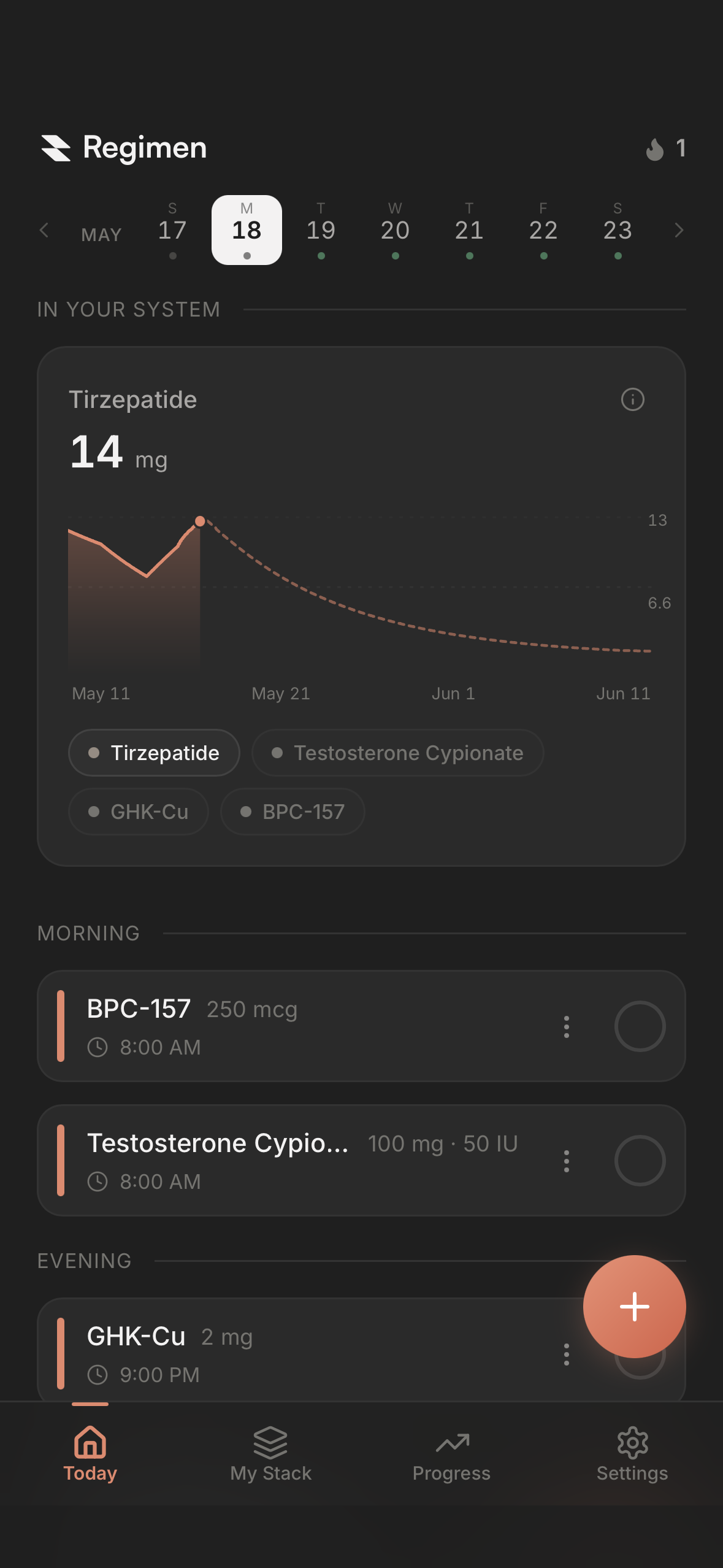
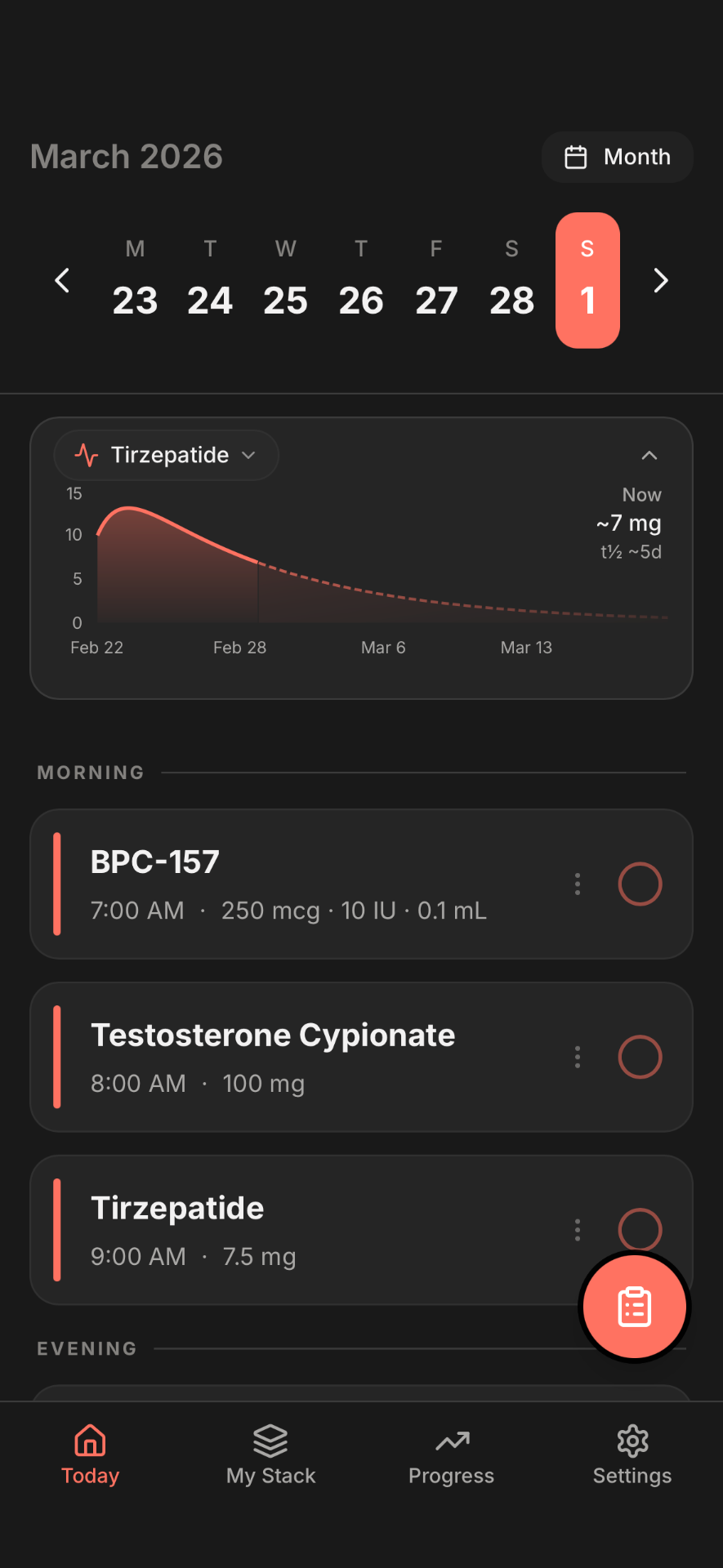
Ready to track your protocol?
- Smart reminders so you never miss a dose
- Progress tracking with photos and weight
- Medication level curves for every compound
Primoteston Depot 250 (testosterone enanthate)
- 250mg testosterone enanthate in 1mL ampoule.
- Injection schedule: Every 1-3 weeks (commonly every 2 weeks on PBS).
- Can be self-administered after training.
- PBS: up to $25 (general) / $7.70 (concession) per ampoule.
- Pros: Flexible dosing, can self-inject, well-established with predictable PK.
- Cons: More frequent injections than Reandron. Glass ampoules can be fiddly.
Sustanon 250
- Four-ester testosterone blend in 1mL ampoule (same as UK).
- Every 2-3 weeks. PBS-listed.
- Multi-ester blend provides both fast and sustained release.
- Complex pharmacokinetics, significant peaks and troughs with fortnightly dosing.
- Licensed for deep intramuscular injection only.
Peanut allergy warning. Sustanon 250 is dissolved in arachis oil, which is peanut oil. It is contraindicated in anyone allergic to peanuts, and because peanut and soya allergy can occur together, people with a soya allergy should avoid it too. If either applies to you, tell your prescriber before you are given Sustanon and ask about an alternative. Reandron and Primoteston do not contain arachis oil: Reandron is in benzyl benzoate and castor oil, and Primoteston Depot is in benzyl benzoate and castor oil as well. Check the leaflet in your own pack.
Compounding pharmacy options
Australia has a well-established compounding pharmacy system. Common compounded preparations:
- Testosterone cream (typically 50-100mg/mL, applied daily to forearms or scrotum)
- Testosterone troches (sublingual lozenges)
- Testosterone cypionate (not commercially available in Australia but can be compounded)
Compounded preparations are not PBS-subsidised and typically cost $80-150/month.
Cost Comparison
| Preparation | PBS (general) | PBS (concession) | Private/compounded |
|---|---|---|---|
| Reandron 1000 (per injection, every ~12 weeks) | up to $25 | $7.70 | $180-250 |
| Primoteston Depot 250 (per ampoule) | up to $25 | $7.70 | $40-60 |
| Sustanon 250 (per ampoule) | up to $25 | $7.70 | $40-60 |
| Compounded cream (per month) | N/A | N/A | $80-150 |
| Compounded troches (per month) | N/A | N/A | $60-120 |
Safety net: Once you reach the PBS Safety Net threshold ($1,748.20 general / $277.20 concession from 1 January 2026), your scripts become cheaper for the rest of the calendar year: free for concession card holders, and up to $7.70 for general patients.
Monitoring Requirements
- Blood work every 6 months initially, then annually once stable.
- Tests to monitor: Total testosterone, free testosterone, SHBG, haematocrit (FBC), PSA, liver function, lipids, oestradiol.
- Haematocrit threshold: Australian guidelines flag concern at haematocrit above 0.52 (52%). Action required above 0.54 (54%).
- PSA: Annual monitoring. Rising PSA requires urology referral.
Blood donation for haematocrit management
The Australian Red Cross Lifeblood accepts blood donations. Men can donate whole blood every 12 weeks. If your haematocrit is trending high on TRT, regular blood donation is the most common management strategy. TRT use does NOT disqualify you from donating.
Tracking Your TRT Protocol
Whether you are on 12-weekly Reandron, fortnightly Primoteston, or daily compounded cream, keeping track of injections, doses, and blood work matters - especially for PBS authority renewals where documented compliance helps. Regimen works with any testosterone preparation and injection interval available in Australia.
Frequently Asked Questions
Is TRT covered by PBS in Australia?
Yes. Testosterone is PBS-listed for confirmed androgen deficiency. The qualifying level is total testosterone below 6 nmol/L, measured on at least two separate days, or between 6 and 15 nmol/L with LH above 1.5 times the upper limit of the young-male reference range or above 14 IU/L. The threshold was lowered from 8 nmol/L, so older guidance overstates who qualifies. It needs specialist confirmation and an authority prescription.
How much does TRT cost in Australia with PBS?
Up to $25 per script at the general rate, or $7.70 with a concession card, since the general co-payment was reduced from $31.60 on 1 January 2026. This covers Reandron, Primoteston, and Sustanon.
Does Sustanon contain peanut oil?
Yes. Sustanon 250 is dissolved in arachis oil, which is peanut oil. It is contraindicated in anyone allergic to peanuts, and because peanut and soya allergy can occur together, people with a soya allergy should avoid it too. Reandron and Primoteston Depot do not contain arachis oil. Tell your prescriber about either allergy before you are given Sustanon.
Can I get testosterone cypionate in Australia?
Testosterone cypionate is not commercially available but can be compounded by specialty pharmacies. It is not PBS-subsidised and costs around $80-150/month.
How often do I need blood tests on TRT in Australia?
Every 6 months initially, then annually once stable. Tests should include total testosterone, free testosterone, haematocrit, PSA, liver function, and lipids.
Track your Australian TRT protocol with Regimen - works with Reandron, Primoteston, Sustanon, and compounded preparations. Free for one compound.
Regimen is a tracking tool, not a medical service. We do not provide medical advice. Always consult your healthcare professional before starting, changing, or stopping any medication protocol.
Sources
- PBS fees and Safety Net thresholds: the $25.00 general co-payment, the $7.70 concessional rate and the 2026 Safety Net thresholds, effective 1 January 2026.
- Current guidelines for prescribing testosterone on the PBS, Lawley Pharmaceuticals: the qualifying level lowered from 8 nmol/L to 6 nmol/L, and the specialist categories.
- Diagnosing and treating androgen deficiency in men, Healthy Male: the LH criterion and repeat-testing requirement.
- Sustanon 250 SmPC: arachis oil excipient, peanut and soya contraindication, deep intramuscular route.
PBS criteria change. Confirm current status at pbs.gov.au before making treatment decisions.