You’ve drawn up your retatrutide and now you’re standing there with the syringe, not totally sure where it’s supposed to go. Short version on where to inject reta: into the fat just under your skin. Most people use the stomach, thigh, or back of the arm. Here’s where each spot is and how to rotate so you’re not hitting the same place every week.
The Bottom Line
Where to inject retatrutide: subcutaneously, at one of four reliable sites, abdomen (left/right of the navel), upper thigh (front/outer), upper outer glute, and upper arm. Volumes are small (0.05-0.25 mL at typical microdose concentrations), so a 29-31G, 5/16” insulin syringe is the standard. Rotate every injection, even on a weekly cadence.
Reta injection sites, specifically: which spots actually work, what makes reta different from semaglutide and tirzepatide site-wise, and a rotation pattern you can stick with on a weekly cadence.
If you want the full primer on SubQ vs IM and all seven subcutaneous sites in detail, our broader peptide injection sites guide covers that. This page sticks to what’s specific about retatrutide.
Best Retatrutide Injection Sites
Retatrutide goes subcutaneously, into the fat just under the skin, not into muscle. There are four places that reliably work:
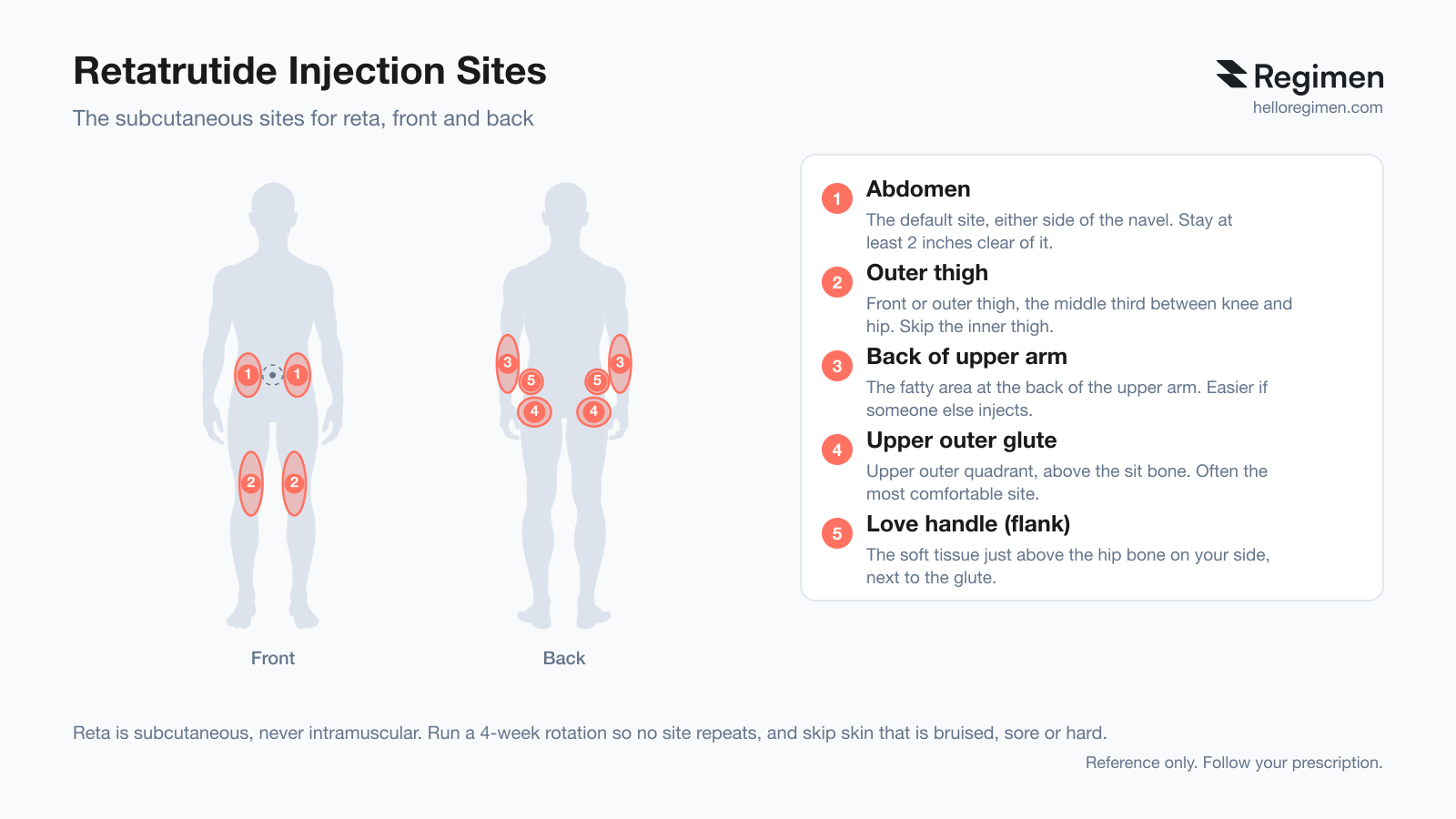
- Abdomen - the default. Stay at least 2 inches from the navel, skip the midline, avoid visible veins. Easy to reach, consistent absorption, and most people have enough fat here even when lean.
- Upper thigh (front/outer) - middle third between knee and hip. Pinch a fold; if you can grab tissue, it works. Skip the inner thigh - more nerve endings, more sting.
- Upper outer glute - upper-outer quadrant of the buttock, above the sit bone. Often reported as the most comfortable site, though comfort is individual and no innervation comparison has been published. Use a mirror or inject standing.
- Upper arm (back/tricep) - viable if you have enough fat to pinch, but hardest to self-inject. Many weekly injectors skip arms entirely and that’s fine.
The Bottom Line
Reta-specific note: because injection volumes are tiny (often 5-25 units on an insulin syringe), site choice rarely affects dose accuracy. It affects tissue health. Pick spots you can hit cleanly and rotate them.
Injection Technique
Standard subcutaneous technique applies. Three steps:
Proper subcutaneous technique: pinch & lift a skin fold, insert at 45°, inject slowly over 5–10 seconds.
Use a 29-31 gauge, 5/16 inch (8mm) insulin syringe. At typical microdose concentrations (2-4 mg/mL), a weekly 1 mg dose lands at 0.25-0.5 mL - well within an insulin syringe’s accuracy range. For a deeper walkthrough on reading the syringe markings, see our insulin syringe guide. For the unit count itself, run your vial through the retatrutide reconstitution calculator.
Rotation Pattern for Weekly Retatrutide
Most retatrutide protocols are once-weekly. Pinning four times a month sounds infrequent enough that rotation shouldn’t matter, but it does. Injecting the same square inch every Sunday for six months is more than enough to develop lipohypertrophy, and the resulting unpredictable absorption is one of the underdiagnosed causes of “my dose stopped working.”
A simple 4-week rotation:
| Week | Site |
|---|---|
| 1 | Left abdomen |
| 2 | Right thigh |
| 3 | Right abdomen |
| 4 | Left thigh |
| 5+ | Repeat, micro-shifting 1-2 inches within each site |
Add glutes if you want a 6-week cycle. Track where you jabbed each week - it’s the only way to stay honest about rotation, since memory is unreliable across months.
How Retatrutide Differs from Semaglutide and Tirzepatide
Site mechanics are identical - all three are SubQ. On absorption, the labelled GLP-1s (semaglutide, tirzepatide) show similar exposure across abdomen, thigh and upper arm; nothing comparable has been published for retatrutide or for the glute, so assume rather than assert equivalence. What’s different:
- Injection site reactions are slightly more common with reta than with tirz in Phase 2 data - mild redness, itching, transient swelling. Aggressive rotation matters more here than on tirz.
- Volumes are usually smaller. Microdosed reta often runs 0.05-0.25 mL per shot versus 0.25-0.5 mL for branded tirz pens. An insulin syringe is the right tool.
- Weekly cadence is the standard. Some users split into twice-weekly to smooth side effects. If you split, treat each shot as its own rotation step (so 8-site rotation instead of 4).
When to Skip a Site
- Bruising or lingering tenderness from a previous injection
- Any visible lump, hardness, or dimpling (early lipohypertrophy)
- Active rash, broken skin, or recent shaving nicks
- Tattoos, moles, or scars (move at least 1 inch away)
If a site stays sore for more than 48 hours after injection, give that whole region, not just the exact spot, a 4-6 week rest before you jab there again.
Frequently Asked Questions
Where do you inject retatrutide?
Retatrutide is injected subcutaneously into the abdomen (at least 2 inches from the navel), the front or outer upper thigh, or the upper outer glute. Upper arms work for people with enough subcutaneous fat there. Rotation is about tissue health rather than dose response: for semaglutide and tirzepatide the manufacturers found similar exposure across abdomen, thigh and upper arm. Retatrutide has no approved label and no published site-comparison data, and the glute is not a site any GLP-1 label lists, so treat cross-site equivalence for reta as a reasonable assumption rather than a measured fact.
Is retatrutide subcutaneous or intramuscular?
Subcutaneous (SubQ). The Phase 2 and Phase 3 trial protocols, and every community microdosing protocol we’ve seen, use SubQ. There is no published or community use case for IM retatrutide, and the small injection volume makes SubQ the obvious route.
How often should you rotate retatrutide injection sites?
Rotate every injection. Even on a weekly schedule, returning to the exact same spot week after week is enough to develop lipohypertrophy over a few months. A simple 4-site rotation (left abdomen, right thigh, right abdomen, left thigh) gives each spot ~4 weeks to recover.
Can injection site choice affect retatrutide side effects?
Site choice doesn’t meaningfully change GI side effect intensity, since absorption rates are similar across SubQ sites. But injecting into damaged tissue (lipohypertrophy) absorbs unpredictably and can produce more erratic side effects week to week. Site rotation is more about consistency than reducing nausea.
What needle size is best for retatrutide?
Most people use a 29-31 gauge, 5/16 inch (8mm) insulin syringe. Retatrutide injection volumes are small (often 0.05-0.25 mL at typical microdose concentrations), so an insulin syringe gives the most accurate measurement and least painful injection.
Can you inject retatrutide in your glute?
Yes, and plenty of people prefer it. Use the upper outer quadrant of the buttock, above the sit bone, and keep it subcutaneous rather than deep into the muscle. Many people find it the most comfortable of the four sites, though that is individual and not something any published comparison establishes. Injecting standing up or using a mirror makes it easier to reach.
Can you inject retatrutide in your thigh?
Yes. Use the front or outer thigh in the middle third between knee and hip, and pinch a fold first: if you can grab tissue, there is enough fat to inject into. Skip the inner thigh, which has more nerve endings and stings more.
Is it better to inject retatrutide in the thigh or the stomach?
Neither absorbs meaningfully faster, so pick on comfort and reach rather than results. The abdomen is the default because it is the easiest to see and usually has the most tissue to work with. The thigh is a good alternative when the abdomen is sore or bruised, which is exactly what rotating between them is for.
Can you inject retatrutide into love handles?
Yes. The flank, or love handle, is the soft tissue just above the hip bone on your side, and it usually has a generous fat layer, which makes it a comfortable spot. Treat it as its own site sitting next to the upper glute rather than part of the abdomen, and keep each injection 1 to 2 inches from the last.
How do you inject retatrutide in the stomach?
Pick a spot at least 2 inches from the navel, avoiding the midline and any visible veins. Pinch and lift a fold of skin and insert at 45 degrees, the same technique the section above covers. Push slowly, and keep the next injection 1 to 2 inches away from this one.
Where’s the best place to pin reta?
The abdomen, for most people. It’s the easiest place to reach one-handed, there’s usually enough tissue to pinch even if you’re lean, and absorption is consistent. The upper outer glute and the front-outer thigh are the next two spots worth building into your rotation. Whichever location you start with, the thing that matters more than which one you pick is moving somewhere new every week.
Is there a best place to inject retatrutide for results?
No published data says one site absorbs retatrutide better than another. For the labelled GLP-1s, exposure looks similar across abdomen, thigh and upper arm, and nothing comparable has been published for retatrutide or for the glute. So the most effective place is the one you can reach cleanly, hit without bruising, and move away from next week. Rotation matters more than which of the four you pick.
Where else can you inject retatrutide?
Beyond the abdomen there are three more places: the front-outer thigh, the upper outer glute, and the back of the upper arm. You cannot jab it just anywhere, though. It goes into subcutaneous fat, so you need somewhere you can pinch a fold, which rules out thin or muscular areas. Within those four you still have plenty of room to shift an inch or two each week, and that small movement is where most of the benefit of rotation comes from.
Related Reading
- Peptide injection sites: SubQ vs IM, the full primer
- Retatrutide dosing guide
- Retatrutide reconstitution calculator and guide
- Microdosing retatrutide: what lean users actually run
- Retatrutide side effects guide
This article is for educational purposes only and is not medical advice. Talk to a licensed clinician before starting, changing, or stopping any medication.
Ready to track your GLP-1?
- Smart reminders so you never miss a dose
- Track weight, photos, and progress over time
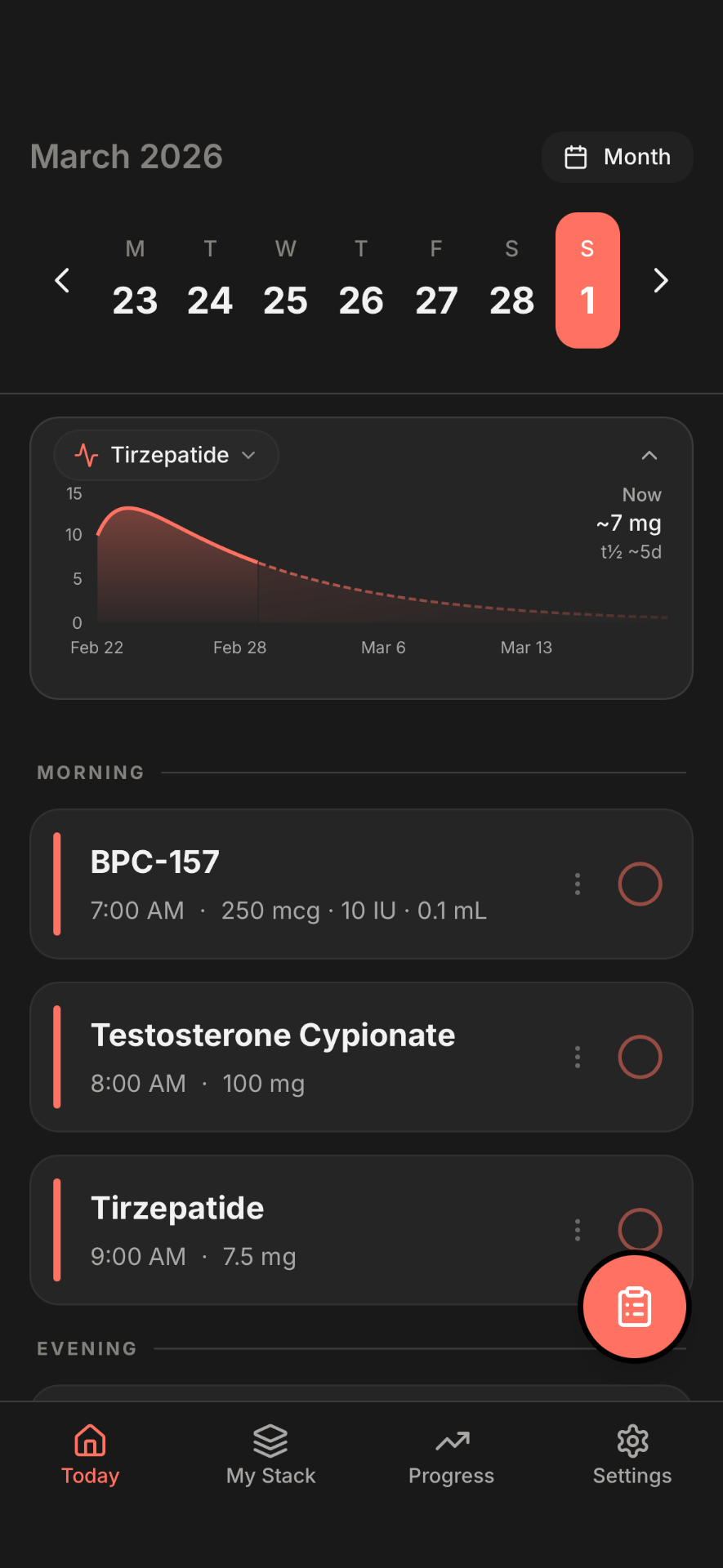
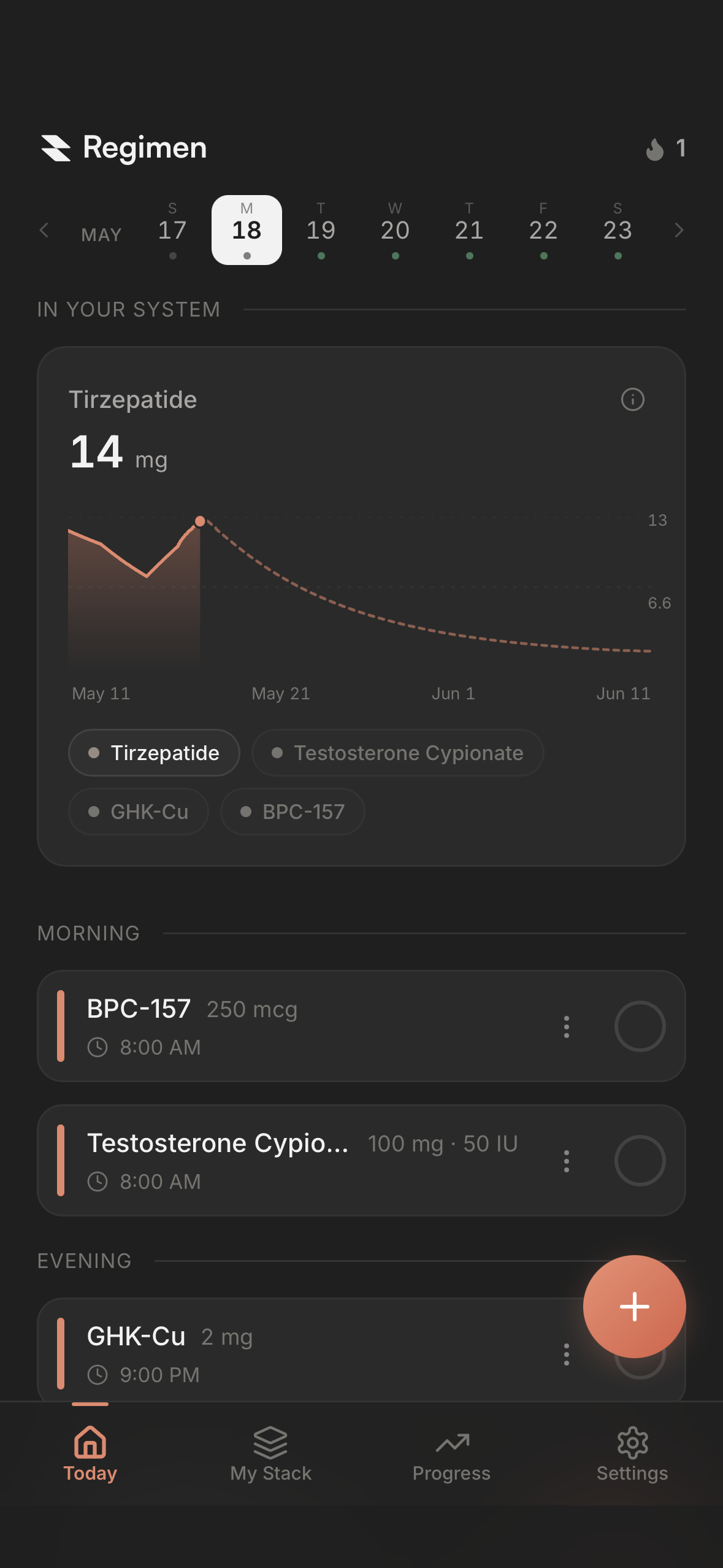
- Medication level curves for every compound