Retatrutide is investigational and not FDA-approved. This article summarizes published trial data and community reports. It is educational, not medical advice.
Does retatrutide raise your heart rate?
Yes, in a dose-dependent way. In the phase 2 obesity trial the heart-rate rise peaked around week 24, then eased back by weeks 36 to 48. Reta also lowers blood pressure. And the “burning skin” reports going around are partly real: the phase 3 data shows a skin-burning (dysesthesia) signal at the 8 to 12 mg trial doses. Here is the actual evidence versus the forum talk.
You have probably seen someone say reta “runs your heart hot.” If you are deciding whether that is a dealbreaker, you want the real numbers, not vibes. Reta is still investigational, so the good data comes from trials, and the scary-sounding stuff usually comes from forums. We will keep those separate.
Does retatrutide raise your heart rate?
Does reta increase heart rate? Yes. In the phase 2 obesity trial (Jastreboff, NEJM 2023, Tier A), the retatrutide heart rate increase was dose-dependent, peaked at week 24, then declined at weeks 36 and 48. The researchers tied it to a known effect of glucagon and GLP-1 on the heart.
For context, the approved cousins raise resting heart rate less: tirzepatide by about 1 to 3 bpm on average, semaglutide by about 1 to 4 bpm. The reta heart rate rise is more noticeable, which fits its extra glucagon activity. The phase 3 obesity readout has not published a clean beat-by-beat curve yet, so the honest summary is: dose-dependent, peaks around week 24, then partly settles.
The glucagon difference (why reta is not just another GLP-1)
Reta hits three receptors, and the third one (glucagon) is what sets it apart. Glucagon activity is linked to higher energy expenditure, which is part of why reta drives such strong fat loss. It is also the likely reason for the heart-rate and “warmth” effects. Worth knowing so the cardiovascular stuff makes sense instead of feeling random. If you want the full mechanism breakdown, see the reta vs tirz comparison.
The “burning skin” reports, and what the trials call it
People online describe running hot, sweating, or a burning-skin feeling. The trials do not publish a rate for “feeling hot,” so we cannot give you a clean number there (that is a genuine gap, not proof it does not happen). But phase 3 TRIUMPH-1 (Tier B, ADA 2026 symposium) did track dysesthesia, defined as a skin-burning sensation.
The rates, and this is important context: 5.1% at 4 mg, 12.3% at 9 mg, and 12.5% at 12 mg, versus 0.9% on placebo. Those are the 4, 9, and 12 mg trial arms. Most people running reta outside a trial microdose far lower (often 0.5 to 4 mg), so their odds are on the low end of that range or below it. The burning-skin theme has a real trial fingerprint, but it clusters at the higher doses.
Blood pressure actually goes down
Good news that surprises people: reta lowers blood pressure. In phase 3, systolic pressure dropped about 8.5 mmHg at 4 mg, 11.3 at 9 mg, and 12.3 at 12 mg by week 80, versus about 1 mmHg on placebo.
The flip side: a hypotension and lightheadedness signal that climbed with dose (2.7% at 4 mg, 5.3% at 9 mg, 8.8% at 12 mg vs 0.9% placebo), and it was more common in people already on blood-pressure medication. If that is you, it is worth a conversation with your prescriber about whether your current BP meds still fit once you have been on reta a few weeks.
When to check in with your provider
A few patterns worth flagging, none of them “panic,” all of them “log it and ask”:
- A resting heart rate that stays elevated for weeks and does not settle
- A pounding or racing heart at rest, not tied to exercise or stress
- Dizziness or lightheadedness when you stand up, especially on BP medication
- Chest pain, shortness of breath, or fainting (call now, do not wait)
What people actually report (community, not trial data)
In community posts the recurring cardiovascular themes are running warm or sweating and a modest resting-heart-rate bump (one user logged 58 to 67 bpm at a 10 mg dose). These are anecdotes: no verified drug source, no denominator, no control group, so read them as “this happens to some people,” not as rates. What is useful is that they line up directionally with the trial signals, and they are usually milder at the lower doses people actually run. If your heart rate bump is showing up alongside real tiredness, the reta fatigue write-up covers where those two overlap.
Cardiovascular profile: reta vs the approved cousins
| Drug | Resting HR change | Blood pressure | Distinctive cardio signal |
|---|---|---|---|
| Retatrutide | Dose-dependent, peaks ~week 24, partly settles | Down 8 to 12 mmHg systolic (phase 3) | Dysesthesia (skin-burning) at 8 to 12 mg; hypotension signal on BP meds |
| Tirzepatide | ~1 to 3 bpm on average | Down, modestly | Primarily GI drug; cardio effects modest |
| Semaglutide | ~1 to 4 bpm on average | Down, modestly | Primarily GI drug; cardio effects modest |
Frequently Asked Questions
Does retatrutide raise or lower blood pressure?
Lowers it. Phase 3 showed systolic drops of about 8 to 12 mmHg by week 80. The trade-off is a lightheadedness and hypotension signal at higher doses, especially in people on BP medication, which is worth a prescriber conversation.
Should I worry about my heart on retatrutide?
Awareness, not worry. A modest heart-rate rise is expected. What is worth flagging to your provider is a resting rate that stays elevated for weeks, a racing or pounding heart at rest, dizziness on standing (especially on BP meds), or anything that feels wrong. Chest pain, shortness of breath, or fainting are not log-and-ask symptoms; call now.
Does retatrutide increase heart rate permanently?
The published data suggests no. In the phase 2 trial the increase peaked around week 24 and then eased back by weeks 36 to 48 at a stable dose. Longer-term follow-up will tell us more, but the pattern so far is peak then partial settle, not permanent climb.
How much does retatrutide raise heart rate?
Trial-level averages have not been published as a single bpm number the way they have for tirzepatide and semaglutide. What we know is that the rise is dose-dependent and more noticeable than either tirz (about 1 to 3 bpm) or sema (about 1 to 4 bpm). Individual responses vary, and community reports at microdoses tend to run milder than the trial-dose picture.
Does retatrutide raise or lower blood pressure?
Lowers it, meaningfully. Phase 3 showed systolic drops of about 8 to 12 mmHg by week 80. The trade-off is a lightheadedness and hypotension signal at higher doses, especially in people on BP medication, which is worth a prescriber conversation.
Is the “burning skin” feeling on retatrutide real?
Yes, at higher doses. Phase 3 TRIUMPH-1 tracked dysesthesia (skin-burning sensation) at 5.1% on 4 mg, 12.3% on 9 mg, and 12.5% on 12 mg, versus 0.9% on placebo. Most people running reta outside a trial dose lower than that, so their odds are on the lower end.
Should I worry about my heart on retatrutide?
Worry is the wrong frame; awareness is the right one. A modest heart-rate rise is expected. What is worth flagging to your provider is a resting rate that stays elevated for weeks, a racing or pounding heart at rest, dizziness on standing (especially on BP meds), or anything that feels wrong. Chest pain, shortness of breath, or fainting are not “log and ask” symptoms; call now.
Can I take retatrutide if I am on blood pressure medication?
That is a prescriber conversation. Reta lowers blood pressure, which stacks with the meds you are already on and can push you into feeling lightheaded. Some people end up dose-adjusting their BP medication after a few weeks on reta. Do not change any prescribed dose on your own.
What to track
If you want to actually see your own pattern instead of guessing from forum posts, the useful things to log:
- Resting heart rate first thing in the morning (same conditions each time)
- Blood pressure if you have a cuff at home, especially in the first 8 weeks and around each dose increase
- “Feeling hot” or dysesthesia episodes, tied to which dose you were on
- Dose changes with dates, so the timeline is legible
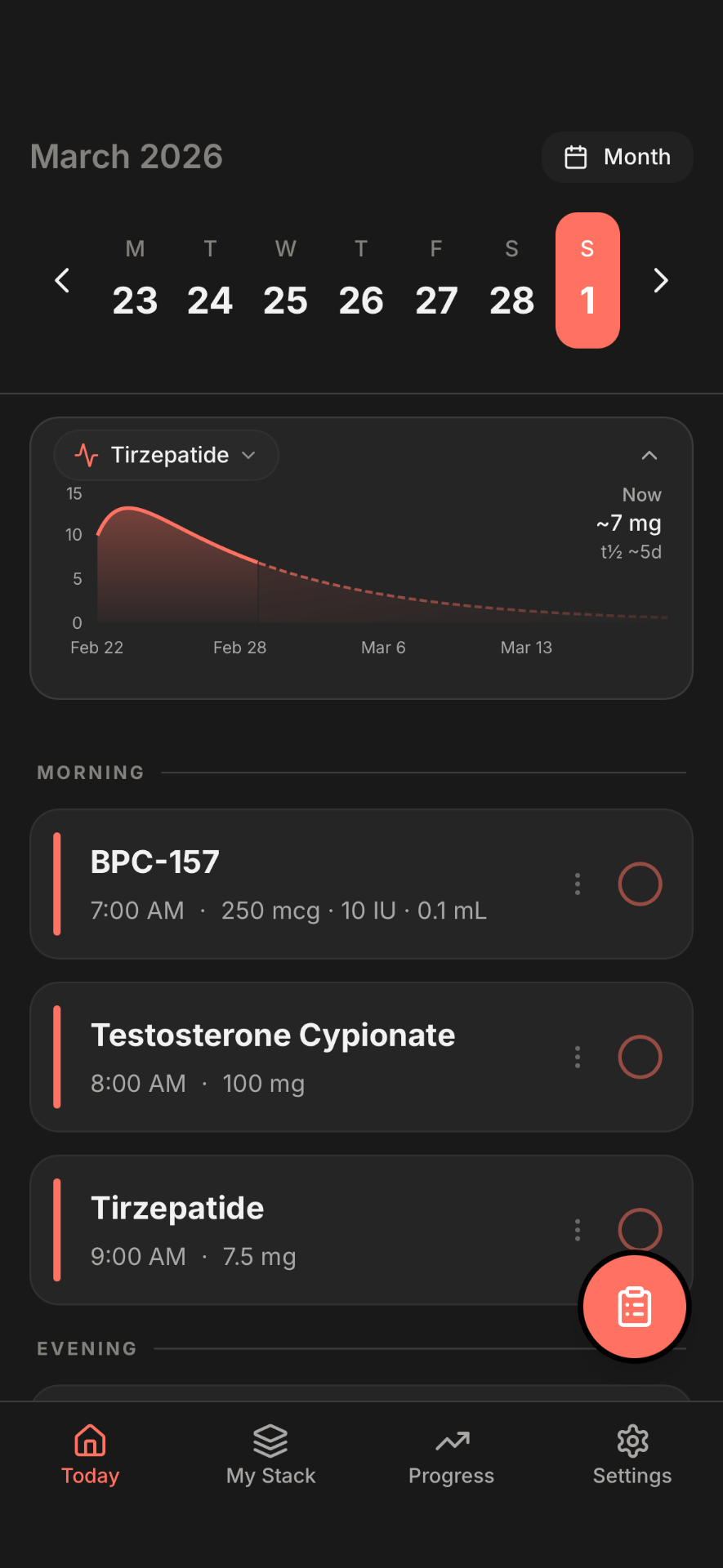
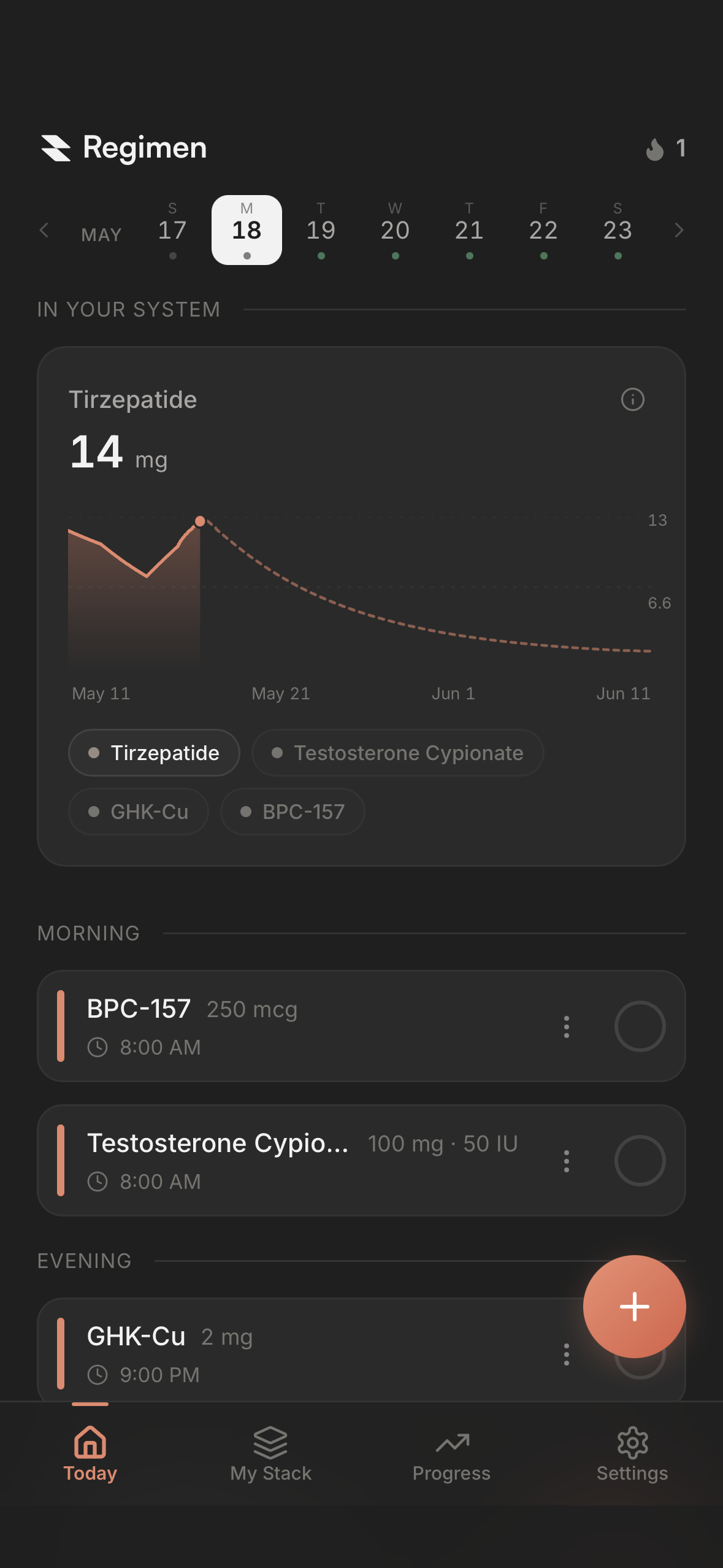
The Regimen retatrutide tracker handles heart rate, blood pressure, and custom symptom markers alongside your dose log, so the cardio picture is visible against your actual titration instead of held in memory. Free for one compound.
Related reading
- Retatrutide Side Effects: What to Expect, Start to Finish (the hub)
- Retatrutide Fatigue: Why You Are Tired and What Helps
- Retatrutide Dosing Guide: How to Titrate
- Retatrutide Tracker
This article summarizes published trial data (phase 2 NEJM 2023 and phase 3 TRIUMPH-1 symposium data) and community reports. It is not medical advice. Retatrutide is investigational; talk to a licensed provider before starting, changing, or stopping any medication.
Ready to track your GLP-1?
- Smart reminders so you never miss a dose
- Track weight, photos, and progress over time
- Medication level curves for every compound