You’ve done the hard part. You found a provider, got your protocol, maybe even figured out reconstitution without panicking. Now you’re three weeks in and wondering: am I doing this right?
Probably. But “probably” isn’t a strategy. Here are seven things that separate the people posting transformation photos from the people quietly quitting at month three.
These aren’t theoretical. They come from clinical pharmacology, thousands of community reports across Reddit and Discord, and patterns we see repeatedly in users who stick with their protocols long enough to get real results.
In this article:
- Rotate Your Injection Sites
- Time Your Doses to Your Life
- Take Progress Photos
- Learn Your Side Effect Patterns
- Don’t Touch Your Dose for 6 Weeks
- Prioritize Protein
- Review Monthly, Not Daily
- FAQs
1. Rotate Your Injection Sites (Yes, It Actually Matters)
Here’s something most starter guides skip: scar tissue builds up invisibly, and it tanks your absorption.
There’s a post on r/Testosterone that gets referenced constantly. Someone was stuck at the same levels for four months, changed nothing except switching from stomach to upper arm, and their next blood draw came back noticeably higher. Same dose, same compound, different tissue.
It makes sense pharmacologically. Subcutaneous absorption depends on local blood flow and tissue integrity. Hit the same half-inch patch three times a week for two months and you’re injecting into a tiny knot of scar tissue that absorbs like a sponge wrung dry.
The fix is simple: rotate systematically. Left abdomen, right abdomen, left thigh, right thigh, upper arms. Some people use a simple pattern they remember. Others track sites so they don’t accidentally repeat before a full cycle.
Community Insight
“I was injecting semaglutide in my left stomach every single week for 3 months. Switched to my thigh and the nausea came back like week one. Same dose. The tissue was just absorbing differently.”
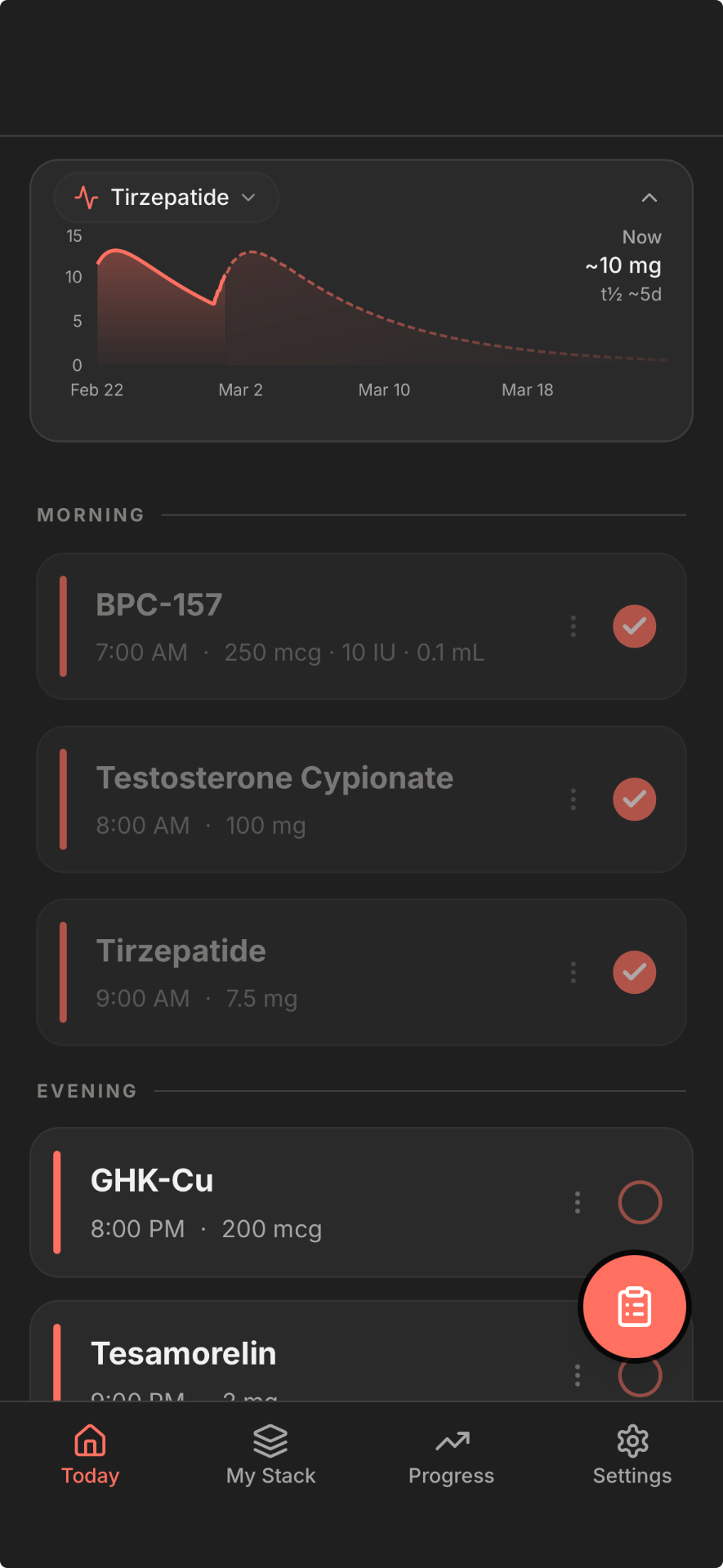
Tracking injection sites prevents the invisible scar tissue problem
2. Time Your Doses to Your Life, Not Just Your Calendar
Most people pick a day and stick to it without thinking about why that day. But timing matters more than you’d think, and it’s different for every compound.
GLP-1 users:
There’s a consistent pattern on r/Ozempic and r/Zepbound where people who inject Thursday or Friday report fewer issues with weekend social eating. Their appetite suppression peaks right when they’re most likely to overeat. People who inject Monday often feel the medication wearing off by Saturday night, exactly when willpower matters most.
TRT users:
Morning vs. evening injections produce different subjective experiences. Some guys report better sleep injecting in the morning. Others prefer evening because they feel the energy boost the next day. There’s no universal right answer, but there is a right answer for you, and you won’t find it without experimenting.
Split-dose protocols:
If you’re splitting GLP-1 doses into 2-3x per week, spacing matters. Your compound’s half-life determines how quickly levels drop between doses. Uneven spacing creates peaks and valleys that amplify side effects.
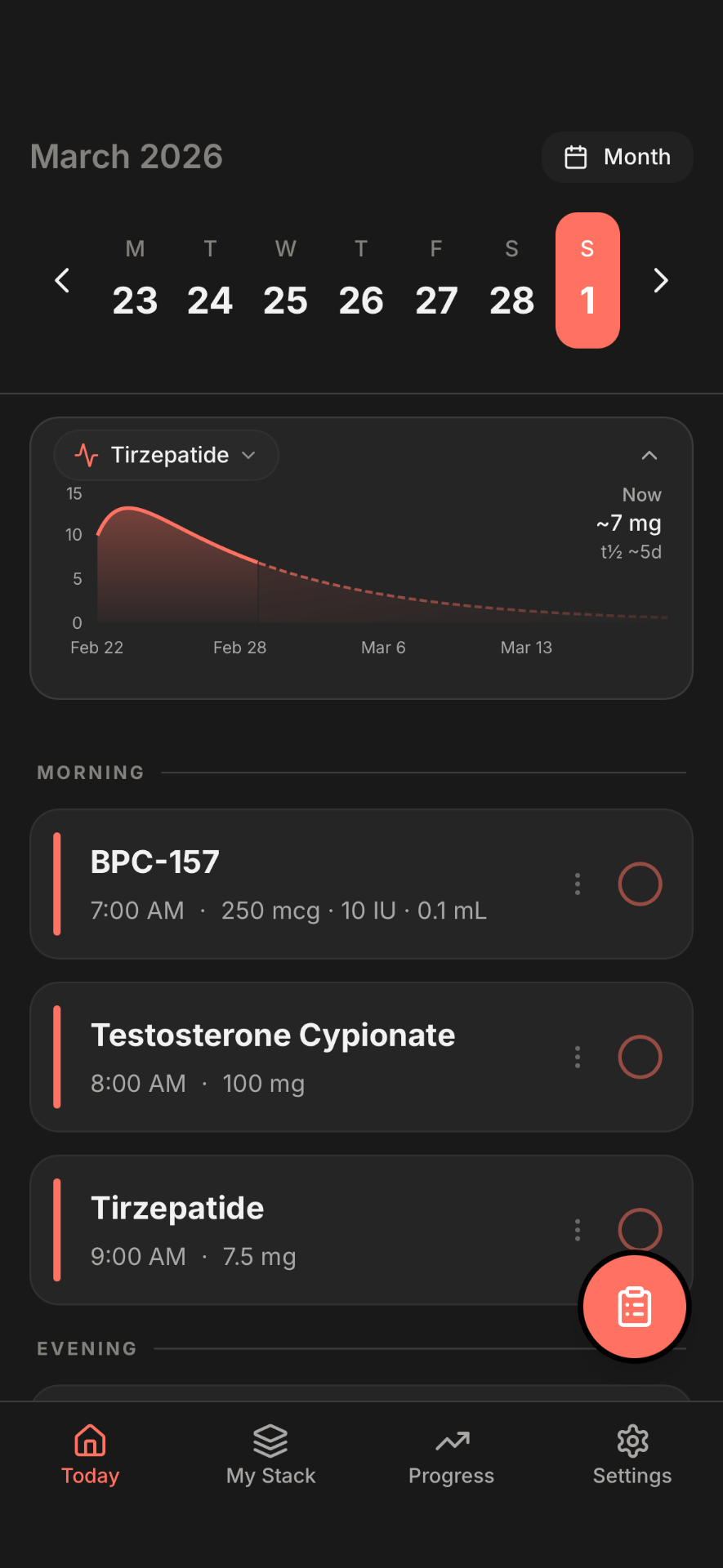
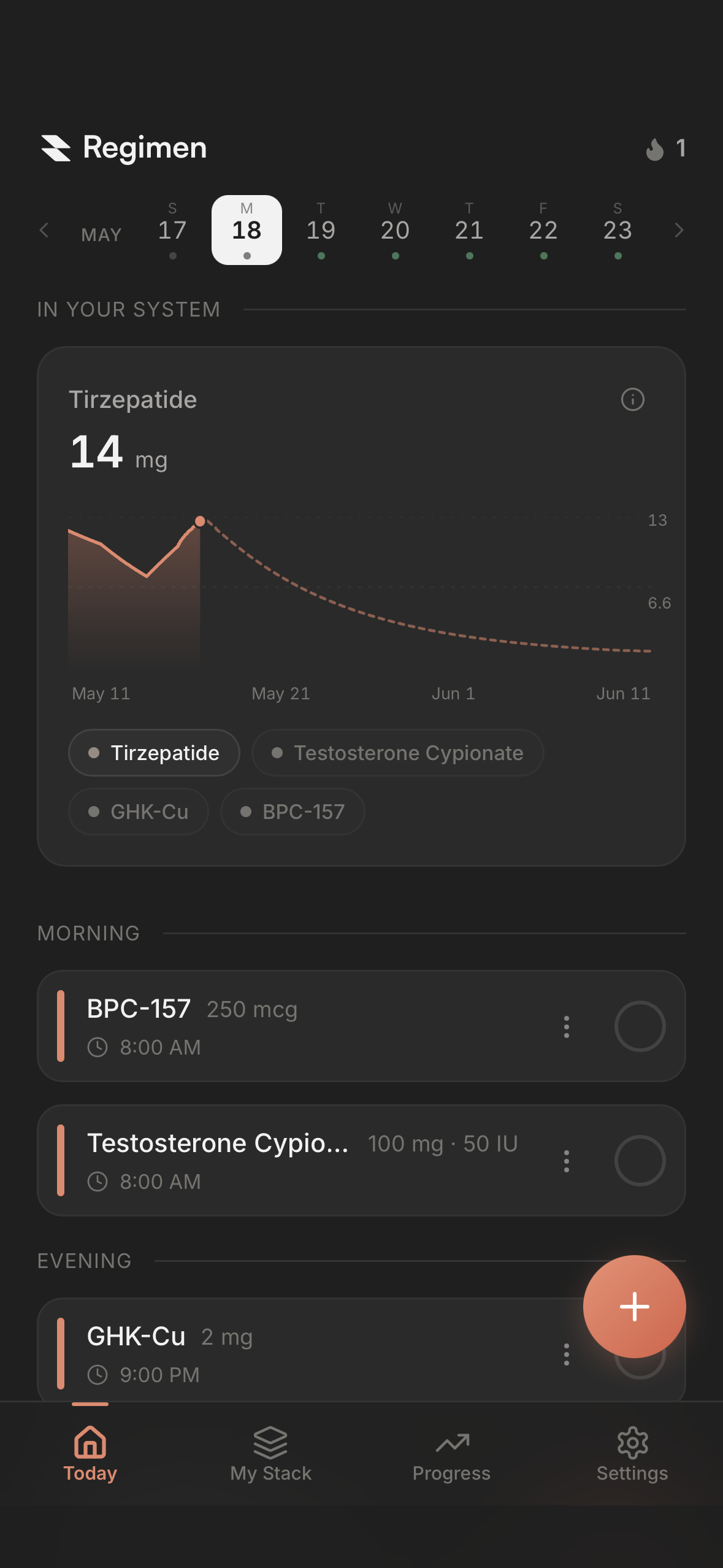
Understanding your compound’s pharmacokinetics helps you time doses for when you want peak levels. The Half-Life Visualizer shows exactly how blood levels fluctuate based on your dosing schedule.
3. Take Progress Photos Even When You Don’t Want To
The scale lies. Not intentionally, but it omits the most important part of the story.
Body recomposition, especially on TRT or while resistance training on GLP-1s, means the number on the scale can stall for weeks while your body is visibly changing. You’re losing fat and gaining muscle simultaneously, and the scale treats both the same.
The people who quit at month three are overwhelmingly the ones who only watched the scale. They lost 15 pounds in month one, 4 pounds in month two, and one pound in month three. Panic. “It stopped working.” Except if they’d taken photos, they’d see their face is leaner, their clothes fit differently, and their midsection is visibly smaller.
From r/progresspics: “The before photo you didn’t take is the one you’ll regret most.” This gets said so often it’s practically a proverb, and it’s true every single time.
Same lighting. Same angle. Same time of day. Once a week or every two weeks. It takes 30 seconds and it’s the single most powerful motivation tool available to you.
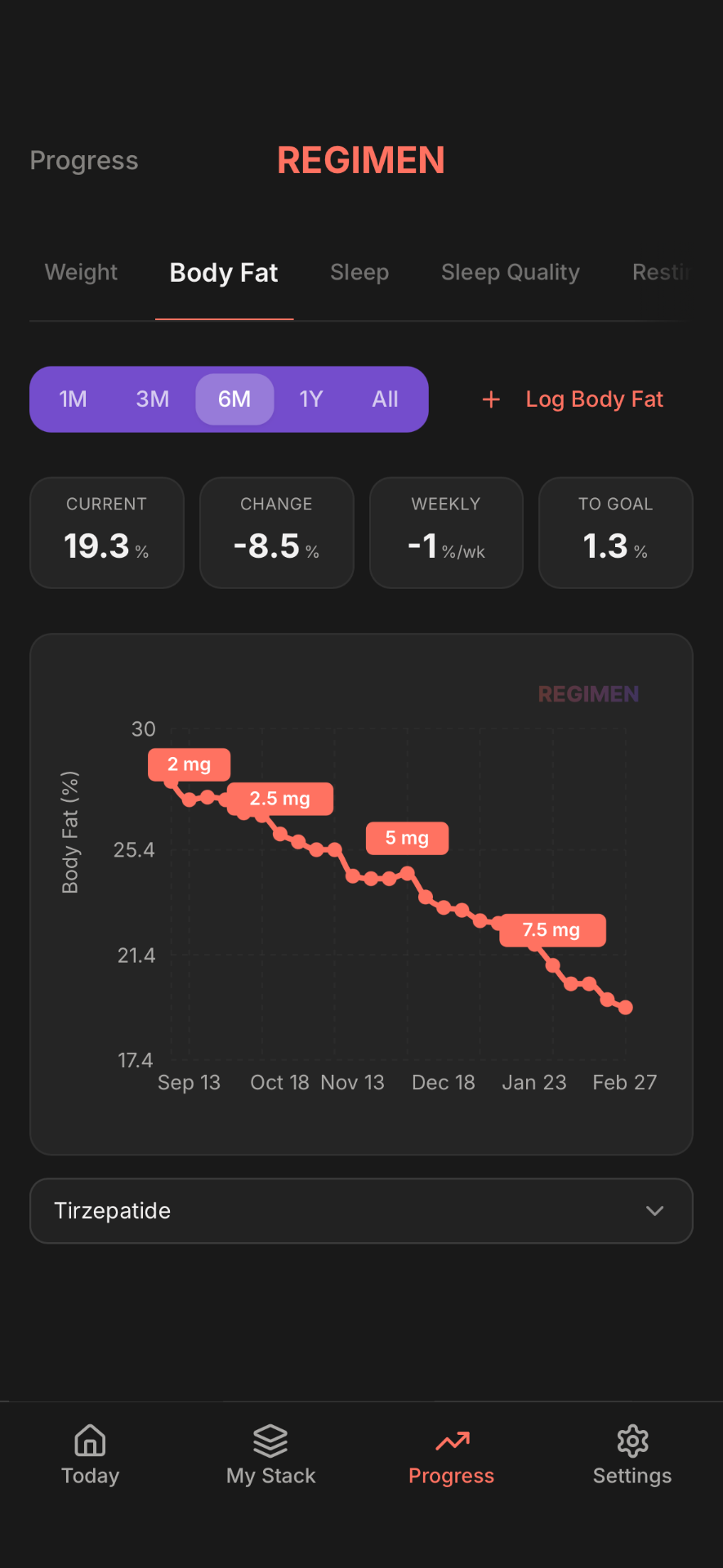
Weekly photos and weigh-ins in one timeline. The scale tells half the story.
4. Learn Your Side Effect Patterns Instead of Fearing Them
Every protocol has a side effect curve, and most people mistake a predictable pattern for a crisis.
GLP-1 nausea
Typically peaks 24-48 hours post-injection and fades by day 4-5. That’s not your body rejecting the medication. That’s the pharmacokinetic curve doing exactly what it’s supposed to do. Knowing this is a pattern (not a red flag) keeps people from panic-quitting during titration.
TRT estrogen symptoms
High estrogen symptoms can often correlate with injection frequency. Guys on once-weekly injections see E2 spike 2-3 days post-injection, right when testosterone aromatization peaks. Switching to more frequent injections flattens that curve and often resolves symptoms without an aromatase inhibitor.
Peptide adjustment
BPC-157 users sometimes report increased fatigue in the first week, which resolves as the body adjusts. TB-500 can cause temporary headaches. These are documented patterns, not reasons to abandon your protocol.
The key is turning subjective feelings into data. When you log how you feel alongside when you inject, patterns emerge fast. Day 2 nausea every single week? That’s useful information, not a reason to stop.
5. Don’t Touch Your Dose for 6 Weeks (Minimum)
This is the habit that separates people who optimize from people who spin their wheels.
Testosterone cypionate has an apparent serum half-life of about 6.9 days (older references quote ~8 days; reconciled here). That means it takes approximately 5-6 half-lives, roughly 5 weeks, to reach steady state after a dose change. Semaglutide’s half-life is about 7 days, so 4-5 weeks to stabilize. If you change your dose after two weeks, you’re reacting to a medication that hasn’t finished loading.
The classic Reddit mistake
“I added HCG, changed my T dose, and started an AI all in the same week.” Now nothing makes sense. Blood levels are chaotic. Side effects could be from any of three variables. And the inevitable follow-up post: “What should I change?”
Everything. You should change everything about your approach to changes. One variable at a time. Six weeks minimum between adjustments. And you need a record of exactly when you changed what, because memory is unreliable and “I think I changed my dose around Thanksgiving” is not useful clinical data.
Having a log of exactly when you changed what, and what happened after, is the difference between optimizing and guessing. Your provider will thank you for it too.
6. Prioritize Protein Like Your Results Depend on It (They Do)
There’s a TRT transformation post that’s been saved thousands of times. The guy lost 60 pounds, put on visible muscle, and his one piece of advice was: “Weight loss happens in the kitchen, not the gym.”
He’s right, and this applies across every protocol category:
GLP-1 users face muscle loss as a real risk. Reduced appetite means you’re eating less of everything, including protein. Studies show GLP-1 patients can lose up to 40% of their weight as lean mass without adequate protein and resistance training.
TRT users have an anabolic advantage they’re wasting if protein intake is inadequate. Testosterone increases muscle protein synthesis, but it needs raw material. Low protein on TRT is like buying premium fuel for an engine with no oil.
Peptide users running recovery compounds like BPC-157 or TB-500 are trying to rebuild tissue. Tissue is made of protein. The math isn’t complicated.
The target: 0.8-1g of protein per pound of your target body weight, daily. Not occasionally. Not “I had a protein shake.” Every day, consistently.
If you’re not sure where you stand calorically, the TDEE Calculator gives you a baseline for maintenance calories and protein targets based on your stats.
7. Review Monthly, Not Daily
Daily scale checking is an anxiety generator, not a progress tracker.
Water retention fluctuates 2-5 pounds day to day. Sodium intake from one meal can mask a week of real progress. A single heavy dinner can undo what looks like three days of work on the scale, except nothing actually changed.
The people who sustain results review their data monthly. They compare photos from four weeks ago. They look at weight trend lines, not individual data points. They ask: “Am I moving in the right direction over 30 days?” not “Why am I up 1.2 pounds since yesterday?”
This mindset shift is especially important during the titration phase of GLP-1s, when dose increases cause water retention changes that temporarily mask fat loss. And on TRT, where initial water retention can add 5-8 pounds in the first month even as body composition is improving.
Zoom out. The daily number is noise. The monthly trend is signal.
The Bottom Line
The protocol is the science. The habits around it are the discipline. And the gap between people who get lasting results and people who quit at month three almost never comes down to the medication itself.
It comes down to whether they rotated sites, timed their doses intelligently, took photos when they didn’t feel like it, understood their side effects instead of fearing them, resisted the urge to change everything at once, ate enough protein, and zoomed out when the daily numbers felt discouraging.
None of this is complicated. But simple and easy aren’t the same thing, and having a system makes the difference between habits that stick and intentions that don’t.
Frequently Asked Questions
How long should I stay on a dose before deciding it’s not working?
At minimum, 5-6 weeks for most injectable compounds. Testosterone cypionate takes about 5 weeks (5 half-lives at ~6.9 days each) to reach steady state. Semaglutide takes 4-5 weeks. If you change doses before that window, you’re reacting to incomplete data.
Does injection site really affect how well my medication works?
Yes. Scar tissue from repeated injections in the same spot reduces absorption over time. Some users report breaking plateaus simply by rotating to a new site. Subcutaneous absorption rates also vary by location (abdomen vs. thigh vs. arm).
How much protein should I eat on a GLP-1 or TRT protocol?
The general recommendation is 0.8-1g per pound of target body weight daily. This is especially important on GLP-1s where reduced appetite can lead to muscle loss, and on TRT where adequate protein supports the muscle-building benefits of testosterone.
Should I weigh myself every day?
Daily weigh-ins create noise and anxiety. Weekly or bi-weekly weigh-ins at the same time (morning, after bathroom, before eating) give you more useful trend data. Monthly photo comparisons are often more motivating than the scale.
What should I do if I get nauseous after my GLP-1 injection?
GLP-1 nausea typically peaks 24-48 hours post-injection and fades by day 4-5. Eating smaller, protein-rich meals, staying hydrated, and avoiding greasy foods helps. If nausea is severe, talk to your provider about split dosing or a slower titration schedule.
Disclaimer: This article is for educational purposes only and is not medical advice. Always consult a qualified healthcare provider before making changes to your protocol. Individual responses to peptides, TRT, and GLP-1 medications vary. Proper medical supervision is recommended.
Ready to track your protocol?
- Smart reminders so you never miss a dose
- Track weight, photos, and progress over time
- Medication level curves for every compound