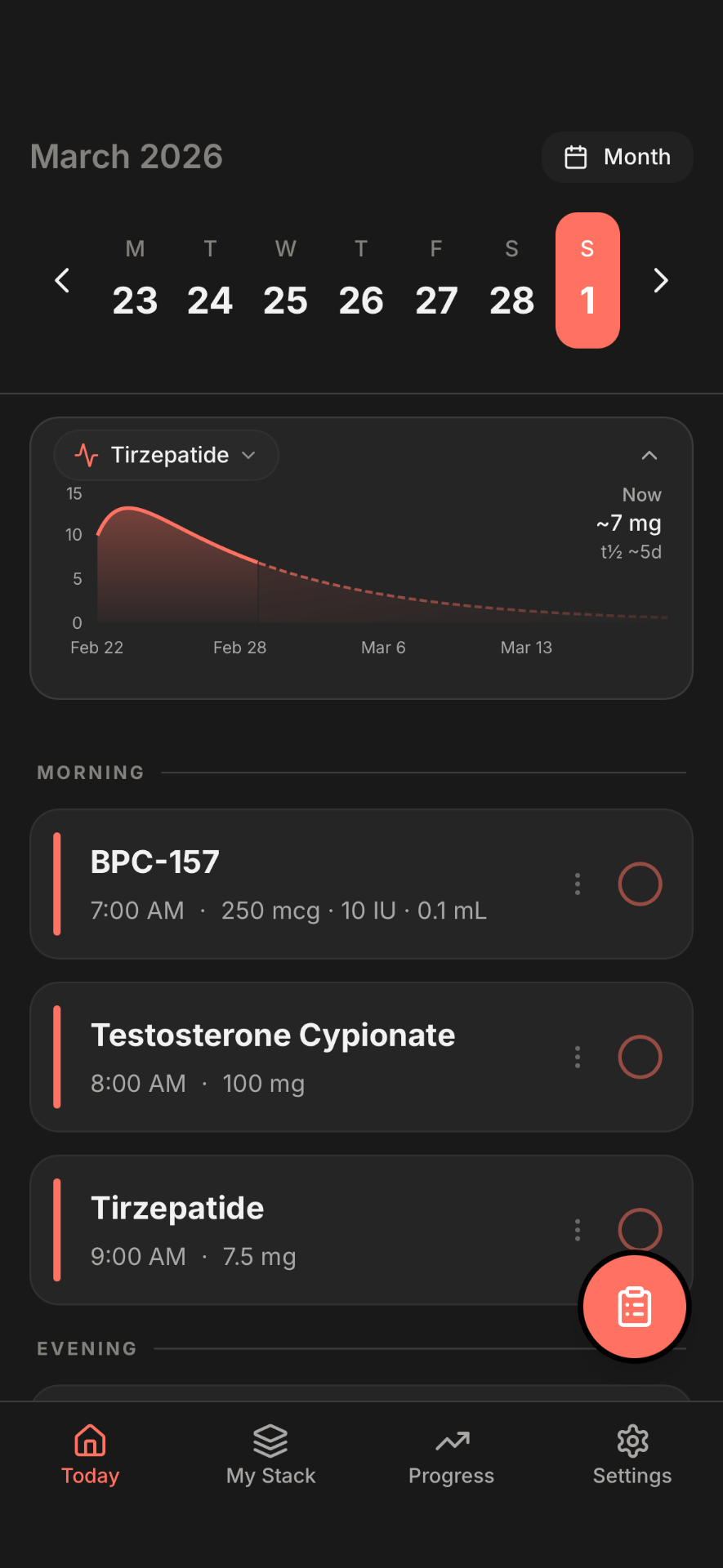
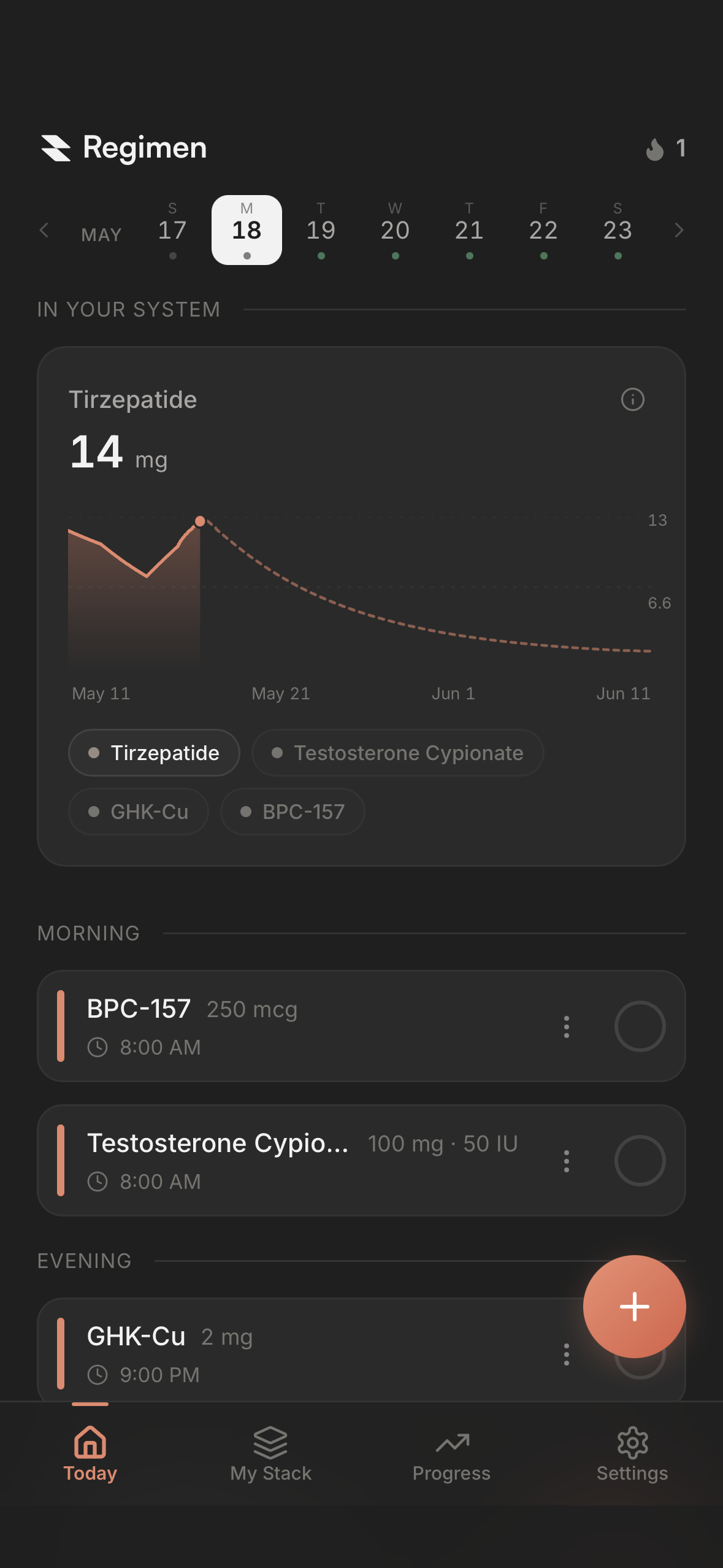
What Is Microdosing GLP-1?
Microdosing GLP-1 means taking a lower weekly dose of a GLP-1 medication, such as tirzepatide (Mounjaro, Zepbound) or semaglutide (Ozempic, Wegovy), than the standard therapeutic range, often split into smaller, more frequent shots. People do it to ease side effects, to hold their weight after losing it, or to make a vial last longer.
It is off-label. The prescribing information (FDA label) for both drugs is one shot a week at set doses, and no randomized trial has tested microdosing. In community reports, people who microdose tirzepatide commonly keep the weekly total at 2.5 mg, the starter dose, or split it into two 1.25 mg shots.
GLP-1 microdosing chart: the low weekly doses people report
| Medication | Low weekly dose | Split into two shots |
|---|---|---|
| Tirzepatide (Mounjaro, Zepbound) | 2.5 mg | 1.25 mg + 1.25 mg |
| Semaglutide (Ozempic, Wegovy) | 0.25-0.5 mg | 0.25 mg + 0.25 mg (for 0.5 mg) |
For comparison, the standard starting doses are 2.5 mg for tirzepatide and 0.25 mg for semaglutide. Retatrutide has no established microdosing protocol; what people actually do with low-dose retatrutide is in our retatrutide microdosing guide. Talk to your prescriber before you lower or split your dose.
Split Dosing vs. Microdosing vs. Dose Stretching
These three terms get used interchangeably online, but they mean different things. Getting this right matters because each strategy has different goals and different risks.
Split dosing
Your prescribed weekly dose, divided into two or more injections. Same total amount, more frequent administration. Goal: reduce peak concentration and side effects.
Microdosing
Taking a lower total weekly dose than the standard therapeutic range. Goal: maintenance after weight loss, milder effect, or tolerability for hyper-responders.
Dose stretching
Extending the interval between doses (e.g., every 10 days instead of 7). Goal: usually cost savings. This is pharmacokinetically different from both split dosing and microdosing.
You can combine strategies. For example, taking a lower total weekly dose and splitting it into two injections. This guide covers all three, but focuses primarily on split dosing and microdosing since those are the most discussed in the GLP-1 community.
Important: All of these approaches are off-label. FDA-approved semaglutide and tirzepatide protocols are once-weekly only. Nothing in this article is medical advice. Always discuss protocol changes with your prescriber.
Why People Microdose GLP-1 Medications
The microdosing trend didn’t start in a doctor’s office. It started in communities like r/Ozempic, r/tirzepatidecompound, and r/GLP1microdosing where people were solving real problems in real time. Here’s what actually drives it:
1. Side effects are dose-dependent and peak-dependent
GLP-1 nausea, vomiting, and fatigue are worst in the 24-48 hours after injection, when blood concentration is highest. Splitting a 2.5mg tirzepatide dose into two 1.25mg injections lowers that peak by roughly 30-40%. For many people, that’s the difference between functional and bedridden. This is the single most common reason people experiment with split dosing, especially at higher dose tiers (10mg+ tirzepatide, 2.4mg semaglutide).
2. Maintenance after weight loss (the rebound problem)
The STEP-1 extension trial showed that participants regained approximately two-thirds of their lost weight within a year of stopping semaglutide. Going from a therapeutic dose to nothing is a recipe for rebound. Instead, many people step down to a maintenance microdose: 0.25-0.5mg semaglutide per week, or 2.5mg tirzepatide, just enough to maintain appetite regulation without the full side effect profile. Think of it as a slow off-ramp instead of driving off a cliff.
3. Athletes and active users need to eat
Bodybuilders, CrossFitters, and endurance athletes want the metabolic benefits (improved insulin sensitivity, better body composition) without the appetite suppression that kills their ability to fuel training. A full therapeutic dose can make it physically difficult to consume 2,500+ calories. A microdose provides a subtler effect: you still have appetite control, but you can actually eat enough to train and recover. This is especially common in the biohacking community where people are already comfortable managing complex injection protocols.
4. Cost management
Brand-name GLP-1s run $900-1,300/month without insurance. Even compounded versions cost $200-400/month. Stretching a single vial across more weeks by using a lower weekly dose cuts monthly cost significantly. This is particularly common among people who’ve hit their target weight and want to maintain without paying full price for a dose they no longer need.
5. Medication sensitivity (hyper-responders)
Some people get significant appetite suppression and side effects even at the lowest starting dose (0.25mg semaglutide or 2.5mg tirzepatide). For these hyper-responders, splitting even the starter dose into two injections makes the medication tolerable. Without this option, they’d have to stop entirely.
Microdosing Semaglutide: Split-Dose and Low-Dose Chart
These are the most commonly discussed semaglutide microdosing protocols. None are FDA-approved. Always work with your prescriber.
| Protocol | Weekly Total | Per Injection | Use Case |
|---|---|---|---|
| 2x/week split | 0.5mg | 0.25mg | Side effect reduction at starter dose |
| 2x/week split | 1.0mg | 0.5mg | Tolerability at mid-tier dose |
| 2x/week split | 2.4mg | 1.2mg | Reducing nausea at max therapeutic dose |
| Every other day | ~0.875mg | 0.25mg | Ultra-stable blood levels |
| Low-dose maintenance | 0.25mg | 0.25mg (1x) | Post-weight-loss maintenance |
| Low-dose maintenance | 0.5mg | 0.25mg (2x) | Maintenance with split dosing |
Practical tip: If you’re splitting semaglutide 2x/week, space injections 3-4 days apart (e.g., Monday AM and Thursday PM). This gives more even blood levels than, say, Tuesday and Wednesday. To translate a split protocol into syringe units for your specific vial concentration, run the numbers through the GLP-1 dose calculator.
Microdosing Tirzepatide: Split-Dose and Low-Dose Chart
Microdosing tirzepatide works a little differently from semaglutide, because tirzepatide (Mounjaro, Zepbound) has a shorter half-life (~5 days vs ~7 days). Blood levels drop more between weekly injections, so splitting makes more sense for tirzepatide.
Microdosing tirzepatide chart
| Protocol | Weekly Total | Per Injection | Use Case |
|---|---|---|---|
| 2x/week split | 5mg | 2.5mg | Most popular split protocol |
| 2x/week split | 10mg | 5mg | GI symptom reduction at higher tiers |
| 2x/week split | 15mg | 7.5mg | Tolerability at max dose |
| 3x/week | 7.5mg | 2.5mg | Athletes wanting stable appetite control |
| Low-dose maintenance | 2.5mg | 2.5mg (1x) | Post-weight-loss maintenance |
Practical tip: If you’re splitting tirzepatide 2x/week, inject Monday AM and Thursday PM. For 3x/week, space evenly: Monday, Wednesday, Friday. The shorter half-life means spacing matters more than with semaglutide.
Retatrutide: The Next-Gen Protocol
Retatrutide is a triple agonist targeting GLP-1, GIP, and glucagon receptors. It’s currently in Phase 3 clinical trials (TRIUMPH-1) and is not yet FDA-approved for any indication. Despite this, it’s generating massive interest in bodybuilding and biohacking communities for its reported effects on fat loss and body composition.
Because retatrutide is still experimental, there is no established dosing protocol. However, the clinical trial data and community discussions provide some reference points:
| Protocol | Weekly Total | Per Injection | Notes |
|---|---|---|---|
| Standard weekly | 2-12mg | 2-12mg (1x) | Clinical trial range |
| 2x/week split | 4-8mg | 2-4mg | Community-reported for GI tolerability |
Split dosing is discussed for retatrutide largely due to the reported side effect profile, which includes nausea, diarrhea, and appetite suppression that some users describe as more intense than semaglutide or tirzepatide at comparable efficacy levels. The glucagon receptor activity is unique to retatrutide and may contribute to different side effect timing.
About 20% of Regimen users on retatrutide split their weekly dose into two or more shots, compared with about 10% on tirzepatide. See all Regimen data.
Research status: Retatrutide is in Phase 3 clinical trials and is not FDA-approved. All use outside clinical trials is experimental. The protocols discussed here come from community reports and should not be interpreted as dosing recommendations. Consult your healthcare provider.
What the Pharmacokinetics Actually Say
There are no randomized controlled trials on microdosing or split-dosing GLP-1 medications. Everything in the community is built on pharmacokinetic reasoning and anecdotal data. Here’s the science that exists:
Semaglutide (half-life: ~7 days)
The long half-life means weekly dosing already produces relatively stable blood levels. Levels are still fairly high by day 4-5 after injection. The pharmacokinetic case for splitting semaglutide is weaker than for tirzepatide. But the peak reduction argument is real: splitting the dose lowers the day 1-2 spike that drives the worst nausea. If side effects are your primary concern, split dosing gives a lower peak and a slightly higher trough.
Tirzepatide (half-life: ~5 days)
The shorter half-life means blood levels drop more significantly between weekly injections. By day 6-7, you’re at a meaningfully lower percentage of peak than with semaglutide. Splitting tirzepatide into 2x/week produces noticeably more stable blood levels, with less of a “rollercoaster” between peak and trough. This is why split dosing is more commonly discussed, and arguably more pharmacokinetically justified, for tirzepatide.
The difference becomes much clearer with tirzepatide:
Weekly vs Split Dose: Tirzepatide Blood Levels (Steady State)
Weekly 5mg
2x/week 2.5mg
Steady-state blood levels after 2 weeks of loading (initial ramp-up omitted for clarity). Same total weekly dose - 5mg. With tirzepatide’s ~5-day half-life, weekly dosing (amber) produces dramatic peaks and deep troughs, while the split protocol (slate) maintains significantly more stable levels.
What doctors are saying (2026)
A growing number of obesity medicine specialists acknowledge that split dosing is happening and that some patients benefit from it. The consensus remains cautious: it’s not officially recommended, but it’s not contraindicated. The key concern is ensuring patients maintain an effective total weekly dose and don’t inadvertently under-dose themselves into losing efficacy.
What People Actually Report
Here’s what the GLP-1 communities on Reddit, Discord, and various forums consistently say about microdosing. This is anecdotal, not clinical data, but it represents thousands of real-world data points.
On split dosing for nausea:
“Most people on r/tirzepatidecompound who split dose report reduced nausea within the first week. The most common comment is some variation of ‘I wish I’d started doing this sooner.’ A smaller group reports no difference, especially at lower dose tiers where the peak isn’t as pronounced.”
On microdosing for maintenance:
“The people who successfully maintain after weight loss tend to step down gradually, not stop cold. A common pattern is dropping one tier every 4-6 weeks until reaching the lowest effective dose. Some stabilize at 0.25-0.5mg semaglutide per week indefinitely.”
On athletic performance:
“Athletes consistently report that full-dose GLP-1s make it impossible to eat enough to support training. Microdosing at 20-30% of therapeutic dose provides ‘just enough’ appetite regulation for body composition goals without compromising recovery or performance.”
What doesn’t work:
“Dose stretching (injecting every 10-14 days instead of weekly) consistently gets poor reviews. People report a ‘feast and famine’ cycle where appetite returns aggressively in the extended gap. Split dosing produces more consistent results than stretching.”
The Maintenance Problem (and How to Solve It)
This might be the most important section if you’re past the weight loss phase. The data on stopping GLP-1 medications is sobering:
- STEP-1 extension: Participants who stopped semaglutide after 68 weeks regained approximately two-thirds of their lost weight within a year.
- SURMOUNT-1 follow-up: Tirzepatide discontinuation showed similar rebound patterns, with most weight regain occurring in the first 6 months.
- Community pattern: People who taper gradually report significantly better weight maintenance than those who stop abruptly.
The emerging consensus in the community is that GLP-1s may be a chronic medication for many people, similar to blood pressure meds. If that’s the case, finding the lowest effective maintenance dose becomes critical for long-term cost, side effect burden, and sustainability.
A practical maintenance taper
The most common approach people report: once you hit your goal weight and maintain it for 4-8 weeks at your current dose, drop one dose tier. Hold that for another 4-6 weeks. If weight stays stable, drop again. Continue until you find your floor, the lowest dose where your weight remains stable and appetite stays regulated. For semaglutide, many people land at 0.25-0.5mg/week. For tirzepatide, 2.5mg/week is a common maintenance floor.
The key: You need objective data, not just how you feel. Track your weight weekly. If you see a consistent upward trend over 3-4 weeks after a dose reduction, your maintenance dose is probably the tier above. Without tracking, you won’t notice the slow creep until you’ve regained 10+ pounds.
This is where having actual data beats vibes. “I feel fine” is not a maintenance strategy when the research shows two-thirds of people rebound.
Why Microdosing Is Harder to Manage
Here’s the part nobody talks about. Microdosing adds real complexity to your protocol, and the margin for error shrinks.
With standard weekly dosing, you set one reminder and inject once. With microdosing, everything multiplies:
- More injection days to remember. Two or three injections per week means more opportunities to forget, double-dose, or lose track of your schedule.
- Smaller doses = bigger percentage errors. Drawing 5 units instead of 20 leaves less room for error. A one-unit mistake at 5 units is a 20% dosing error. At 20 units, it’s 5%.
- You need to verify the lower dose is actually working. Are you still losing weight? Has appetite regulation changed? Without tracking, you’re guessing, and guessing on an off-label protocol isn’t great.
- Side effect patterns change with split dosing. Instead of one bad day per week, you might have two milder days. You need to track this to confirm the protocol is actually an improvement.
- Weekly totals matter more. Missed a dose? Your weekly total is lower than planned. Over a month, those missed doses compound. You need to know your actual weekly total, not just what you intended to inject.
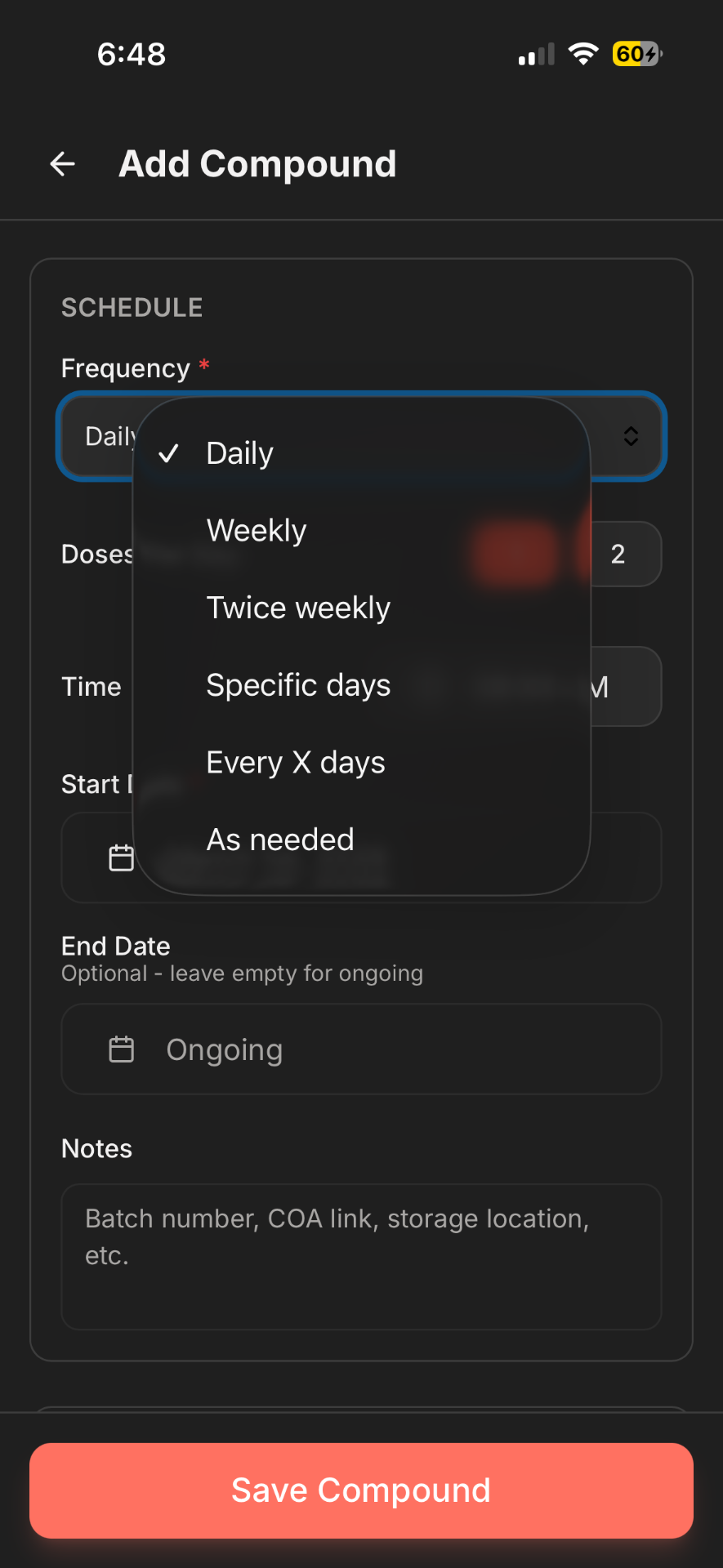
Set custom frequencies for split-dose protocols
What to track on a microdosing protocol
- **Every injection:**Date, time, dose amount, syringe units drawn, injection site
- **Weekly:**Total dose administered, weight, progress photos
- **Daily:**Side effects (type and severity), appetite level, energy
- **Monthly:**Weight trend, protocol effectiveness, discussion notes for prescriber
Stop managing your microdose protocol manually
Set your schedule once. Regimen tells you what to inject, when, and exactly how many units to draw. Smart reminders for every dose, not just once a week.
- Set a weekly target and frequency - Regimen calculates each dose for you
- Built-in split-dose scheduling (Mon AM / Thu PM, or any custom days)
- Automatic syringe unit calculations for any concentration
- Smart reminders for every injection, not just once a week
Risks and What to Watch For
Microdosing isn’t risk-free. Be aware of these before changing your protocol:
Reduced efficacy
Lower doses may not provide the same weight loss or glucose control as therapeutic doses. The FDA-approved dosing was determined through clinical trials to be the minimum effective dose for most people. Going below that means you might not get the results you’re expecting.
Accuracy at small volumes
Drawing 3-5 units on an insulin syringe is technically challenging. The smaller the volume, the larger the percentage error from imprecise technique. If your microdose requires drawing less than 5 units, consider whether a different concentration would give you a more practical draw volume.
The “I feel fine, I’ll stop” trap
Some people microdose their way down to nothing and then stop entirely. Feeling fine is not the same as maintaining your weight. Without tracking your weight and appetite patterns, you might not notice gradual regain until you’ve put back 10-15 pounds. Track your trends even on a microdose, especially during a taper. Objective data beats subjective feelings.
Off-label status
Microdosing is not FDA-approved. Your prescriber may not support it. Insurance won’t cover off-label protocols. If you run into problems, you’re operating outside established guidelines.
Talk to your prescriber. Any protocol changes, including split dosing and dose reduction, should be discussed with the healthcare provider managing your GLP-1 therapy. They can help you determine if microdosing is appropriate for your situation and monitor your progress.
Frequently Asked Questions
What is microdosing GLP-1?
Microdosing GLP-1 means taking a lower weekly dose of a GLP-1 medication such as tirzepatide or semaglutide than the standard therapeutic range, often split into smaller, more frequent shots. People do it to ease side effects, to hold their weight after losing it, or to make a vial last longer. It is off-label: the prescribing information (FDA label) for both drugs is one shot a week at set doses, and no randomized trial has tested microdosing.
How do you microdose tirzepatide?
In community reports, people who microdose tirzepatide commonly keep the weekly total at 2.5 mg, the starter dose, either as one shot or split into two 1.25 mg shots about 3.5 days apart (Monday and Thursday, for example). It is mostly done with vials and an insulin syringe, because the single-dose pens are preset to one dose. Talk to your prescriber before you change your dose, and track your weight weekly to see whether the lower dose is holding.
Is microdosing semaglutide safe?
Semaglutide at any dose should be used under medical supervision. Microdosing is off-label, meaning it hasn’t been studied in clinical trials at sub-therapeutic doses. The medication itself is FDA-approved, but the specific dosing protocol is not. Talk to your prescriber before making any changes to your protocol.
What’s the difference between microdosing and split dosing?
Split dosing takes your prescribed weekly dose and divides it into multiple smaller injections (same total, more frequent). Microdosing means taking a lower total weekly dose than what’s therapeutically recommended. You can combine both strategies, but they solve different problems: split dosing targets side effects, microdosing targets dose reduction.
Can I microdose with an Ozempic pen?
It’s difficult. Ozempic pens deliver pre-set doses and aren’t designed for sub-dose administration. Microdosing is primarily done with compounded semaglutide in vials, where you draw exact amounts with an insulin syringe. If you’re on a brand-name pen, talk to your prescriber about compounded alternatives.
How do I calculate syringe units for a microdose?
It depends on your vial concentration. For example, if your compounded semaglutide is 5mg/2mL (2.5mg/mL), a 0.125mg microdose would be 5 units on a 100-unit insulin syringe. Regimen calculates this automatically for any concentration. Just enter your vial details, and it tells you exactly how many units to draw for each injection.
Will microdosing still help me lose weight?
It depends on the dose and your individual response. Some people respond to very low doses, while others need therapeutic levels for meaningful weight loss. Microdosing is more commonly used for maintenance after initial weight loss or side effect management than as a primary weight loss strategy. Track your weight weekly to know objectively.
Can I microdose retatrutide?
Retatrutide is currently in Phase 3 clinical trials and is not FDA-approved. There are no established microdosing protocols. Community reports suggest some people split doses for tolerability, but all use outside clinical trials is experimental. Discuss with your healthcare provider.
How do I track a microdosing protocol?
Log every injection (date, time, dose, syringe units), track your weekly total, monitor weight trends, and note daily side effects. A dedicated tracker like Regimen handles multi-injection scheduling, automatic syringe unit calculations, and progress visualization so you can see whether your protocol is working.
What’s a good maintenance dose of semaglutide?
There’s no one-size-fits-all answer. Community reports suggest 0.25-0.5mg/week is a common maintenance range for semaglutide, and 2.5mg/week for tirzepatide. The right dose is the lowest one that keeps your weight stable and appetite regulated. Taper gradually and track your weight to find your personal floor.
Related Articles
- Best Peptides for Fat Loss in 2026: The Complete Guide
- Body Recomposition with Peptides: The 2026 Stack Guide
- Why You Need a GLP-1 Tracker (Even If You’re Just Starting)
- Peptide Reconstitution Made Simple: Calculator + Step-by-Step Guide
Related Trackers
- Ozempic Tracker
- Wegovy Tracker
- Mounjaro Tracker
- Zepbound Tracker
- Semaglutide Tracker
- Tirzepatide Tracker
Disclaimer: This article is for educational purposes only and is not medical advice. Microdosing and split dosing GLP-1 medications are off-label practices not approved by the FDA. GLP-1 medications should be used under the supervision of a qualified healthcare provider. Always follow your provider’s guidance on dosing and schedule adjustments. Individual results may vary.
Ready to track your GLP-1?
- Smart reminders so you never miss a dose
- Track weight, photos, and progress over time
- Medication level curves for every compound