The Bottom Line
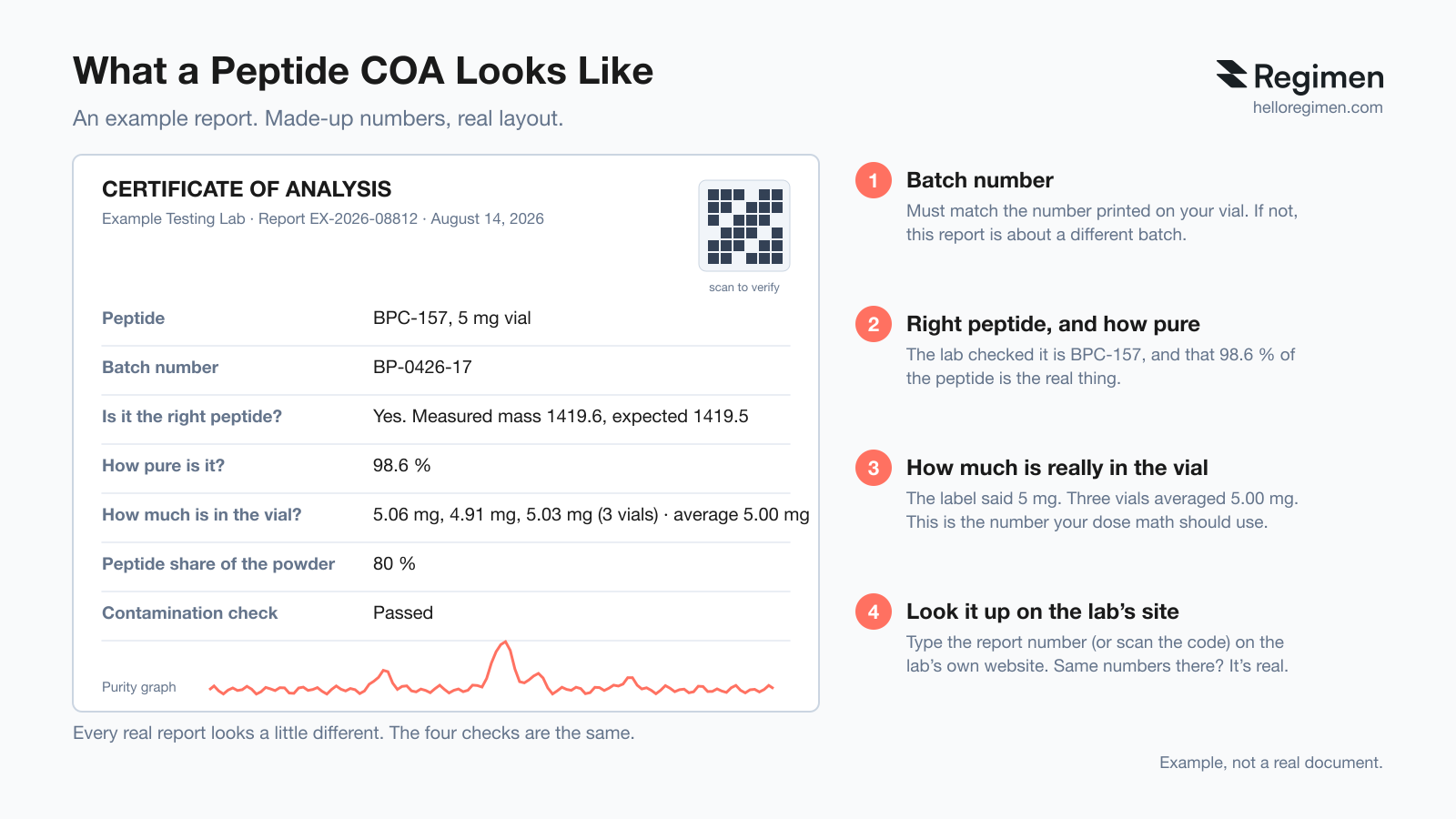
A COA (certificate of analysis) is a lab report on one batch of a peptide. Check five things: the batch number matches your vial, the lab confirmed it is the right peptide, the purity is a specific number from a named test, it says how much is really in the vial, and you looked the report up on the lab’s own website. That last one is the whole test. A PDF from the seller can say anything. The lab’s website cannot.
Regimen is a peptide and GLP-1 tracker app with a reconstitution (mixing) calculator that takes the real amount from your COA and reminds you how much to take each time.
A COA is the lab report a seller sends or links to, to show a peptide was tested. Sometimes it is a PDF, sometimes a web page. Here is what it can tell you, what it cannot, and how to check in two minutes whether it is real.
What is a peptide COA?
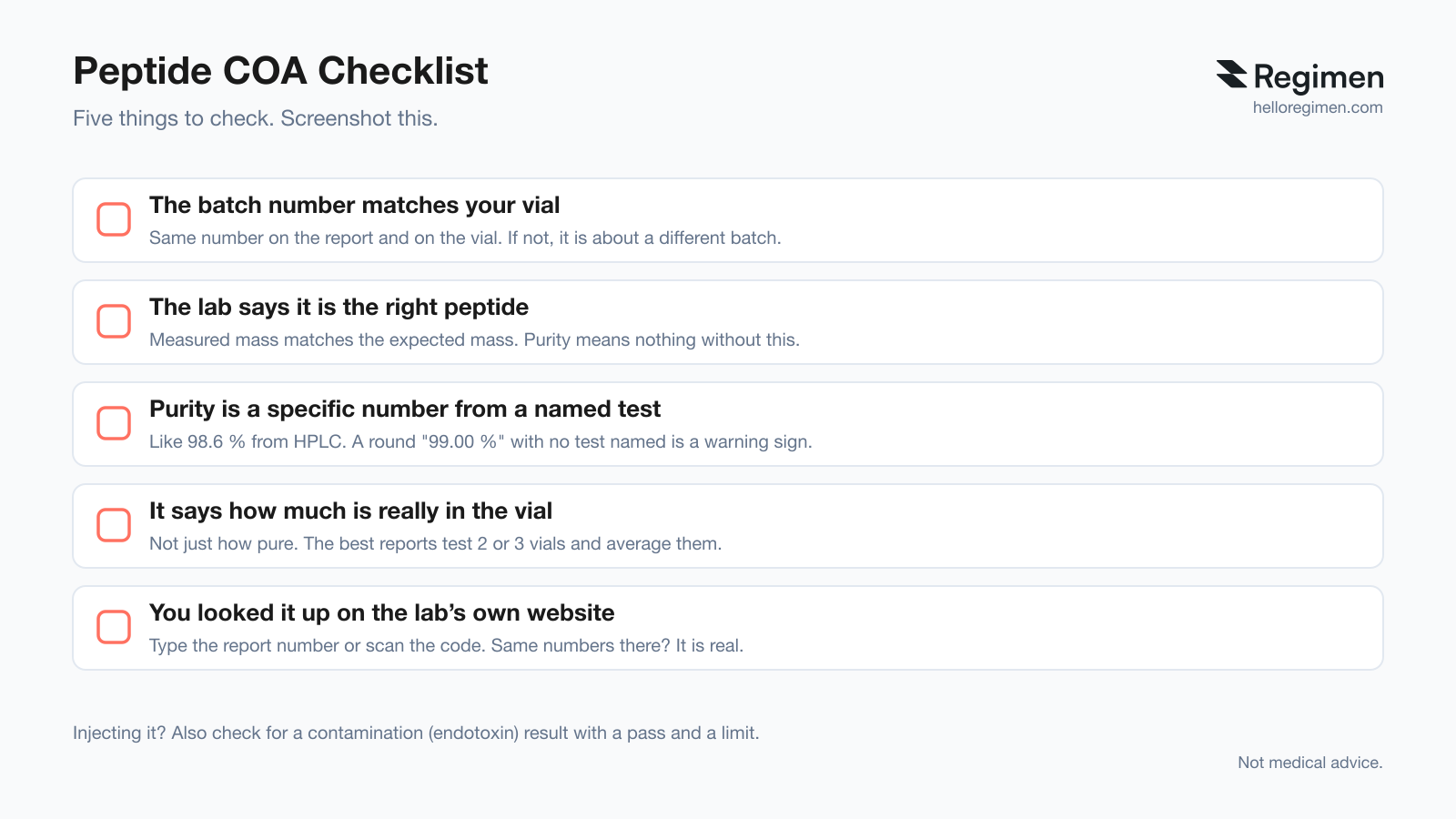
A certificate of analysis is a testing lab’s report on one sample from one batch. A seller sends a vial to a lab, the lab runs a few tests, and the lab writes down what it found. That is all it is.
It is not a safety guarantee. It is not a promise about every vial. And it only means something if a real, independent lab produced it. That is why the lookup step at the end matters more than any number on the page.
What should I check on a peptide COA?
1. The batch number matches your vial
Every vial has a batch (or lot) number printed on it. The report has one too. They have to match. If they do not, the report is about a different batch, and it tells you nothing about the vial in your hand.
While you are there, note the lab’s name and the date. You will need the lab’s name for the lookup.
2. The lab says it is the right peptide
The lab weighs the molecule with a machine called a mass spectrometer. Every peptide has a known weight. BPC-157, for example, weighs about 1419.5 (PubChem); the unit does not matter, the match does.
If the lab measured something close to that, it is BPC-157. If it measured something else, it is not, no matter what the purity number says.
This check comes before purity for a simple reason: a vial of the wrong peptide can be 99% pure.
3. Purity is a specific number from a named test
Purity is the share of the peptide in the vial that is the real thing, with no fragments or leftovers from manufacturing. The test is called HPLC. It separates everything in the sample and draws a graph, and purity is how much of that graph is the main bump (GenScript).
What a good purity result looks like: a specific number like 98.6%, the word HPLC next to it, and a graph with one big bump, a few tiny ones, and a slightly wobbly line. Real machines always wobble a little.
What a bad one looks like: a round number like 99.00% with no test named, or a graph with a perfectly flat line and one spike.
Is 98% enough? As a purity number, yes. A 98% you can look up beats a 99% you cannot. Below 95%, the missing part is peptide-related leftovers you did not order.
Pro tip
Purity does not tell you how much is in the vial. A vial can be 98.6% pure and hold 3 mg. That is why check number 4 exists.
4. It says how much is really in the vial
The label says 5 mg. That is the target the maker was aiming for, not a measurement. Vials come in a little over or a little under, and the only way to know is if the lab measured the peptide in the vial.
The best reports test two or three vials from the same batch and show each result. Three vials, three numbers, one average. If the three numbers are far apart, the batch is inconsistent, and that is worth knowing too.
Not every report has this. Some only give purity. Then the label is the best number you have, and it is an estimate.
5. You looked it up on the lab’s own website
This is the step almost nobody does, and it is the only one that proves anything.
Every real report has a report number, and most have a QR code. Go to the testing lab’s website (type it in yourself, do not click a link in the PDF) and find its lookup page. Enter the number, or scan the code. The lab shows you the report it holds.
Same numbers as your PDF? It is real. Number does not work, or the numbers are different? The PDF is not that lab’s report.
A QR code on its own is not proof. A code can point anywhere. What matters is that it lands on the lab’s own site.
How do I look up a peptide COA?
- Janoshik: janoshik.com/verification, enter the task number and the key printed on the report, or scan the code.
- Freedom Diagnostics: the COA lookup on its site, enter the search code.
- ILS Laboratories: ils-lab.com/verify, enter the code printed under the QR.
- Chromate: chromate.org/verify, enter the job number and access code.
- Peptide Test: verify.peptidetest.net, enter the sample number.
Some labs have no lookup at all. A report from one of those can still be real, but you cannot prove it yourself. The peptide testing labs guide covers who does and does not have one, and what testing costs if you want to send a vial yourself.
How can you tell if a COA is fake?
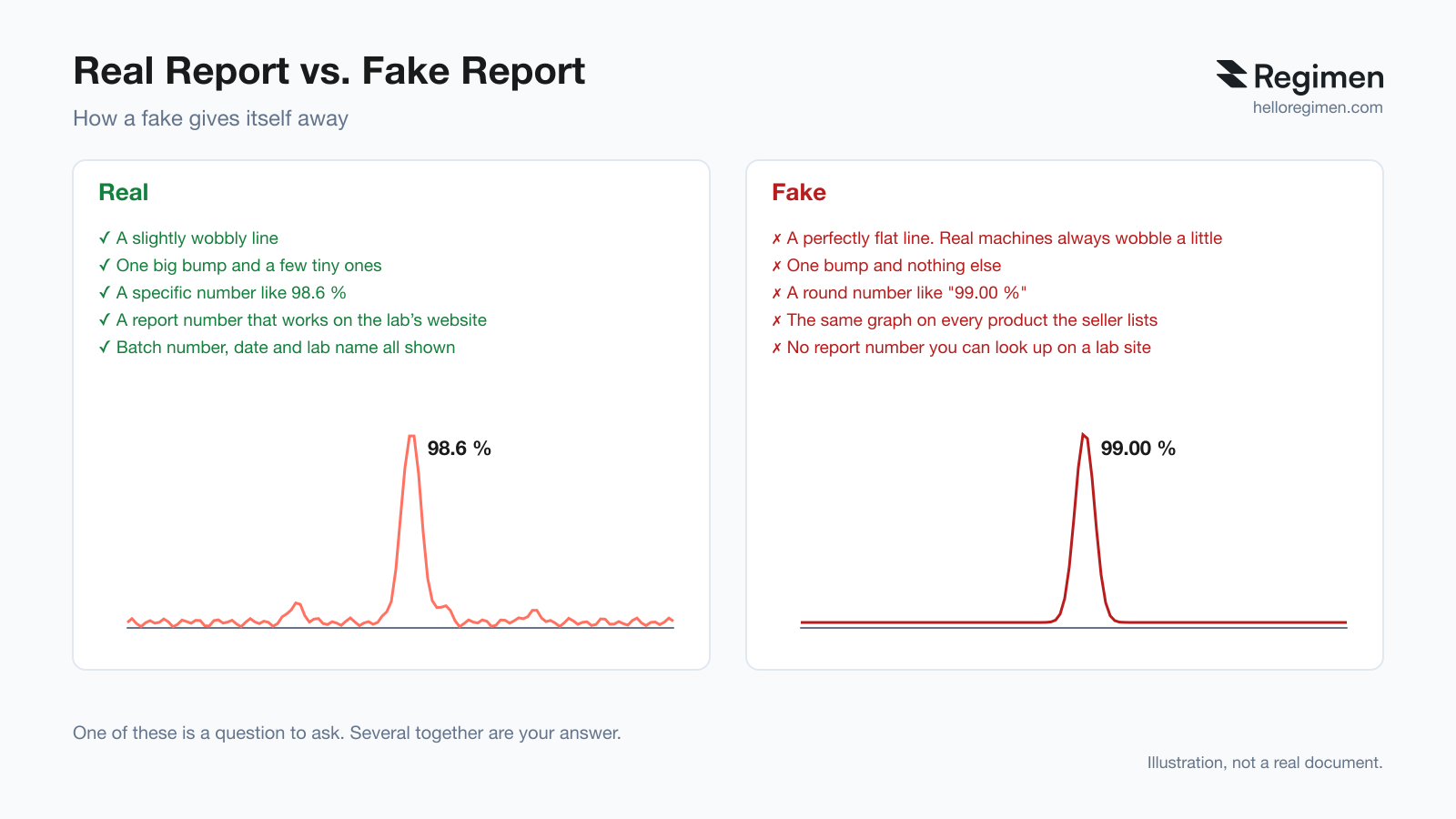
Fakes are usually edited PDFs, and they give themselves away the same few ways:
- A perfectly flat graph with one spike.
- A round number like 99.00% or 100%.
- The same graph on every product the seller lists.
- A test date before the batch could have existed.
- No report number, or one that does not work on the lab’s site.
- A lab name you cannot find anywhere except on that seller’s site.
One of these is a question to ask. Several together are your answer.
Injecting it? Look for a contamination test
Endotoxin is a leftover from bacteria. You cannot see it, and it can cause a fever reaction. Labs test for it with a method called LAL, but it is an extra test that costs $175 to $300 on top of the basic report, so many COAs do not include it. That is normal; it just means nobody paid for it.
If your report has it, it should show a number and a limit (FDA guidance), not just the word “pass”. If you inject and want it, you can order it when you send a vial to a lab yourself.
Some reports also include a sterility test (a check for living germs) or a heavy metals test. Those are extras too.
How does the COA change my dose math?
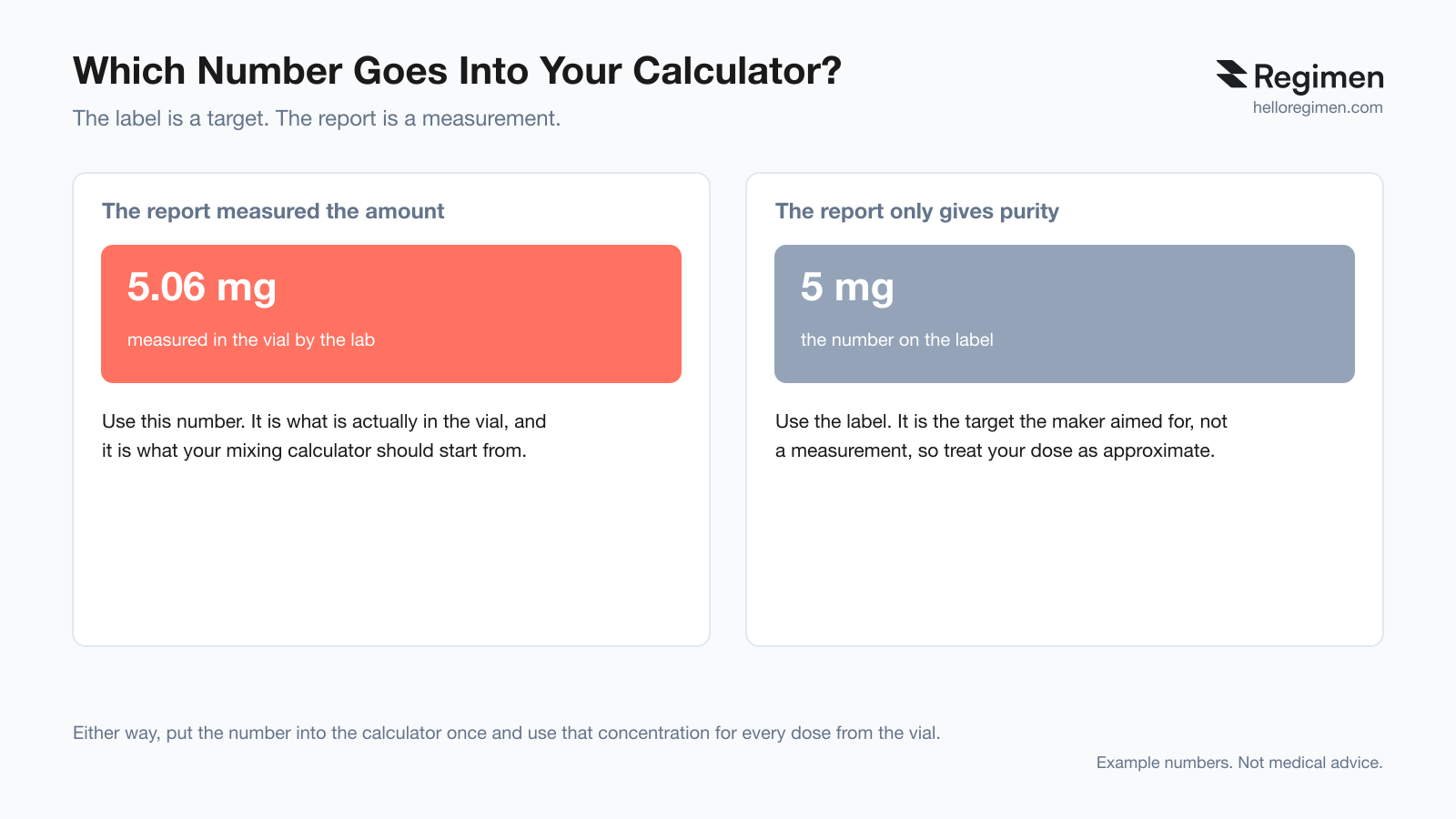
Use the measured amount, if the report has one. If the lab says the vial holds 5.06 mg, that is the number for your reconstitution (mixing) calculator, not the 5 mg on the label. If the report only gives purity, use the label amount and know your dose is approximate.
Units, briefly: an insulin syringe is marked in units, 100 units to 1 mL. How many units your dose comes to depends on how much peptide is in the vial and how much water you add. That is why the amount on the report matters.
What to do with the numbers
Put the measured amount into the reconstitution (mixing) calculator when you mix the vial, and use that concentration for every dose from it.
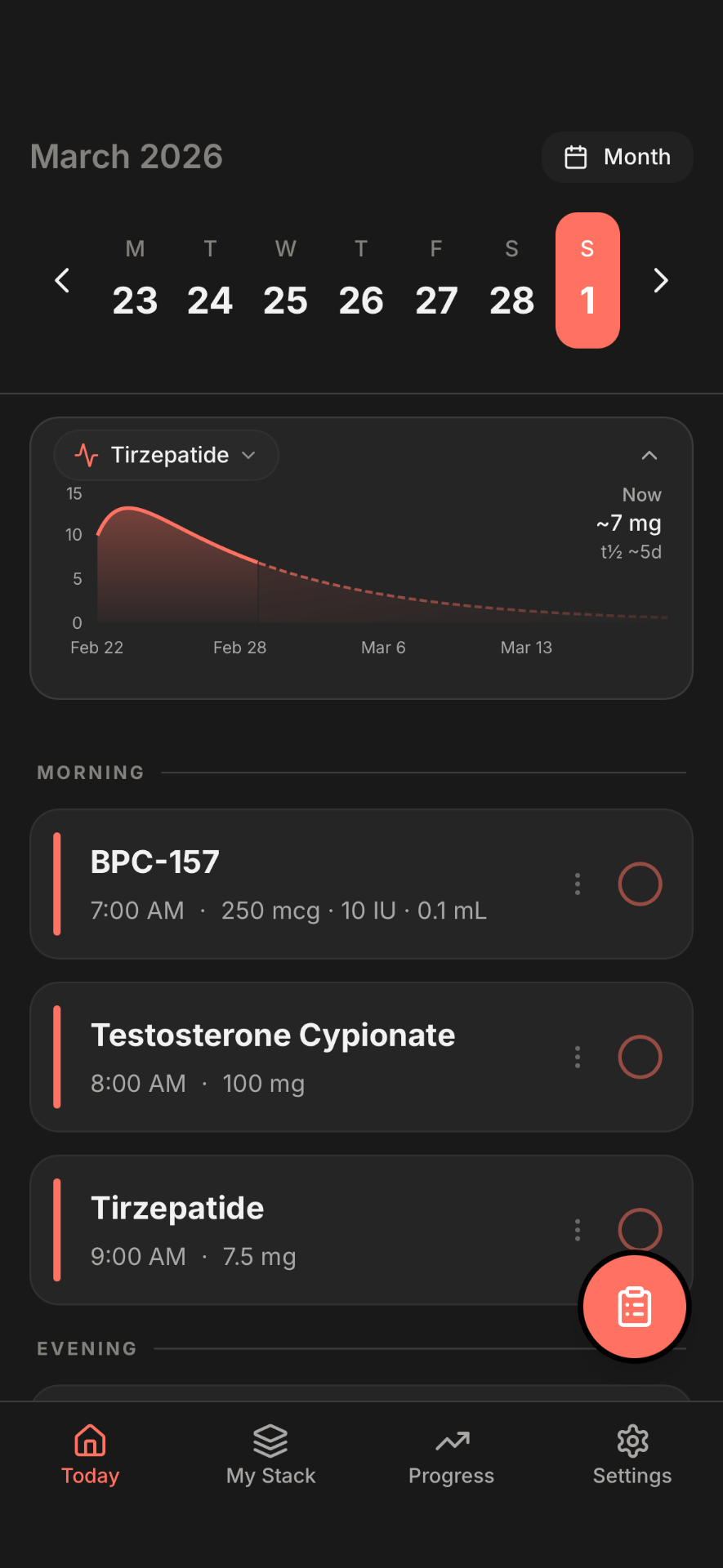
If you track your protocol in Regimen, the calculator is in the app, and each dose reminder tells you how much to take, so you are not redoing the math from memory a month later. When the next batch arrives with its own report, run the numbers again before you mix it.
Glossary
| Term | Plain English |
|---|---|
| COA | Certificate of analysis. A lab report on one batch. |
| Batch or lot number | The number printed on your vial that ties it to a report. |
| HPLC | The test that measures purity. It separates the sample and draws a graph. |
| Chromatogram | That graph. The big bump is your peptide. |
| Purity | How much of the peptide is the real thing, as a percent. |
| Mass spectrometry (MS) | The test that confirms it is the right peptide by weighing the molecule. |
| Quantity or content | How much peptide is really in the vial, in mg. |
| Net peptide content | On some reports, the share of the powder that is peptide after water and salt. Most consumer reports do not include it. |
| Endotoxin | A bacterial leftover that causes fever reactions. Measured by the LAL test. |
| Sterility test | A check for living germs in the sample. |
| ISO/IEC 17025 | A standard for testing labs. Granted by accreditation bodies, not by ISO. |
| Report number | The number you type into the lab’s website to see the real report. |
Frequently Asked Questions
What does COA mean for peptides?
COA stands for certificate of analysis. It is a lab report on one batch of a peptide. It tells you whether the powder is the right peptide, how pure it is, and, on the better reports, how much is really in the vial and whether it passed a contamination check.
How do I tell if a peptide COA is real?
Look it up on the testing lab’s own website, not the seller’s. Type in the report number (or scan the code on the report) and see if the lab shows the same numbers. If the number does not work, or the numbers are different, the report is not real.
How do I look up a peptide COA?
Find the lab’s name on the report, go to that lab’s website, and use its lookup page. Janoshik asks for a task number and a key, Freedom Diagnostics for a search code, ILS for a code under the QR, Chromate for a job number and access code, Peptide Test for a sample number. Our peptide testing labs guide lists each one.
Can a COA be faked?
Yes. A PDF can be edited in a minute. The giveaways: a perfectly flat graph with one spike, a round number like 99.00%, the same graph on every product, a date before the batch existed, and no report number that works on a lab’s website. Looking the report up on the lab’s site catches all of them.
How much does it cost to get a COA on peptides?
About $150 to $400 to have one vial tested for purity and identity, plus $175 to $300 if you add a contamination (endotoxin) test. Every lab works by mail. Our peptide testing labs guide has the prices lab by lab.
Is 98% purity good?
For purity, yes, as long as the lab also confirmed it is the right peptide and the number comes from a named test. A specific 98.3% you can look up beats a round 99% you cannot. Below 95%, the missing part is peptide-related leftovers you did not order. Nothing on a COA makes a vial safe to inject.
How do I read a peptide label?
The label gives you the peptide name, the amount of powder (say 5 mg) and the batch number. It does not tell you purity, whether it is the right peptide, or how much peptide is really in that 5 mg. The COA does. Start by matching the batch number on the label to the one on the COA.
How old can a COA be?
The batch matters more than the date. A year-old report for the exact batch in your hand is still that batch’s report. A report from last week for a different batch tells you nothing about yours.
How many units is 1 mL?
100 units on a standard insulin syringe, so 1 unit is 0.01 mL. How much peptide those units hold depends on how much peptide was really in the vial and how much water you added. That is why the amount on the COA matters for your dose math.
Your Next Steps
- Peptide testing labs: who tests, what it costs, how to verify a COA
- Peptide reconstitution calculator guide
- Units vs mL vs mg on a syringe
- How to start your first peptide protocol
Medical disclaimer: This content is for informational purposes only and does not constitute medical advice. Consult a licensed healthcare provider before starting any peptide protocol.
Ready to track your protocol?
- Reconstitution math from the amount you actually have
- Dose reminders that tell you how much to take
- Medication level curves for 150+ compounds
Sources
- GenScript, Peptide Quality Control: HPLC purity and mass spectrometry identity. genscript.com
- AAPPTec, Peptide Quality FAQ: net peptide content and why powder weight is not peptide weight. peptide.com
- FDA, Pyrogen and Endotoxins Testing: Questions and Answers (USP chapter 85 method, dose-based limits). fda.gov
- A2LA, ISO/IEC 17025 chemical testing accreditation. a2la.org
- PubChem, BPC-157 (CID 9941957), molecular weight 1419.5. pubchem.ncbi.nlm.nih.gov
- Lab lookup pages: Janoshik, ILS, Chromate, Peptide Test