The Bottom Line
TRT is not steroids. Clinical doses (100-200mg/week) restore normal levels, and changes are gradual. Energy and mood improve in weeks 2-4. Libido follows in month 2. Visible body composition changes start around month 3-4 and continue through month 12. The men who track consistently are the ones who actually see how far they have come.
Setting Realistic Expectations
TRT restores your testosterone to the normal physiological range. It does not put you at supraphysiological levels like a steroid cycle. The changes you will experience are real and meaningful, but they happen gradually - think months, not weeks.
The biggest factor in your results is not the TRT itself. It is what you do alongside it: training, nutrition, sleep, and consistency. TRT amplifies your effort. It does not replace it.
Month-by-Month TRT Timeline
| Timeframe | What Changes | What You Will Notice |
|---|---|---|
| Week 1-2 | Hormones stabilizing | Usually nothing dramatic. Do not panic. Some men report slightly better sleep. |
| Week 3-4 | Energy, sleep quality | Waking up more refreshed. Less afternoon crash. Slightly better recovery from workouts. |
| Month 2 | Libido, mood, motivation | Often the first “I feel different” moment. Morning erections return. Mental clarity improves. |
| Month 3 | Body composition starting | Subtle muscle fullness, especially shoulders and upper back. Slight fat reduction. |
| Month 4-6 | Visible body changes | Measurable muscle gain. Noticeable fat loss around midsection. Strength increasing in the gym. |
| Month 6-12 | Full recomp in progress | ~5-7% increase in lean mass. Significant fat redistribution. Clothes fit differently. |
| Year 1+ | New baseline | Stable body composition. Ongoing maintenance. Continued slow improvement with training. |
Water Retention in the First 1-2 Months
If you just started TRT and the scale jumped 4-7 pounds in the first two weeks, take a breath. This is one of the most common, and most anxiety-inducing, early experiences on testosterone therapy. It is almost certainly water, not fat.
What is happening:
Testosterone increases glycogen storage in your muscles. Glycogen binds water. For every gram of glycogen stored, your body retains approximately 3 grams of water. Additionally, testosterone aromatizes to estradiol, and estrogen promotes fluid retention. The result is 3-8 lbs of water weight in the first 2-6 weeks.
Why it is actually a good sign:
Increased intramuscular water and glycogen is part of why your muscles start looking fuller on TRT. It means the testosterone is working and your muscles are responding. This is not the bloated, puffy water retention you get from eating too much sodium. It is largely intramuscular.
When it stabilizes:
Most men see water retention plateau and begin to normalize by weeks 6-8. Your body reaches a new equilibrium with the higher glycogen stores and adjusted fluid balance. The scale should stop climbing and may even drop back 1-2 lbs as your body adjusts.
If it does not stabilize by week 8:
- Check estradiol levels. Persistently high E2 is the most common cause of ongoing water retention on TRT. If E2 is elevated, discuss management options with your provider.
- Assess sodium intake. High sodium combined with elevated E2 can amplify water retention significantly.
- Review your injection frequency. Less frequent injections (e.g., every 2 weeks) cause larger hormone fluctuations and can worsen water retention. More frequent, smaller doses (twice weekly or every other day) provide more stable levels.
How to track weight accurately on TRT:
- Weigh yourself at the same time every day. First thing in the morning, after using the bathroom, before eating or drinking.
- Record the daily number but focus on weekly averages, not daily readings.
- Daily weight can fluctuate 2-4 lbs based on hydration, sodium, food volume, and bowel movements.
- Compare this week’s average to last week’s average. That is the real trend.
- Do not react to any single day. A “bad” weigh-in after a high-sodium dinner means nothing.
What the Research Shows
- Lean mass increase: Approximately 5.7% over 12 months in clinical studies of hypogonadal men starting TRT.
- Fat mass decrease: Variable, but most studies show a meaningful reduction in visceral fat, particularly around the midsection. Results depend heavily on training and diet.
- Strength increase: 10-13% improvement in major lifts (bench, squat, deadlift) over 6-12 months.
- Bone density: Measurable improvement at 6+ months. This matters more for older men and is one of the underappreciated long-term benefits of TRT.
Factors That Affect Your Results
- Starting testosterone level: Men with very low baseline levels (under 200 ng/dL) tend to see more dramatic improvements than men starting at 350-400 ng/dL.
- Training and nutrition: TRT without a training stimulus will produce some improvement, but far less than TRT combined with progressive resistance training and adequate protein (0.7-1g per pound of bodyweight).
- Sleep quality: Testosterone is produced primarily during sleep. Ironically, TRT often improves sleep, creating a positive feedback loop.
- Injection frequency and consistency: More frequent injections (twice weekly or daily microdosing) produce more stable blood levels and often better subjective results. See the microdosing TRT guide.
- Age and genetics: Younger men and those with favorable genetics for muscle building will see faster results. But nearly every man sees meaningful improvement.
What to Track During Your Recomp
The men who get the best results on TRT are the ones who track. Your mirror lies to you because it sees you every day. Monthly progress photos and weekly weight logs show trends that you cannot perceive in real time.
- Body weight: Weekly, same conditions (morning, fasted, after bathroom).
- Body measurements: Monthly. Waist, chest, arms, thighs.
- Progress photos: Monthly, same lighting and angle.
- Energy and mood: Daily, even a 1-5 scale is useful.
- Lab results: Every 3-6 months. Total T, free T, E2, hematocrit.
Why Some Men Do Not See Results
- Dose too low: Some men are underdosed, especially if their provider is overly conservative. Trough levels below 500 ng/dL often leave men symptomatic.
- Poor injection compliance: Missing injections or inconsistent timing creates hormone fluctuations that undermine results.
- Not training or eating to support recomp: TRT is not magic. Without a training stimulus and adequate protein, body composition changes are minimal.
- Underlying thyroid or metabolic issues: Hypothyroidism, insulin resistance, and sleep apnea can blunt TRT results. Get a full workup.
- Unrealistic expectations: TRT doses produce 600-900 ng/dL levels. This is the normal range, not a bodybuilding cycle. Expect meaningful improvement, not a transformation in 4 weeks.
Nutrition Strategy for TRT Body Recomposition
TRT changes your hormonal environment, but it does not override the laws of thermodynamics. Your nutrition strategy determines whether you gain muscle, lose fat, or both. Here are three approaches. Pick the one that matches where you are starting from.
Option 1: Lean Bulk (Slight Surplus, 200-300 Calories Above Maintenance)
Best for: Men who are already relatively lean (under 20% body fat) and want to maximize muscle gain while keeping fat accumulation minimal.
You eat slightly more than your body needs, providing extra energy and nutrients to fuel muscle growth. TRT amplifies this by increasing protein synthesis and nitrogen retention, meaning your body is primed to build muscle with that surplus.
Expected results: Slow, steady muscle gain of 1-2 lbs per month with minimal fat accumulation. Over 6 months, you might gain 8-12 lbs of lean mass with only 2-3 lbs of fat.
The TRT advantage: Natural lifters often need a 400-500 calorie surplus to see meaningful muscle gain, which comes with more fat. With TRT, a smaller surplus of 200-300 calories is enough. The enhanced anabolic environment does the heavy lifting.
Option 2: Body Recomposition (Eat at Maintenance)
Best for: Men between 15-25% body fat who want to simultaneously lose fat and gain muscle.
You eat at or very close to maintenance calories. Your body uses stored fat for energy while directing nutrients toward muscle growth. In natural lifters, this is painfully slow and mostly works for beginners. On TRT, it is a realistic strategy for most men.
Why TRT makes recomp work: Testosterone shifts your body’s nutrient partitioning. More calories go toward muscle, fewer toward fat storage. High-normal testosterone levels create an anabolic environment that supports muscle protein synthesis even without a caloric surplus.
Expected results: The scale stays roughly the same over 3-6 months, but your body composition shifts noticeably. You might weigh 200 lbs at month 1 and 200 lbs at month 6, but your waist is 2 inches smaller and your shirts fit tighter in the shoulders.
Option 3: Cut (Moderate Deficit, 300-500 Calories Below Maintenance)
Best for: Men over 25% body fat who need to prioritize fat loss before focusing on muscle gain.
The TRT advantage: Testosterone is profoundly muscle-sparing during a caloric deficit. Studies show that men with higher testosterone levels retain significantly more lean mass during weight loss compared to men with low testosterone. This is the single biggest advantage of cutting on TRT versus cutting naturally.
Expected results: Fat loss of 1-1.5 lbs per week with minimal muscle loss. Over 3 months, you might lose 12-18 lbs of fat while maintaining (or even slightly gaining) lean mass.
Critical rules for cutting on TRT:
- Protein is non-negotiable: 0.8-1.0g per pound of body weight minimum. This is the most important number in your diet.
- Do not cut too aggressively: Keep the deficit at 300-500 calories. Larger deficits (700+) risk muscle loss even with TRT.
- Keep lifting heavy: The stimulus to maintain muscle comes from training. Do not switch to “light weights, high reps” during a cut. Keep the intensity high.
- Plan diet breaks: Every 8-12 weeks, eat at maintenance for 1-2 weeks. This helps with adherence, hormonal balance, and recovery.
Practical Protein Guide
Regardless of which approach you choose, protein intake is the foundation.
| Body Weight | Minimum Protein (0.7g/lb) | Optimal Protein (1.0g/lb) |
|---|---|---|
| 160 lbs | 112g/day | 160g/day |
| 180 lbs | 126g/day | 180g/day |
| 200 lbs | 140g/day | 200g/day |
| 220 lbs | 154g/day | 220g/day |
| 240 lbs | 168g/day | 240g/day |
Worked Example — What Realistic Progress Looks Like
Theory is helpful, but most men want to know: what will this actually look like for me? Here is a realistic, month-by-month example based on typical clinical outcomes.
Starting point: 200 lb man, 25% body fat (50 lbs of fat, 150 lbs of lean mass). Starting TRT at 150mg/week testosterone cypionate. Training 3-4 days per week. Eating at roughly maintenance calories (~3,000/day) with adequate protein (~180g/day).
Month 1
Weight: 205 lbs (up 5 lbs). Waist: unchanged. Gym: slightly better energy, no meaningful strength gains yet.
What is happening: water retention. That is it. Testosterone takes 4-6 weeks to build up to steady state levels. You have not gained fat. The muscle-building has not meaningfully started yet. Your reaction: “I am gaining weight, this is not working.” This reaction is normal and wrong. Do not change anything.
Month 2
Weight: 202 lbs (down from peak, still above starting weight). Waist: unchanged or down a quarter inch. Gym: noticeably stronger. Recovery between sets and between workouts is better. You can push harder.
Month 3
Weight: 201 lbs. Waist: down 0.5 inches. Gym: bench press up 10 lbs, squat up 15-20 lbs. You feel meaningfully stronger. This is usually the first “I can see it” moment. Shoulders look a bit rounder. Belly is slightly flatter. Estimated body composition: ~155 lbs lean mass (+5 lbs muscle, including water), ~47 lbs fat (-3 lbs fat). Body fat ~23%.
Month 6
Weight: 198 lbs. Waist: down 1.5 inches. Gym: significant strength gains across all lifts. You look different in the mirror. Visible muscle definition in shoulders, arms, and upper chest. Midsection is noticeably leaner. Estimated body composition: ~160 lbs lean mass (+10 lbs muscle), ~38 lbs fat (-12 lbs fat). Body fat ~21%.
Month 12
Weight: 195 lbs. Waist: down 2.5 inches from baseline. People who have not seen you in months will comment. Estimated body composition: ~159 lbs lean mass (+9 lbs muscle), ~36 lbs fat (-14 lbs fat). Body fat ~18-19%.
What the scale says: you lost 5 lbs. What actually happened: you lost approximately 14 lbs of fat and gained approximately 9 lbs of muscle. This is why the scale is the worst measure of TRT progress.
Key takeaways from this example:
- The scale lies during body recomposition. Track waist circumference, progress photos, and strength numbers instead.
- The first real visible changes happen around month 3. If you quit at month 2, you will miss them.
- Year-one results on TRT are the best you will ever get. Your body is most responsive to the new hormonal environment in the first 12 months. Make them count with consistent training and nutrition.
- These results assume consistent training (3-4 days/week), adequate protein (0.8-1.0g/lb), and reasonable caloric intake. TRT without effort produces minimal results.
Related Guides
- Body Recomposition with Peptides: The 2026 Stack Guide
- Best Peptides for Muscle Building in 2026
- TRT Dose Calculator
- First TRT Injection: What to Expect
- TRT Injection Schedule Guide
- Microdosing TRT Guide
- TRT Blood Work Guide
This guide is for educational purposes only and is not medical advice. TRT results vary by individual. Body composition changes depend on training, nutrition, sleep, and genetic factors in addition to testosterone therapy. Work with your prescribing provider to optimize your protocol.
Ready to track your protocol?
- Smart reminders so you never miss a dose
- Track weight, photos, and progress over time
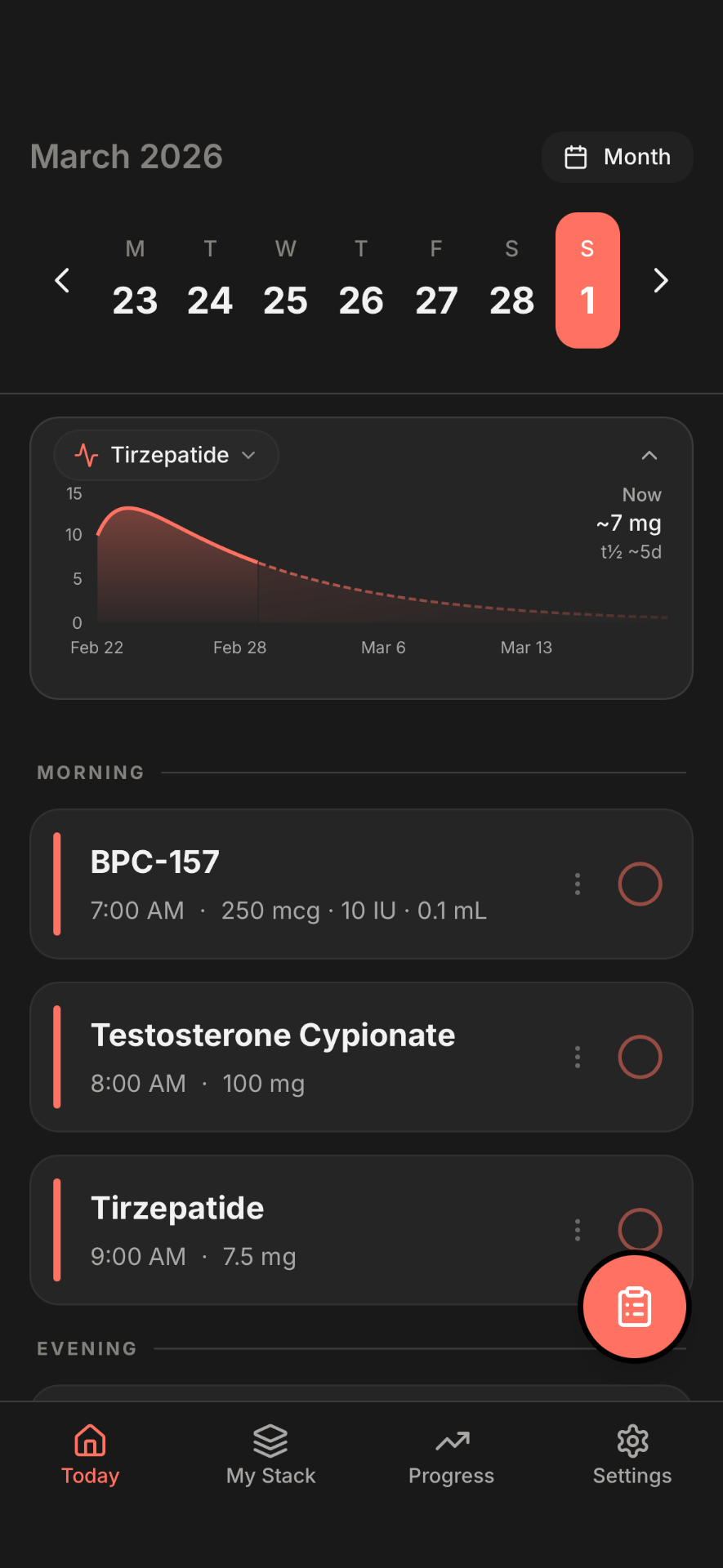
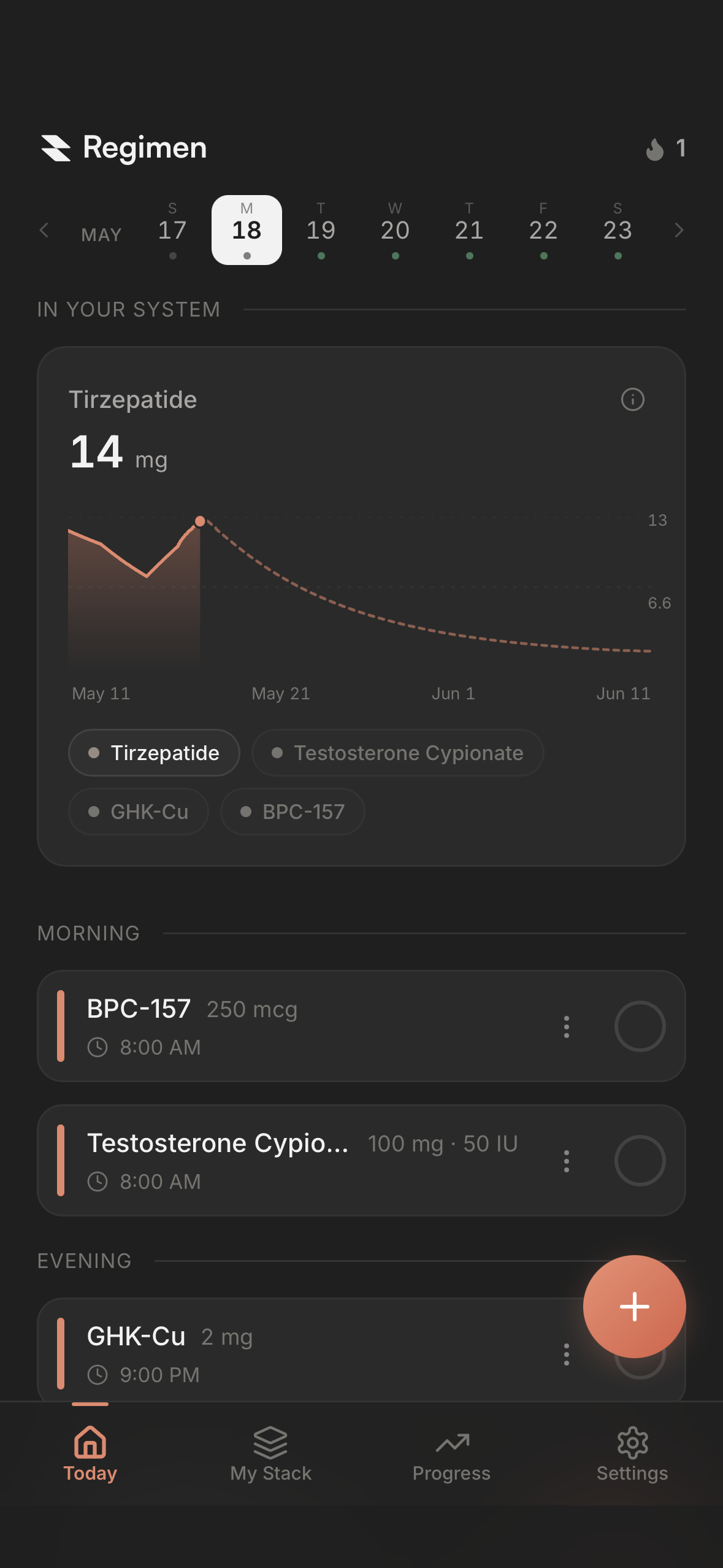
- Medication level curves for every compound
Frequently Asked Questions
How long does TRT take to work?
Energy and mood improvements typically appear in weeks 2-4. Libido follows in month 2. Visible body composition changes (muscle gain, fat loss) start around month 3-4 and continue through month 12. Full steady-state effects require 6-12 months of consistent therapy.
How much muscle can you gain on TRT?
Clinical studies show approximately 5.7% increase in lean mass over 12 months in hypogonadal men. This is with clinical doses (100-200mg/week) that restore normal levels, not supraphysiological doses. Results depend heavily on training and nutrition.
Does TRT help with fat loss?
Yes, TRT improves body composition by increasing lean mass and reducing visceral fat, particularly around the midsection. However, TRT amplifies effort — it does not replace training and proper nutrition. Men who combine TRT with resistance training and adequate protein see the best results.
Why am I not seeing results on TRT?
Common reasons include: dose too low (trough below 500 ng/dL), poor injection compliance, not training or eating to support recomposition, underlying thyroid or metabolic issues, or unrealistic expectations. TRT produces meaningful but gradual changes over months.