←Part of TRT, Explained: The Complete Guide
The Bottom Line
The first 12 weeks of TRT are when patterns establish. Log from day one: injection day and time, mood (1 to 10), energy (1 to 10), libido (1 to 10), sleep quality, and any new acne. Get baseline labs before starting and follow-up labs at week 8 to 12 (total T, free T, SHBG, estradiol, hematocrit, PSA). Most TRT users don’t optimize their dose until they have lab data to adjust by. Subjective markers and labs together drive the conversation with your prescriber.
This is educational content, not medical advice. Always work with your prescribing clinician on dosing, lab schedules, and protocol adjustments.
You filled the prescription. The first injection went in (or the first patch went on, or the first pellet got inserted). Now you’re 4 days in, wondering whether anything’s supposed to feel different yet and what you should be paying attention to so the next follow-up appointment isn’t a guessing game.
The honest answer is that the first 12 weeks of TRT are a data-collection window, not an optimization window. Your prescriber needs labs at week 8 to 12 to know whether your dose is correct, and your subjective response across those weeks is the other half of the picture. The earlier you start logging, the better that conversation goes.
What should I feel in the first month of TRT?
The common early shifts, in rough order of when they show up:
- Week 1 to 2: Often nothing noticeable, or mild mood lift. Some people report improved sleep within the first 10 days. Others feel no change at all.
- Week 2 to 4: Energy and libido changes often start here. Some people report increased motivation or “drive.” Acne (if it’s going to appear) typically shows up around week 3 to 4.
- Week 4 to 8: Sleep, mood, and libido patterns become more stable. Strength gains (if you train) start to show. Body composition shifts are slower and won’t be obvious yet.
- Week 8 to 12: Steady-state effects. This is when your follow-up labs become meaningful and your dose can be adjusted based on data, not guesses.
Individual response varies. Some patients report dramatic changes in the first month; others see slower onset. Neither pattern indicates a problem with the medication.
When should I get my follow-up labs?
The standard window is 6 to 12 weeks after starting, with week 8 to 12 being the most common because that’s when most injectable testosterone protocols reach steady state. Per the Endocrine Society guidelines, follow-up labs typically include:
- Total testosterone
- Free testosterone
- SHBG (sex hormone binding globulin)
- Estradiol (sensitive assay, not standard immunoassay)
- Hematocrit and hemoglobin
- PSA (especially if over 40 or with risk factors)
For injectable protocols, draw timing matters. Most clinicians draw at the trough (right before your next injection) so the lab number reflects the low end of your weekly cycle. Some draw at the peak. Be consistent week to week so the numbers are comparable.
Is acne in week 4 normal or a sign of too much?
Acne in the first 4 to 8 weeks is common and isn’t automatically a sign of supratherapeutic dosing. It usually reflects your sebaceous glands adjusting to higher androgen levels. For many patients, it stabilizes by week 8 to 12.
What’s worth flagging to your prescriber: severe acne, acne that doesn’t improve after week 8 to 12, or acne paired with other estrogen-related symptoms (nipple sensitivity, mood changes, water retention). That cluster sometimes points to an estradiol-management conversation, which is dose- and protocol-dependent.
How do I know if my dose is right?
Two inputs, not one:
- Labs. Total testosterone in the mid-to-upper end of the reference range (typically 600 to 900 ng/dL for most labs) is the common starting target, with adjustments based on free T, SHBG, and clinical response. Your specific target depends on your protocol and clinician.
- Subjective markers. Energy, mood, libido, sleep quality, and recovery from training. A dose that hits the lab range but leaves you feeling worse than baseline isn’t the right dose.
The “right dose” is the one where the labs are in range and the subjective markers are stable or improved. That conversation happens with your prescriber, with data on both sides of the table.
What’s the difference between cypionate, enanthate, and Sustanon for tracking purposes?
From a tracking standpoint, the relevant differences are injection frequency and steady-state timing:
- Testosterone cypionate: apparent serum half-life about 6.9 days (older references quote ~8 days; reconciled here). Weekly or twice-weekly injections most common. Steady state by week 5 to 6.
- Testosterone enanthate: same ~6.9-day apparent serum half-life as cypionate. Similar dosing cadence. Steady state by week 5 to 6.
- Sustanon 250: blend of four esters with different release rates. Weekly or split twice-weekly injections most common despite older protocols suggesting every 3 weeks. Steady state takes longer to settle due to the mixed ester profile.
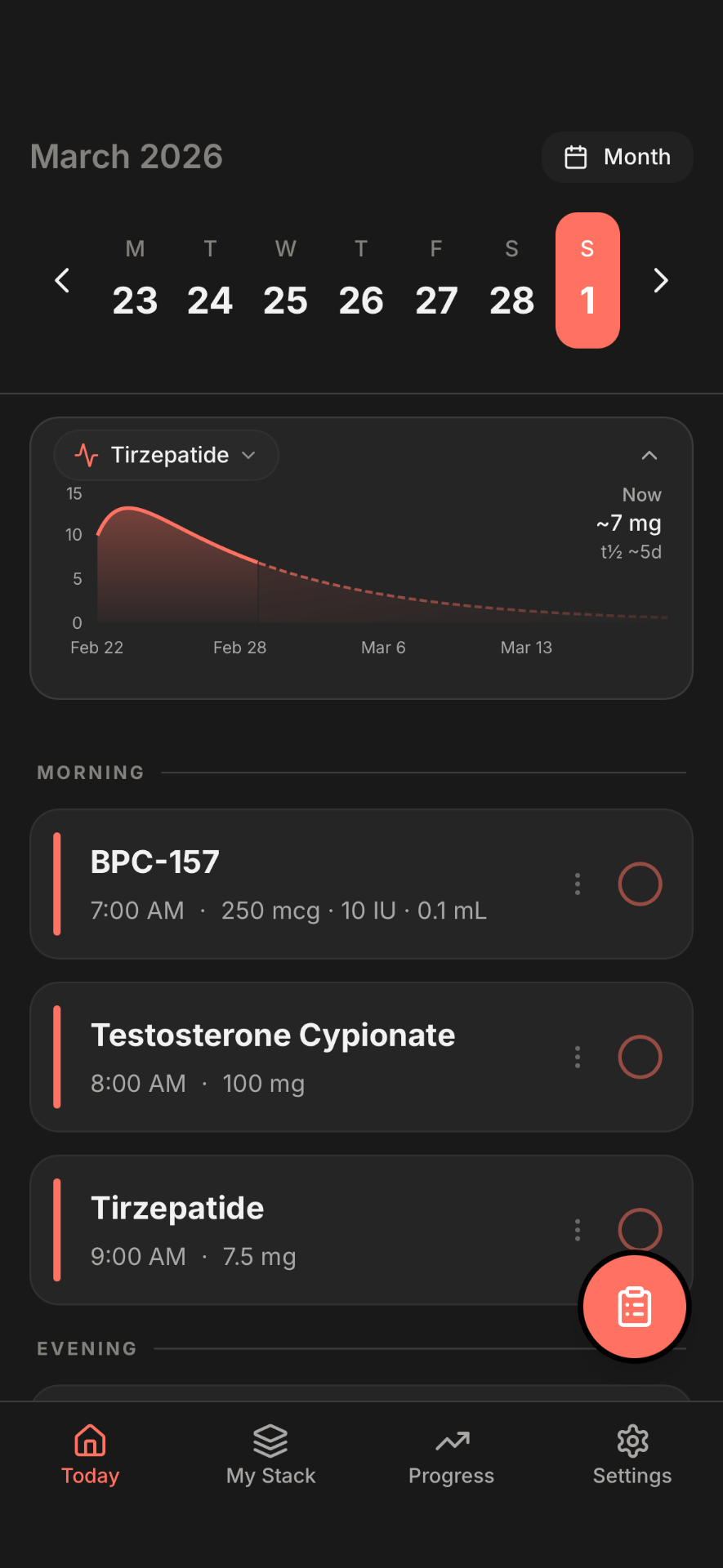
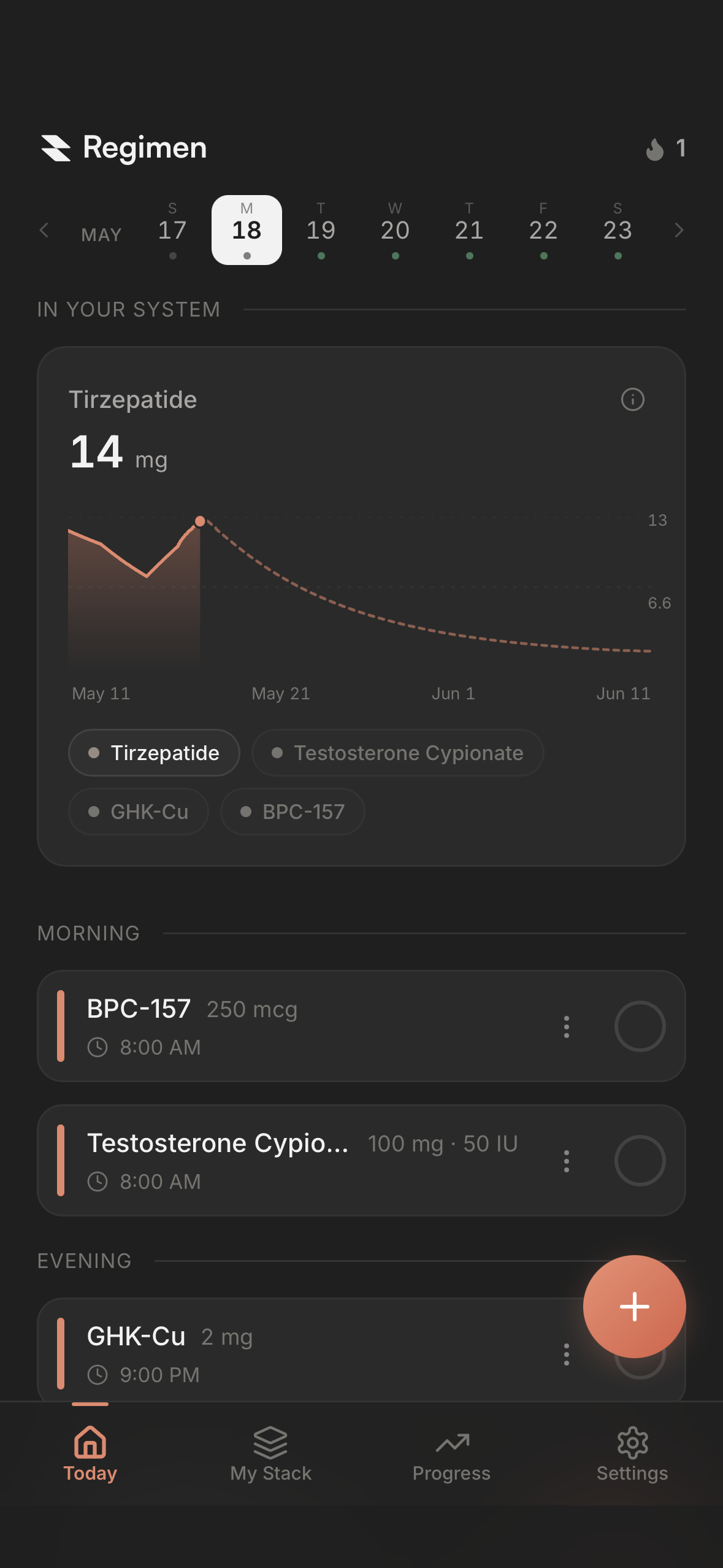
All three are tracked the same way in practice: injection day, time, dose in mg, injection site if you rotate, and the subjective markers afterward. A tracker like Regimen handles all three and shows the PK curve for your specific ester so you can see where you are in the cycle when you draw labs.
Should I track every day or weekly?
Daily subjective markers (mood, energy, libido, sleep) capture the within-cycle variation that weekly tracking misses. For people on once-weekly or twice-weekly injections, the first 3 to 4 days post-injection often feel different from the last 2 to 3 days. That pattern is information.
What you don’t need daily: weight, every lab, every measurement. Weekly weight is enough. Labs are quarterly to twice-yearly after the initial titration window. Trying to track too much causes most new TRT patients to abandon tracking by week 4.
What’s the difference between weekly and twice-weekly injection schedules?
Once-weekly produces a more pronounced peak-to-trough swing in testosterone and estradiol levels. Twice-weekly (typically Monday and Thursday, or any split with roughly even spacing) flattens that curve. Many patients report better day-to-day stability of mood and energy on twice-weekly, though the total weekly dose is the same.
Neither schedule is “better” in a clinical sense. It’s a tradeoff between injection frequency (more injections per week vs. one) and within-week stability (flatter curve vs. more swing). Your prescriber’s preference, your tolerance for self-injection, and your subjective response together decide.
When should I call my prescriber?
Call before your scheduled follow-up if you experience:
- Severe acne that doesn’t improve
- Significant water retention or rapid weight gain
- Nipple sensitivity or breast tissue changes (possible elevated estradiol)
- Mood changes that feel out of character
- Chest pain, shortness of breath, or leg swelling (rare but important: hematocrit-related concerns)
- Any sudden change in libido or erectile function
None of these are reasons to panic. Most have straightforward protocol adjustments. They are reasons to call rather than wait.
Frequently Asked Questions
How long until I feel TRT working?
Energy and libido changes often show up between weeks 2 and 4. Mood and sleep typically stabilize by weeks 4 to 8. Strength and body composition shifts are slower and take 12 to 16 weeks or more. Individual response varies widely.
Do I need to track injection sites?
Yes, especially for intramuscular injections. Site rotation prevents scar tissue buildup. Common rotation patterns are upper outer quadrant of glutes, ventroglutes, and lateral thigh, alternating sides each injection.
What’s a normal estradiol level on TRT?
This is contested. Many clinicians target estradiol (sensitive assay) in the 20 to 40 pg/mL range, with adjustments based on symptoms. Aggressive aromatase inhibitor use to crush estradiol below the lower bound is increasingly avoided in current practice because of the side-effect profile.
Should I use an AI (aromatase inhibitor) from the start?
Most current clinical guidance is to wait for symptoms or lab evidence before introducing an AI. Routine prophylactic AI use is no longer standard. This is a prescriber conversation, not a self-management decision.
How often do I need labs long-term?
After the initial titration window, most patients are on a 6-month or annual lab schedule depending on stability and prescriber preference. Hematocrit and PSA monitoring continues per cardiovascular and prostate-screening guidelines.
Related reading
Ready to track your protocol?
- Smart reminders so you never miss a dose
- Track weight, photos, and progress over time
- Medication level curves for every compound