Anti-inflammatory peptides like BPC-157 and TB-500 get talked about like they’re settled science. They’re not. Here’s the honest state of the evidence for each one people actually use, where the 2026 legal situation stands, and how to tell if any of it is doing something for you.
If you’ve spent any time on recovery forums, you know the pattern. A wrecked shoulder, six weeks of BPC-157, and someone’s back to lifting like nothing happened. TB-500 for a nagging hamstring. KPV for gut flares. The KLOW blend for everything at once. The stories are real to the people telling them, and the goal underneath all of them is the same: heal faster, hurt less, get back to training.
That goal is legit. So let’s go peptide by peptide, what each one is, what people actually reach for it to do, and what you can realistically expect once you strip out the hype.
The quick answer
The recovery and anti-inflammatory peptides people talk about most, sorted by how much human evidence exists behind them:
- BPC-157 and TB-500: the go-to pair for tendons, joints, and soft-tissue recovery. Huge animal data, almost no human data. Popular for a reason, but “proven in people” it is not.
- KPV: the gut-and-skin inflammation one. Clean mechanism, promising, but no human trials specifically for it yet.
- GHK-Cu: the collagen and skin peptide. Topical version has real human data. Injectable version doesn’t.
- KLOW blend: a four-peptide mix (KPV + BPC-157 + TB-500 + GHK-Cu) sold as an all-phases recovery stack.
- Thymosin alpha-1: the one with a real human evidence base, but it’s an immune peptide, not a joint-and-tendon recovery one.
Quick legal note before we dig in: except for thymosin alpha-1 abroad, none of these is an FDA-approved drug. When injected they’re unapproved, sold “for research use,” and off-limits if you get drug-tested. That’s the whole legal story most people need. There’s a fuller version near the end if you want it.
The part I can actually help with is the “how do I know if it’s working” question, and that runs through the whole article.
BPC-157: the soft-tissue recovery one
BPC-157 is where most people start. It’s the peptide people run when a tendon, ligament, or gut lining has been cranky for months and rest alone isn’t cutting it. The pitch is faster soft-tissue healing, and it’s the most talked-about recovery peptide there is.
There’s a real reason people reach for it. The animal evidence is genuinely large. Well over 100 studies in rats and mice show effects on gut integrity, tendon and ligament repair, and angiogenesis (that’s the body growing new blood vessels into an injured area, which is how healing tissue gets fed). That preclinical work is why the community is so convinced, and it’s not nothing.
Here’s what to realistically expect. A 2025 systematic review in an orthopaedic sports medicine journal screened 544 articles on BPC-157. Exactly one was a clinical study in humans. The other 35 that made the cut were animal models.
So as of 2026 there’s no completed, published, randomized placebo-controlled trial showing BPC-157 works for any injury in people. The human evidence is a tiny 2025 IV safety pilot (two people) plus scattered case reports. That’s a safety signal, not proof it heals your shoulder.
None of that means it does nothing. It means if someone tells you it’s “proven” to fix tendons, they’re describing rat studies. And the one way you get burned here is buying an injectable sold as a research chemical and assuming the vial actually contains what the label says. Plenty don’t.
If you run it, the honest move is to measure whether anything changed instead of going off memory, which is where tracking your inflammation markers over time comes in (more on that below). There’s also a BPC-157 tracker if you want a compound-specific log.
TB-500: the recovery peptide people pair with it
TB-500 is BPC-157’s usual running mate. People reach for it for the same reason, nagging soft-tissue stuff that won’t fully heal, and it’s known for getting repair cells to move toward an injury faster. It’s a synthetic 17-amino-acid fragment of a natural protein called thymosin beta-4.
That last detail matters more than it looks, and it’s the thing to get right.
The encouraging human research you’ll see cited is almost always for full-length recombinant thymosin beta-4, which is a larger, related, but genuinely different molecule from the TB-500 fragment people actually inject. When someone points to “human data on TB-500,” they’re usually pointing at trials of the parent protein, not the fragment.
For the fragment itself, there’s no completed human efficacy trial as of 2026. The preclinical work is extensive and the animal safety data looks fine, but long-term human data is thin.
It’s like reading the safety record for a Boeing 747 and assuming it applies to a paper airplane you folded from the same blueprint. Related, sure. The same thing, no.
Realistic expectation: people report faster recovery, the animal data backs the mechanism, and the human proof isn’t there yet. If you run it, track the timeline and how you actually feel over weeks so you’re working from data, not a hunch. The TB-500 tracker keeps that in one place.
KPV: the gut and skin inflammation one
KPV is what people reach for when the problem is inflammation itself, gut flares, skin stuff, autoimmune-related irritation, rather than a torn tendon. It’s a tiny three-amino-acid piece of alpha-MSH, a hormone your body already makes, and the appeal is that it seems to keep the anti-inflammatory action without the pigmentation effects.
The mechanism is genuinely clean. In lab and animal models, KPV blocks NF-kB from moving into the cell nucleus (NF-kB is basically the master switch that turns on inflammation genes), and it lowers the big inflammatory signals: TNF-alpha, IL-1beta, IL-6. On paper that’s exactly what you’d want from an anti-inflammatory.
Here’s the honest limit. There are no registered clinical trials specifically for KPV. Everything is in-vitro, animal colitis models, or dermatology experiments. So it’s a peptide with a great mechanism and zero human efficacy proof, and it isn’t FDA-approved for anything.
If you’re using it for a measurable problem like gut inflammation, that’s actually the good news, because you can track markers and see whether the number moves rather than guessing.
GHK-Cu: the collagen and skin one
GHK-Cu (copper tripeptide) is the peptide people use for skin quality and collagen, and it’s the one corner of this whole world with real human data. One tight point to get straight: the topical version and the injectable version are not the same evidence base.
Topical GHK-Cu has the strongest human evidence in this entire article. A 2002 photoaging trial and a 2023 topical gel study reported roughly a 28% increase in skin collagen density at three months. It’s regulated as a cosmetic ingredient (you’ll see it on labels as “Copper Tripeptide-1”), which is the low-friction, actually-legal way to use it. Injectable GHK-Cu is a different story: mostly preclinical, no human trial confirming it works, not FDA-approved. So when someone says “GHK-Cu has human studies,” the serum has the data, the vial doesn’t.
Whichever route you’re running, the GHK-Cu tracker logs both topical applications and injectable doses on one timeline for skin and recovery changes over time.
LL-37: the one to be careful with
LL-37 shows up on recovery lists, and this one earns a genuine flag. It’s the only human cathelicidin antimicrobial peptide, part of your innate immune system, with broad germ-killing activity. Sounds great.
The catch is real. LL-37 has both anti-inflammatory and pro-inflammatory effects depending on concentration, and at higher concentrations (roughly the 1 to 10 micromolar range in studies) it’s actually toxic to a lot of human cell types. It’s not a clean “calm the inflammation down” peptide. The research is mechanistic and preclinical, and there’s no FDA-approved LL-37 therapy.
I’m including it because you’ll see it recommended, and it’s more double-edged than the forum version makes it sound.
Thymosin alpha-1: the real evidence base, different category
If you want to see what actual human peptide evidence looks like, thymosin alpha-1 is it. Sold abroad as Zadaxin, approved in 35+ countries (not the US) for hepatitis B and immune deficiency, with 30+ clinical trials and more than 11,000 subjects across hepatitis, HIV, cancer immunotherapy, sepsis, and COVID.
That’s a different universe from BPC-157’s single clinical study.
Two honest notes. Even this one has mixed results: a large 2025 sepsis trial called TESTS (around 1,100 patients) found no clear survival benefit, so “well-evidenced” still doesn’t mean “works for everything.” And it’s an immune-modulating peptide, not a tendon-and-joint recovery one. It’s on this list for completeness, not because it does what BPC-157 promises.
The KLOW blend: the all-phases stack
KLOW comes up constantly because it bundles four popular peptides into one vial and pitches “one peptide per phase of healing.” People use it for systemic inflammation, gut issues, autoimmune-related tissue damage, and post-surgery recovery, with a community timeline of weeks to months.
The name is an acronym of the ingredients:
| Letter | Peptide | What it’s pitched to do |
|---|---|---|
| K | KPV | Calm inflammation |
| L | BPC-157 | Grow new blood supply to the area |
| O | TB-500 | Recruit and move repair cells in |
| W | GHK-Cu (“GloW”) | Tissue remodeling and collagen |
The story is tidy, and that’s the appeal: KPV handles inflammation, BPC-157 builds blood supply, TB-500 moves repair cells in, GHK-Cu remodels the tissue. Here’s the real tradeoff nobody in the blend threads mentions. You’re stacking four peptides at once, so if something helps (or something goes sideways), you have no idea which of the four did it. And like the others, it’s sold “for research use only” and none of the four is an approved drug when injected. If you run a four-peptide stack, tracking becomes more important, not less, because it’s the only way to make sense of a moving target.
The legal reality, kept short
You don’t need a lecture on this, so here’s the version that actually matters.
None of these (except thymosin alpha-1 abroad) is an FDA-approved drug. Injected BPC-157, TB-500, KPV, and injectable GHK-Cu are unapproved new drugs in the US. That’s the durable line.
The details shifted this spring. Around April 23, 2026, the FDA removed 12 peptides, including BPC-157, TB-500, KPV, injectable GHK-Cu, and LL-37, from its Category 2 “significant safety risks” list. Forums treated that as a green light. It isn’t. Removal from that list doesn’t mean approved and doesn’t mean freely compoundable, and the compounding question is literally under review right now: the FDA’s Pharmacy Compounding Advisory Committee is set to review BPC-157, KPV, TB-500, and MOTS-C on July 23, 2026. The accurate word is “under review,” not “banned” and not “legal.”
One thing worth knowing if you compete: if you get drug-tested, these are a problem. BPC-157 is prohibited at all times under WADA (S0, referenced under S2), with real sanctions on record including a four-year ban tied to BPC-157/TB-500 and a 2024 one-year ban of a US speed skater. TB-500 has been banned under S2 since 2011. GHK-Cu and KPV aren’t named, but WADA’s S0 catch-all can capture any unapproved substance, so assume none of them is safe for a tested athlete. The one clean exception is topical cosmetic GHK-Cu, which is legally sold as a skincare ingredient.
How to actually know if it’s working
This is the part that separates spending money on peptides from learning something from them.
The honest way to tell whether any of this is doing something is to measure inflammation directly instead of going off how your knee feels on a random Tuesday. The markers worth logging:
- hs-CRP (high-sensitivity C-reactive protein) is the headline one. Your liver pumps it out within hours of an inflammatory trigger, and the high-sensitivity version catches the low-grade chronic inflammation that regular CRP misses. It’s the best single marker to repeat over time, and most consumer lab panels include it.
- ESR (erythrocyte sedimentation rate) moves slower than CRP, which makes it better for tracking longer chronic trends than sudden changes.
- IL-6 is the upstream cytokine that drives CRP production. More specialized, less commonly tracked, but it’s the mechanism behind the number.
- Fibrinogen sometimes rides along in the same panel as a secondary marker.
For most people, hs-CRP over time is the practical one, with ESR alongside it for slower trends.
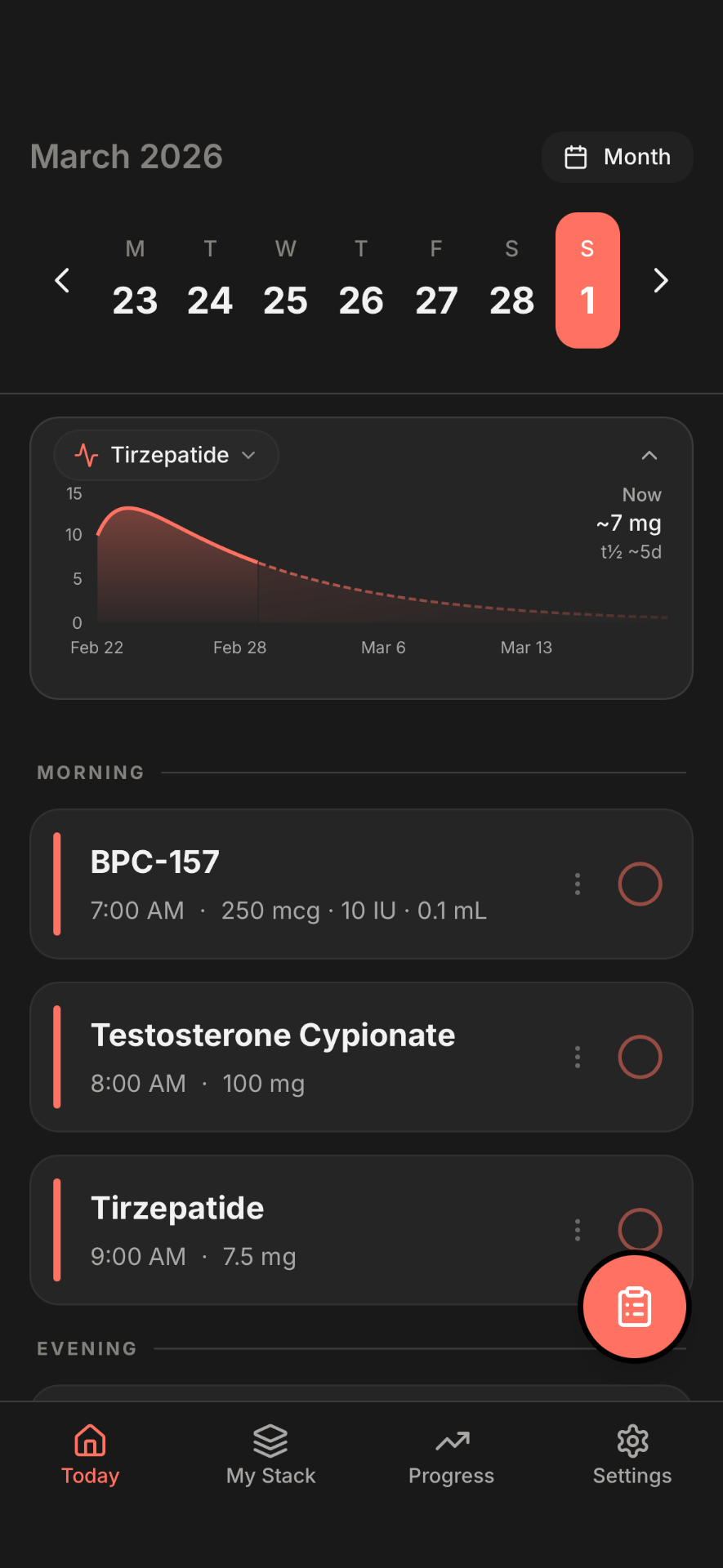
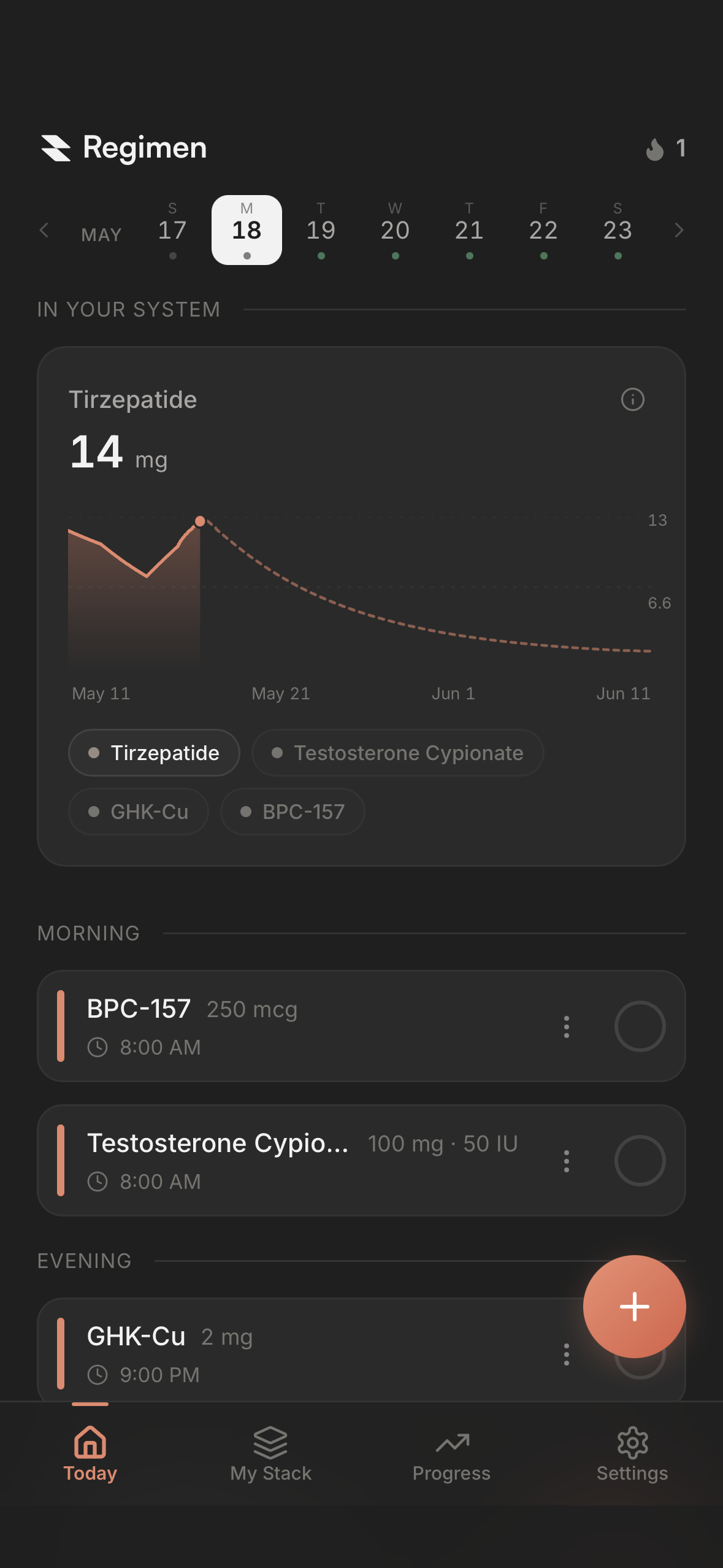
This is exactly what Regimen is built to do, and it’s why one-off lab results never tell you much on their own. Regimen’s built-in pattern detection connects what you’re taking to your actual labs and your daily markers, then watches how they move together over time. So instead of “my CRP is 1.2, is that good,” you get “your hs-CRP has trended down over the eight weeks you’ve been running this, and your recovery check-ins moved with it.” That’s the difference between a number and an answer.
One caveat so you don’t fool yourself: if your hs-CRP drops while you’re running a peptide, that’s correlation, not proof the peptide did it. Sleep, training load, diet, and stress all move that number. Which is the other reason the daily markers matter, they give you the context to tell those apart instead of crediting the peptide by default.
Run it like you’re actually curious what happens
If you’re going to experiment on yourself, get something back for it. Log what you take, track hs-CRP over time, and let the data tell you whether it worked instead of the forum.
That’s what Regimen does. It connects your peptides to your labs and your daily markers and surfaces what’s actually moving together, so you find out whether the thing is working for you specifically.
Running the topical protocol? The BPC-157 tracker and GHK-Cu tracker pages walk through the specifics.
Frequently Asked Questions
Are anti-inflammatory peptides proven to work in humans?
Mostly no. BPC-157, TB-500, and KPV are backed almost entirely by animal and lab studies, with essentially no completed human efficacy trials as of 2026. Topical GHK-Cu has real human data, and thymosin alpha-1 has a large human evidence base, but it’s an immune-modulator, not a recovery peptide. Anyone calling the popular recovery peptides “proven” in people is overselling it.
Is BPC-157 legal in 2026?
It’s not an FDA-approved drug, and injected BPC-157 is an unapproved new drug in the US. The FDA removed it from the Category 2 list in April 2026, but that isn’t approval, and its compounding status is under active review, with a committee vote scheduled for July 23, 2026. The accurate description right now is “unapproved and under review,” not “legal” and not “banned.”
Will these peptides make me fail a drug test?
For a tested athlete, assume yes. BPC-157 and TB-500 are explicitly prohibited by WADA, and BPC-157 carries real multi-year sanctions. GHK-Cu and KPV aren’t named on the list, but WADA’s S0 catch-all can capture any unapproved substance, so none of them is safe for someone who gets tested.
What’s the best way to tell if an anti-inflammatory peptide is actually doing anything?
Track hs-CRP over time. It’s the most sensitive widely available inflammation marker, and repeating it gives you real data instead of a gut feeling. Just remember correlation isn’t causation: a drop while you’re running a peptide could be sleep, diet, or training just as easily as the peptide.
Is topical GHK-Cu the same as injectable GHK-Cu?
Same molecule, completely different evidence and legal status. Topical GHK-Cu is a legally sold cosmetic ingredient with actual human collagen-density data. Injectable GHK-Cu is an unapproved drug with mostly preclinical evidence. Don’t treat the skincare studies as proof the injection works.
This article is for educational purposes only and is not medical advice. The peptides discussed here are not FDA-approved for the uses described, and most are unapproved new drugs when injected. Always consult a qualified healthcare provider before starting, modifying, or stopping any compound.
Ready to track your protocol?
- Smart reminders so you never miss a dose
- Track weight, photos, and progress over time
- Medication level curves for every compound