The Bottom Line
BPC-157 is the most-tracked starter peptide in the recovery community, largely because the dosing windows are forgiving and most users tolerate it well. It remains a research-use chemical in the United States and is not FDA-approved for human use. If you’re considering it, the conversation belongs with a qualified clinician, not a forum post. What this article covers: what BPC-157 users typically track in the first protocol, the data points that make a follow-up conversation with a provider productive, and the patterns worth watching across the first 4 to 8 weeks.
This is educational content, not medical advice. BPC-157 is not FDA-approved for human use and is regulated as a research chemical in the United States. Use of any peptide for personal health applications should involve a qualified clinician. Nothing in this article should be read as a recommendation to start, dose, or self-administer BPC-157.
If you’ve spent time in recovery, longevity, or biohacking circles, BPC-157 comes up quickly. It’s often described as a “gateway peptide” because the tolerability profile is generally mild and the protocols most users report are relatively forgiving compared to more potent or more easily mis-dosed compounds.
This article doesn’t tell you how to dose BPC-157. That’s a clinician’s job. What it does is walk through what people actually track when they’re running a BPC-157 protocol, why those data points matter for a follow-up conversation, and what patterns are worth watching across the first 4 to 8 weeks. If you’re working with a knowledgeable provider, this is the structure that makes those check-ins productive.
Why does BPC-157 come up so often as a starter protocol?
Three reasons surface repeatedly in the recovery community:
- Tolerability. Most users report few systemic side effects at the dose ranges discussed in community protocols. Local injection-site reactions are the most common complaint.
- Reconstitution forgiveness. The reconstitution math has a wider acceptable window than more potent peptides where small calculation errors can produce 2x or 10x dosing accidents.
- Subjective response timeline. Many users report noticing recovery-related changes within 1 to 2 weeks, which keeps motivation high for protocol completion.
Important context: most of the human-relevant evidence for BPC-157 is preclinical (animal studies, in vitro work) or anecdotal. The clinical trial base in humans is small. The community confidence in the molecule outpaces the formal evidence base. Anyone making a decision about whether to use it should know that.
What do BPC-157 users typically track?
The data points that matter most depend on why the protocol was started in the first place. For a recovery-focused protocol, common tracked markers include:
- The specific symptom or injury site. Pain level (1 to 10), range of motion, swelling, or whatever measurable thing is the reason you’re running the protocol.
- Injection day, time, and site. Site rotation reduces local irritation. Logging the site at injection time is the only reliable way to maintain rotation across a 4 to 8 week protocol.
- Dose in mcg. Most community protocols report dosing in micrograms, not milligrams. Confusion between the two is the most common dose-math mistake.
- Reconstitution details. Vial size, volume of bacteriostatic water used, resulting concentration, and the corresponding insulin syringe unit count. The peptide reconstitution calculator handles this math; logging it ensures you don’t have to recalculate every time.
- Side effects. Injection-site reactions, any GI changes for oral protocols, fatigue, sleep changes, or anything else that wasn’t there before starting.
What about reconstitution? Why does it matter so much?
Reconstitution is where the most common preventable mistakes happen. The peptide arrives as a lyophilized powder in a vial. Bacteriostatic water is added to dissolve it. The concentration that results depends on how much water was added, and that concentration determines how many syringe units you draw per dose.
Getting the math wrong doesn’t usually create a safety crisis with BPC-157 specifically, because the dose windows discussed in the community are wide. But it does mean you can’t know what dose you actually took, which makes any subjective response data hard to interpret. If the recovery markers don’t move, was it because the dose was too low, too high, or simply not working? Without accurate reconstitution math, you can’t tell.
The peptide reconstitution calculator takes vial size, bacteriostatic water volume, and target dose, and returns the exact syringe unit count to draw. Logging the reconstitution details once per vial means you reference the log, not your memory, every time you redraw.
Sub-Q or oral? Which form is more common?
Subcutaneous injection is the most commonly reported route in the community for systemic recovery applications. Oral BPC-157 is sometimes used for gut-specific applications, with the rationale being that the molecule may exert local effects in the GI tract even if systemic absorption is limited.
The evidence base for either route in humans is limited. Bioavailability differences between oral and injectable BPC-157 in humans have not been rigorously established in the peer-reviewed literature. Community reports lean toward subcutaneous for systemic effects.
How long until you’d notice anything?
Self-reports in the recovery community typically describe subjective changes within 1 to 2 weeks, with more pronounced changes by weeks 3 to 4. Some users report no perceptible change at all, which is consistent with the variability you’d expect from any intervention with limited human clinical data.
This is exactly why tracking the specific symptom you started for matters. Without a baseline measurement before starting, you have no way to detect a 15% improvement in pain or a 20% improvement in range of motion. Memory smooths the trajectory in both directions: people who feel better tend to forget how bad it was, and people who feel no better tend to under-credit modest gains.
The BPC-157 plus TB-500 stack: what’s worth knowing?
The combined BPC-157 plus TB-500 protocol is the most-discussed peptide stack in the recovery community, and many users report that running both produces a different subjective response than either alone. The mechanistic rationale is that the two molecules act through different pathways (BPC-157 via angiogenesis and growth-factor modulation; TB-500 via actin sequestration) and may have complementary effects on soft-tissue repair.
The human clinical evidence for the stack is thin. The community confidence is high. If you’re considering it, the same principle applies: this is a clinician conversation, not a self-management decision. Our BPC-157 plus TB-500 stack guide covers the protocol patterns people report.
When should you stop and reassess?
Specific situations that warrant pausing and contacting a clinician:
- Any new unexplained symptom that emerges after starting the protocol
- Persistent injection-site reactions beyond mild redness
- Any GI symptoms that don’t resolve within a few days
- No change in the target symptom or injury after 4 to 6 weeks
- Any concern from a healthcare provider reviewing your labs
“Stopping” is a feature of a responsible protocol, not a failure. Recovery markers either move or they don’t; if they don’t move after a reasonable trial, continuing is just expense and exposure without benefit.
Frequently Asked Questions
How do people decide between BPC-157 alone and the BPC-157 plus TB-500 stack?
Most community decisions come down to severity of the recovery situation, cost, and clinician guidance. Mild or acute issues are commonly run with BPC-157 alone first. Chronic soft-tissue issues are where the stack more often appears.
Is BPC-157 FDA-approved?
No. BPC-157 is not FDA-approved for human use. It is regulated as a research chemical in the United States and was placed on the FDA’s 503A bulks Category 2 list in 2023, restricting compounding-pharmacy access. Any use for personal health applications belongs in a conversation with a qualified clinician who can weigh the risk and evidence picture for your specific case.
Why do people track injection sites for BPC-157?
Site rotation reduces the chance of local irritation, scar tissue, or repeated micro-trauma at one site. For subcutaneous injection, common rotation sites include the abdomen (avoiding the navel), the outer upper thighs, and sometimes the upper outer arm.
What’s the most common reconstitution mistake?
Confusing micrograms and milligrams in the dose math, or assuming the syringe unit count from one vial concentration carries over to a vial reconstituted with a different volume of bacteriostatic water. A calculator and a written reconstitution log prevent both.
How do people decide between BPC-157 alone and the BPC-157 plus TB-500 stack?
Most community decisions come down to the severity and chronicity of the recovery situation, cost, and clinician guidance. Mild or acute issues are commonly run with BPC-157 alone first. Chronic or stubborn soft-tissue issues are more often where the stack appears in community protocols.
What should I bring to a follow-up appointment about a BPC-157 protocol?
The reconstitution details for each vial, the dose log, the injection-site rotation pattern, the baseline measurement of whatever symptom you started for, and the current measurement. A clinician reviewing your protocol can’t optimize anything without that data.
Related reading
- BPC-157 tracker
- BPC-157 plus TB-500 stack guide
- GHK-Cu vs BPC-157 for joint recovery
- Peptide reconstitution calculator
Ready to track your protocol?
- Smart reminders so you never miss a dose
- Track weight, photos, and progress over time
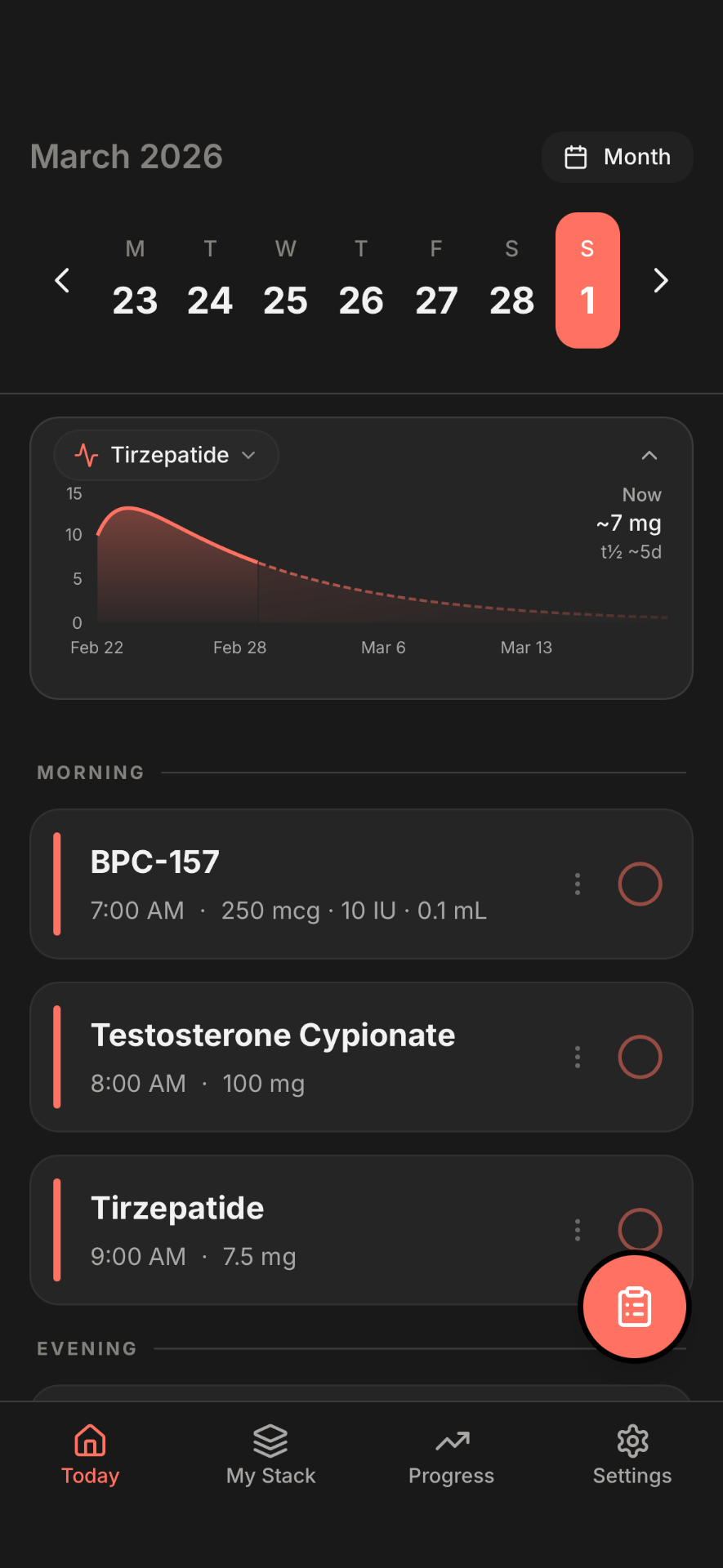
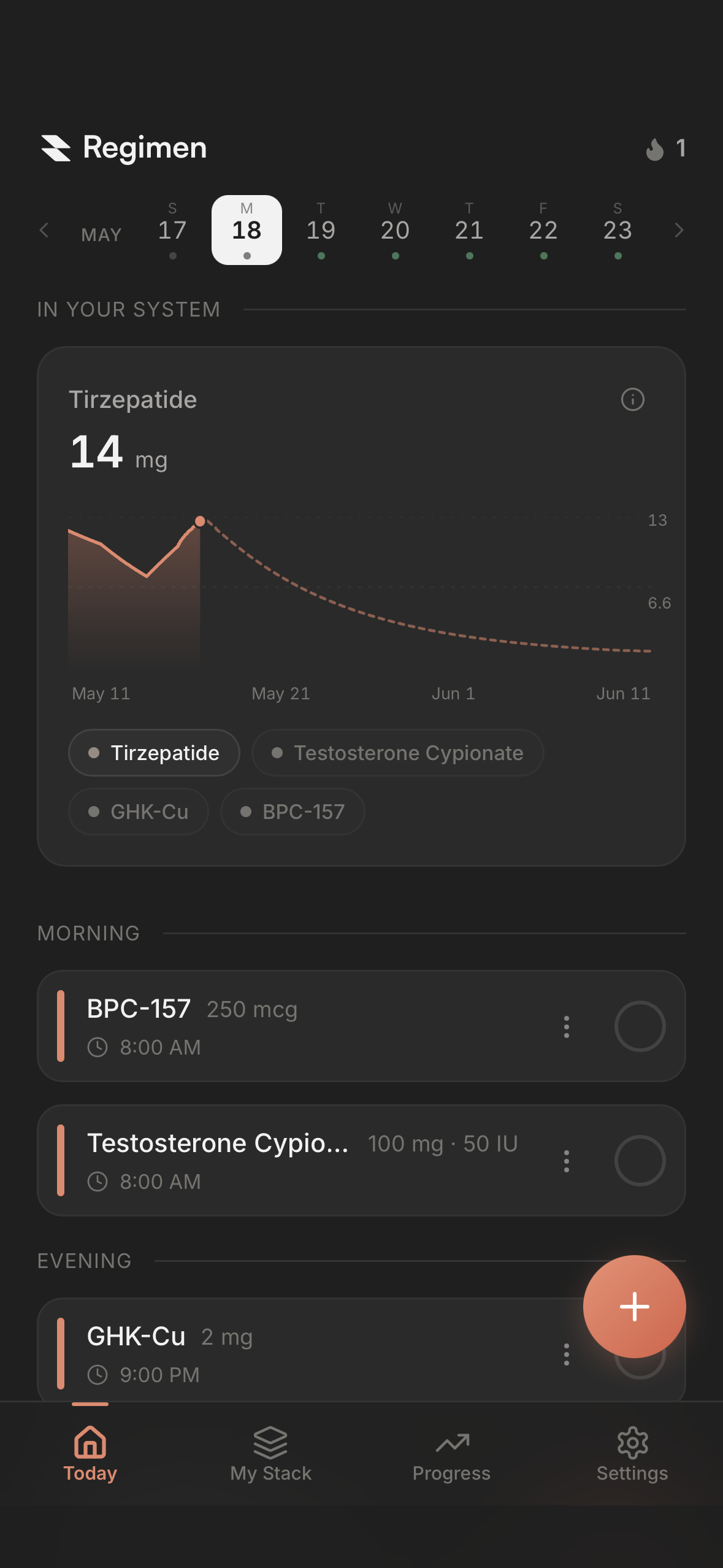
- Medication level curves for every compound