The Bottom Line
BPC-157 is your go-to for localized healing: tendons, ligaments, gut tissue, injuries you can inject near. TB-500 is better for systemic recovery: widespread inflammation, multiple injury sites, and post-surgical healing. Most experienced users stack both because they work through completely different pathways. If you can only pick one: BPC-157 for a specific injury, TB-500 for general recovery.
BPC-157 and TB-500 are two of the most widely used recovery peptides. BPC-157 is a gastric peptide studied for tendon and gut healing, while TB-500 (Thymosin Beta-4) promotes tissue repair and reduces inflammation. They are frequently stacked together in injury recovery protocols. Choosing between them (or deciding to run both) depends on what you’re trying to heal, your budget, and how you feel about daily injections.
This guide skips the deep science and focuses on the practical differences: which one works better for which injuries, how to dose each one, realistic timelines, and when stacking makes sense versus running one on its own.
Quick Comparison Table
| Factor | BPC-157 | TB-500 |
|---|---|---|
| Full name | Body Protection Compound-157 | Thymosin Beta-4 fragment |
| Origin | Derived from gastric juice protein | Naturally occurring in most cells |
| How it works | New blood vessel formation, growth factor boost at injury site | Cell migration, reduces systemic inflammation |
| Best for | Localized injuries, tendons, gut healing | Systemic recovery, multiple injuries, post-surgical |
| Where to inject | Near the injury (subcutaneous) | Anywhere subcutaneous (it’s systemic) |
| Typical dose | 250-500 mcg, 1-2x daily | 2-2.5 mg, 2x weekly (loading), 1x weekly (maintenance) |
| How fast it kicks in | 1-2 weeks | 2-4 weeks |
| Protocol length | 4-8 weeks | 6-12 weeks |
| Cost per month | $40-80 | $60-120 |
| Oral option? | Yes (for gut issues, though less studied) | No (must be injected) |
How They Work (The Short Version)
BPC-157: The Targeted Healer
BPC-157 works by promoting the formation of new blood vessels at the injury site. More blood flow means more nutrients, oxygen, and immune cells reaching damaged tissue. It also boosts growth factors and has anti-inflammatory properties that are particularly effective in the gut.
The big advantage is its local action. When you inject near an injured tendon or joint, it concentrates healing effects right where you need them. Think of it as calling a specialist to fix one specific thing.
TB-500: The Systemic Rebuilder
TB-500 (a fragment of Thymosin Beta-4) works by helping cells migrate to injury sites and reducing inflammation throughout your body. It doesn’t matter where you inject it; it distributes everywhere and helps wherever there’s damage.
Think of it as a general contractor who walks through your whole house and fixes everything, not just one room.
When BPC-157 Is the Better Choice
- One specific injury: Torn rotator cuff, tennis elbow, Achilles issues, patellar tendon problems. Injecting near the site concentrates the effect
- Gut healing: IBS, leaky gut, ulcers, gastric inflammation. BPC-157 was literally discovered from a gastric protein, so it’s uniquely suited for this
- Tendon and ligament work: More research specifically on tendon healing, with studies showing faster collagen rebuilding
- Budget-friendly: Cheaper than TB-500 and often enough on its own for straightforward injuries
- Faster results: Many people notice pain relief within the first 1-2 weeks
When TB-500 Is the Better Choice
- Multiple injuries: Bad shoulder AND tweaked knee AND chronic back issues? TB-500 addresses everything from a single injection
- Post-surgery: General tissue remodeling and reducing inflammation throughout the body
- Muscle injuries: TB-500 is particularly relevant for muscle fiber repair and preventing scar tissue buildup
- Cardiac recovery: TB-500 has unique research on heart tissue repair that BPC-157 doesn’t match
- Chronic inflammation: When the inflammation is diffuse without a clear focal point
- Simpler schedule: Only 1-2 injections per week (vs BPC-157’s daily shots), and the injection site doesn’t matter
Why Most People Stack Both
Here’s what you’ll hear in every peptide community: “Why not both?” And the logic is solid.
BPC-157 and TB-500 work through completely different mechanisms. BPC-157 drives local healing at the injury site. TB-500 provides systemic anti-inflammation and cell migration. Running both gives you local precision AND full-body coverage, and since they don’t compete for the same receptors, there’s no overlap or diminishing returns.
Typical Stack Protocol
| Phase | BPC-157 | TB-500 | Duration |
|---|---|---|---|
| Loading | 500 mcg/day (near injury) | 2.5 mg 2x/week | 4 weeks |
| Maintenance | 250 mcg/day | 2.5 mg 1x/week | 2-4 weeks |
| Off | - | - | 2-4 weeks |
For a complete week-by-week stacking guide with reconstitution math and expectations, check out our BPC-157 + TB-500 Recovery Stack Guide.
Popular Blends: Wolverine, GLOW & KLOW
If you don’t want to source BPC-157 and TB-500 separately, pre-made blends are everywhere. These combine multiple peptides in a single vial so you only need one injection. The tradeoff is you can’t adjust each peptide’s dose independently.
The Wolverine Stack
This is probably the most talked-about recovery blend in the peptide community. It typically combines BPC-157, TB-500, and GHK-Cu (a copper peptide for collagen and skin repair). The name should tell you the vibe: it’s marketed as the ultimate “heal everything” stack. If you’re dealing with both soft tissue damage and want some skin/collagen benefits, this is the popular option.
GLOW (GHK-Cu + TB-500 + BPC-157)
A 3-peptide blend: 50mg GHK-Cu, 10mg TB-500, and 10mg BPC-157 per vial (70mg total). Primarily used for skin, collagen, and tissue repair. Similar to the Wolverine concept but with standardized ratios. Because the ratio is locked, dosing for one peptide automatically determines your dose of the other two.
KLOW (GHK-Cu + BPC-157 + TB-500 + KPV)
Builds on the GLOW formula by adding KPV, an anti-inflammatory peptide. 80mg total per vial. The extra KPV component targets inflammation more aggressively, which some users prefer for chronic conditions. Same fixed-ratio tradeoff as GLOW.
For all blend dosing math, use our Peptide Blend Calculator. It’ll break down exactly how much of each peptide you’re getting per injection based on your reconstitution volume.
Dosing Protocols
BPC-157 Dosing
- Standard dose: 250-500 mcg per injection
- Frequency: 1-2x daily (morning and evening for faster healing)
- Where to inject: Subcutaneous, as close to the injury as possible
- Common vial: 5mg reconstituted with 2mL BAC water = 250 mcg per 10 units on an insulin syringe
- Cycle length: 4-8 weeks
TB-500 Dosing
- Loading dose: 2-2.5 mg, 2x per week for 4-6 weeks
- Maintenance dose: 2-2.5 mg, 1x per week for 4-6 weeks
- Where to inject: Subcutaneous anywhere (abdomen, thigh; doesn’t need to be near injury)
- Common vial: 5mg reconstituted with 1mL BAC water
- Cycle length: 8-12 weeks
Need help with the reconstitution math? Use our Peptide Reconstitution Calculator.
Side Effects Compared
Both peptides are generally well-tolerated. Side effects are mild and uncommon. Here’s what people report:
| Side Effect | BPC-157 | TB-500 |
|---|---|---|
| Injection site irritation | Mild, common | Mild, common |
| Nausea | Rare, usually with oral dosing | Very rare |
| Headache | Occasional, first few days | Occasional during loading |
| Dizziness | Rare | Uncommon, dose-dependent |
| Fatigue | Not typically reported | Some users notice it during loading phase |
Cost Comparison
Budget is a real factor for a lot of people picking between these two. Here’s what you’re looking at:
| Protocol | Monthly Cost (approx) | 8-Week Total |
|---|---|---|
| BPC-157 only (500 mcg/day) | $40-80 | $80-160 |
| TB-500 only (2.5 mg 2x/week) | $60-120 | $120-240 |
| BPC-157 + TB-500 stack | $100-200 | $200-400 |
| Pre-made blend (GLOW/Wolverine) | $80-150 | $160-300 |
Pre-made blends simplify your protocol to a single injection per day. The tradeoff is less dosing flexibility since you can’t adjust one compound without changing the other. Use our Peptide Blend Calculator to figure out what you’re getting per injection from any blended vial.
Tracking Your Recovery Protocol
Recovery peptides are one area where tracking makes a huge difference. Without logging, you’re guessing whether the peptides are actually working or if you would’ve healed on your own.
What to Track
- Pain level (1-10): Log daily. Look for the trend over weeks, not day-to-day noise
- Range of motion: Note what movements are limited at the start and test weekly
- Injection sites: Rotate and log to avoid irritation, especially with BPC-157’s daily schedule
- Dose and timing: Essential if you’re transitioning from loading to maintenance
- Sleep and energy: General recovery markers that tend to correlate with healing progress
Frequently Asked Questions
Can I take BPC-157 and TB-500 together?
Yes. Stacking them is one of the most common peptide protocols. They work through different mechanisms, so the combination is complementary, not redundant.
Which is better for tendon injuries: BPC-157 or TB-500?
BPC-157 is generally preferred for localized tendon and ligament injuries because it can be injected near the injury site. TB-500 is better for systemic inflammation or multiple injury sites.
Is BPC-157 or TB-500 better for gut healing?
BPC-157 is the clear choice. It’s derived from a gastric peptide and has extensive research on gut tissue repair, ulcer healing, and intestinal inflammation.
How long does it take for BPC-157 to work?
Most users notice effects within 1-2 weeks, with significant improvement by weeks 3-4. Full tissue healing takes 4-8 weeks depending on injury severity.
Which is cheaper: BPC-157 or TB-500?
BPC-157 is generally cheaper. A typical month costs $40-80, while TB-500 costs $60-120. Running both typically costs $100-200/month.
Do I need to cycle BPC-157 or TB-500?
Common practice is 4-8 week cycles with 2-4 weeks off. Most users run them for a specific injury and stop once healed.
Disclaimer: This article is for educational purposes only and is not medical advice. BPC-157 and TB-500 are research peptides and are not FDA-approved for human use. Always consult with a healthcare provider before starting any peptide protocol. Individual responses vary.
Ready to track your protocol?
- Smart reminders so you never miss a dose
- Track weight, photos, and progress over time
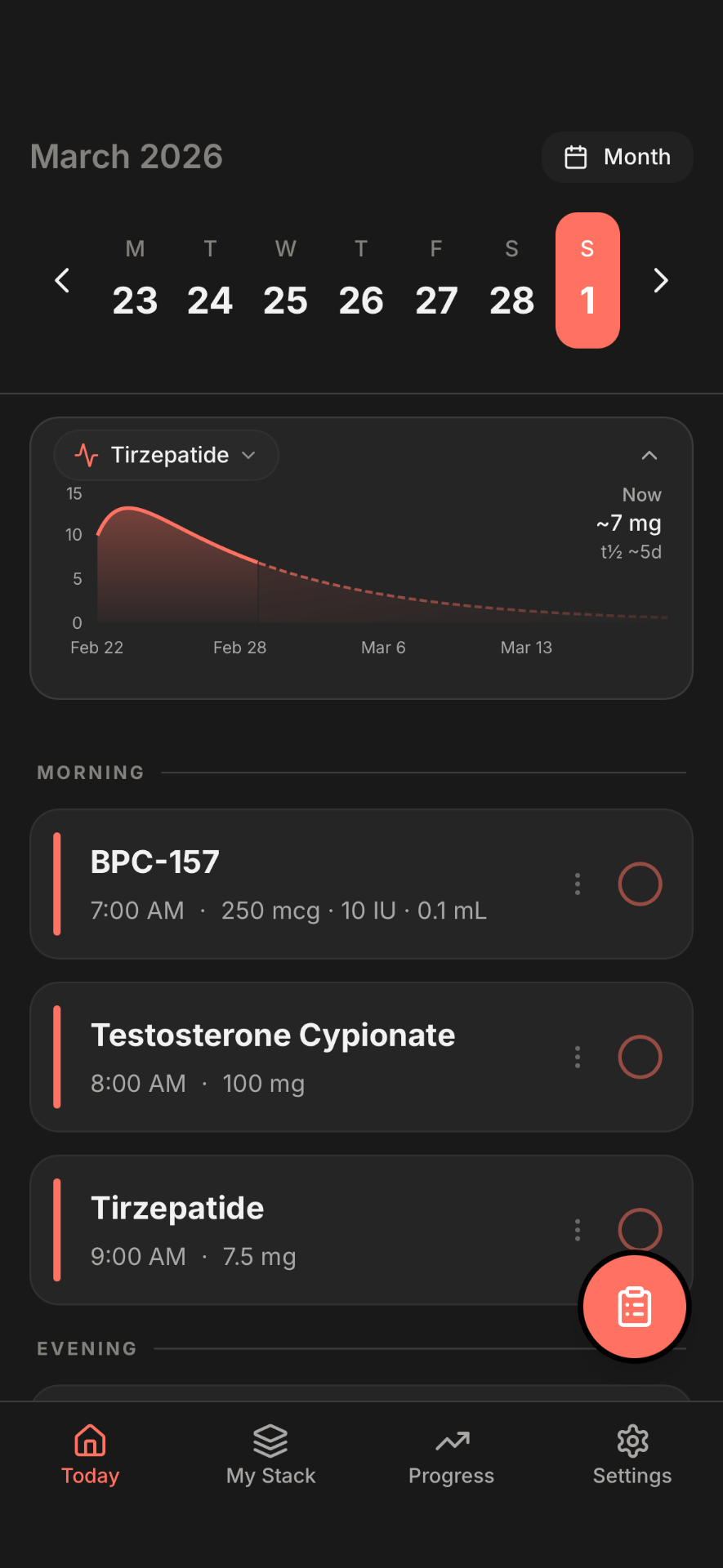
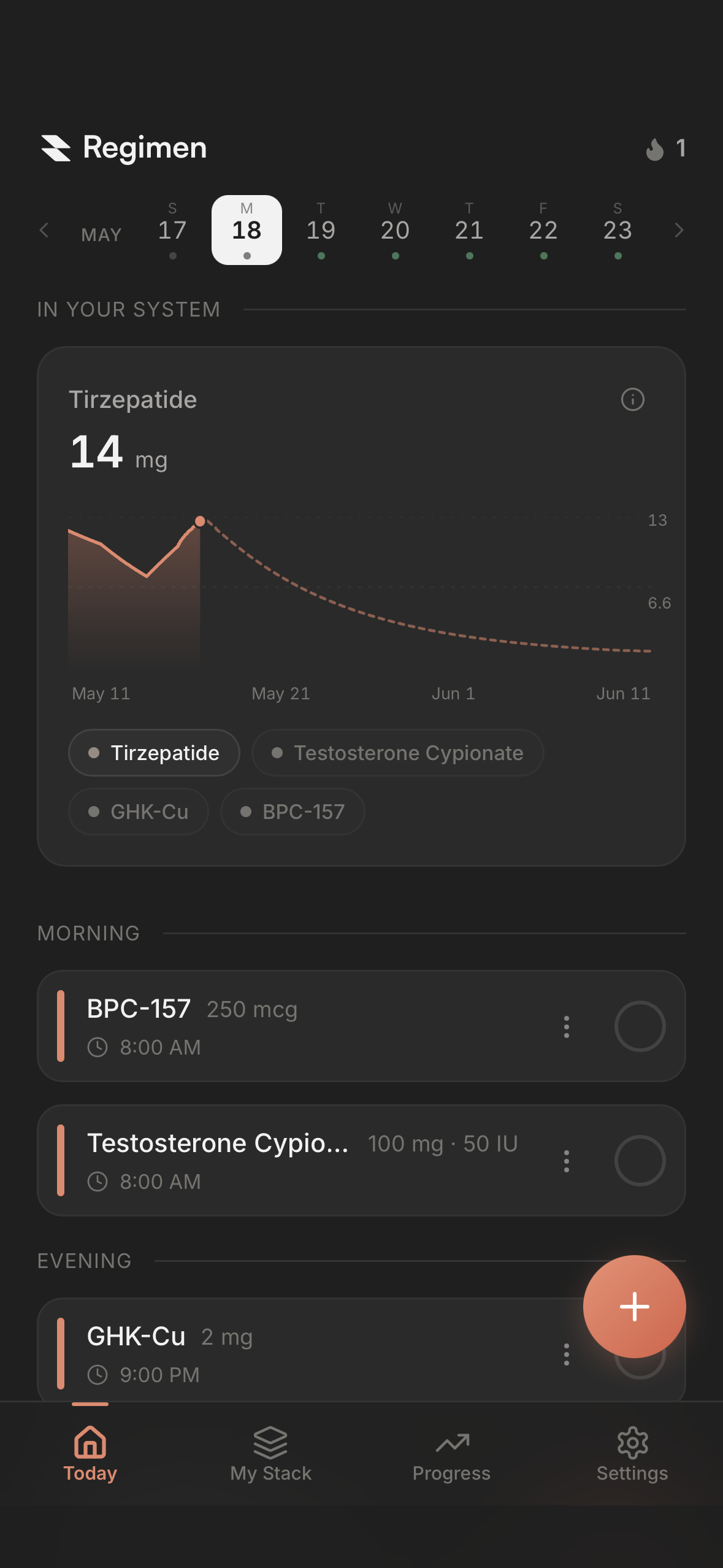
- Medication level curves for every compound
How long does it take for TB-500 to work?
TB-500 typically takes a bit longer than BPC-157 to kick in, usually 2-4 weeks. Loading doses (higher initial doses for the first 2-4 weeks) are common to speed things up. Full protocol duration is typically 6-12 weeks.
Can I inject BPC-157 and TB-500 in the same syringe?
Some people do combine them for convenience, but most providers recommend separate injections. They have different optimal approaches: BPC-157 works best injected near the injury site, while TB-500 works systemically from any subcutaneous spot.