Do I Have Low Testosterone? Free Screening Quiz (ADAM Test)
The validated ADAM questionnaire. Answer 10 quick yes/no questions to see if your symptoms line up with low testosterone. Takes about a minute.
ADAM questionnaire
A 10-question screening tool for low testosterone symptoms. Not a diagnosis.
1.Do you have a decrease in libido (sex drive)?
2.Do you have a lack of energy?
3.Do you have a decrease in strength and/or endurance?
4.Have you lost height?
5.Have you noticed a decreased "enjoyment of life"?
6.Are you sad and/or grumpy?
7.Are your erections less strong?
8.Have you noticed a recent deterioration in your ability to play sports?
9.Are you falling asleep after dinner?
10.Has there been a recent deterioration in your work performance?
Answer all 10 questions to see your result.
This screening tool is for informational purposes only, so always double-check your result with a healthcare provider. The ADAM questionnaire is a screening instrument, not a diagnostic test. We assume no liability for dosing errors.
Last updated September 2026 · Reviewed by the Regimen Team
The tool
How it works, what it tells you, what it doesn't.
This screening quiz uses the ADAM questionnaire, a 10-question tool developed at Saint Louis University to flag symptoms linked to low testosterone. You answer yes or no to questions about libido, energy, mood, strength, and more, and it tells you whether your answers meet the ADAM criteria for possible androgen deficiency. It is deliberately sensitive, so it catches most men with low testosterone but also flags some men whose levels are normal. That is the point of a screener: a positive result is a reason to get blood work, not a diagnosis. Only a morning blood draw can confirm low testosterone.
How to use it
How the Screening Quiz Works
- 01
Answer 10 yes/no questions
Each question asks about a common symptom of low testosterone, like libido, energy, and mood.
- 02
Get your screening result
See whether your answers meet the ADAM criteria for possible androgen deficiency.
- 03
Review your next steps
If your result is positive, learn which blood tests to ask your doctor for.
- 04
Confirm with blood work
Only a morning blood draw can confirm low testosterone. Bring your results to your doctor.
What Is the ADAM Questionnaire?
The ADAM (Androgen Deficiency in the Aging Male) questionnaire is a validated clinical screening tool developed by researchers at Saint Louis University. It’s used by healthcare providers as a quick initial assessment for symptoms of low testosterone.
The questionnaire has an 88% sensitivity rate, meaning it correctly identifies most men with low testosterone. However, its specificity is around 60%, which means some men will screen positive even with normal testosterone levels. That’s why this is a screening tool, not a diagnosis. A positive result means “get your blood tested,” not “you definitely have low T.”
Normal Testosterone Levels by Age
| Age Range | Low (ng/dL) | Normal Range (ng/dL) | Optimal Range (ng/dL) |
|---|---|---|---|
| 20-29 | Below 264 | 264 – 916 | 500 – 916 |
| 30-39 | Below 252 | 252 – 916 | 450 – 916 |
| 40-49 | Below 237 | 237 – 870 | 400 – 870 |
| 50-59 | Below 215 | 215 – 794 | 350 – 794 |
| 60+ | Below 196 | 196 – 740 | 300 – 740 |
These ranges are based on morning, fasting blood draws. Testosterone levels fluctuate throughout the day and are highest in the morning. A level drawn at 3pm after a meal will be significantly lower than one drawn at 8am fasted. This is why most guidelines require two separate morning draws before diagnosing hypogonadism.
“Normal” range doesn’t mean “optimal.” A 35-year-old with a total testosterone of 280 ng/dL is technically in range but at the very bottom. Many men with symptoms experience significant improvement when levels are optimized to the upper portion of the normal range.
What Blood Work Should You Get?
If your ADAM screening is positive or you have ongoing symptoms, ask your doctor for these tests:
| Test | Why It Matters |
|---|---|
| Total Testosterone | Your primary number. Needs to be drawn in the morning, fasting. |
| Free Testosterone | The portion your body can actually use. Some men have normal total T but low free T. |
| SHBG | Binds to testosterone, making it unavailable. High SHBG can cause low free T even with normal total T. |
| LH | Tells you whether the problem is in your brain (secondary) or testes (primary). High LH + low T = primary. Low LH + low T = secondary. |
| FSH | Works alongside LH. Important for fertility assessment. |
| Estradiol (E2) | Elevated estrogen can suppress testosterone and cause overlapping symptoms. |
| CBC | Baseline before starting any treatment. Includes hematocrit, which TRT can elevate. |
| Comprehensive Metabolic Panel | Liver and kidney function baseline. |
| Thyroid Panel (TSH, Free T4) | Thyroid dysfunction mimics many low T symptoms. Rule it out. |
| Prolactin | Elevated prolactin can suppress testosterone. Usually only checked if levels are very low. |
For a deeper dive, check our complete TRT Blood Work Guide.
If Your Doctor Prescribes TRT
Starting testosterone replacement therapy can feel overwhelming. The most important things to know:
- It takes 4-8 weeks to feel the initial effects and 3-6 months for full body composition changes
- You’ll need regular blood work (every 3-6 months) to monitor your levels and safety markers
- Injection frequency matters - many men do better on more frequent, smaller doses (daily or every-other-day) rather than large weekly injections
For a detailed walkthrough of what to expect, read our First TRT Injection Guide. You can calculate your optimal dose using our TRT Dose Calculator.
Related Resources
- Free Testosterone Calculator - calculate free T from your lab results
- TRT Blood Work Guide - what labs to get and when
- TRT Side Effects Management Guide - what to watch for on therapy
- TRT Dose Calculator - calculate injection volumes
- First TRT Injection: What to Expect
Medical Disclaimer
This screening tool is for educational purposes only and is not a substitute for professional medical advice, diagnosis, or treatment. The ADAM questionnaire is a screening instrument, not a diagnostic test. Only a qualified healthcare provider can diagnose low testosterone through appropriate clinical evaluation and laboratory testing. If you are experiencing symptoms of low testosterone, please consult your doctor.
Get the app
Symptoms are easier to track than to remember
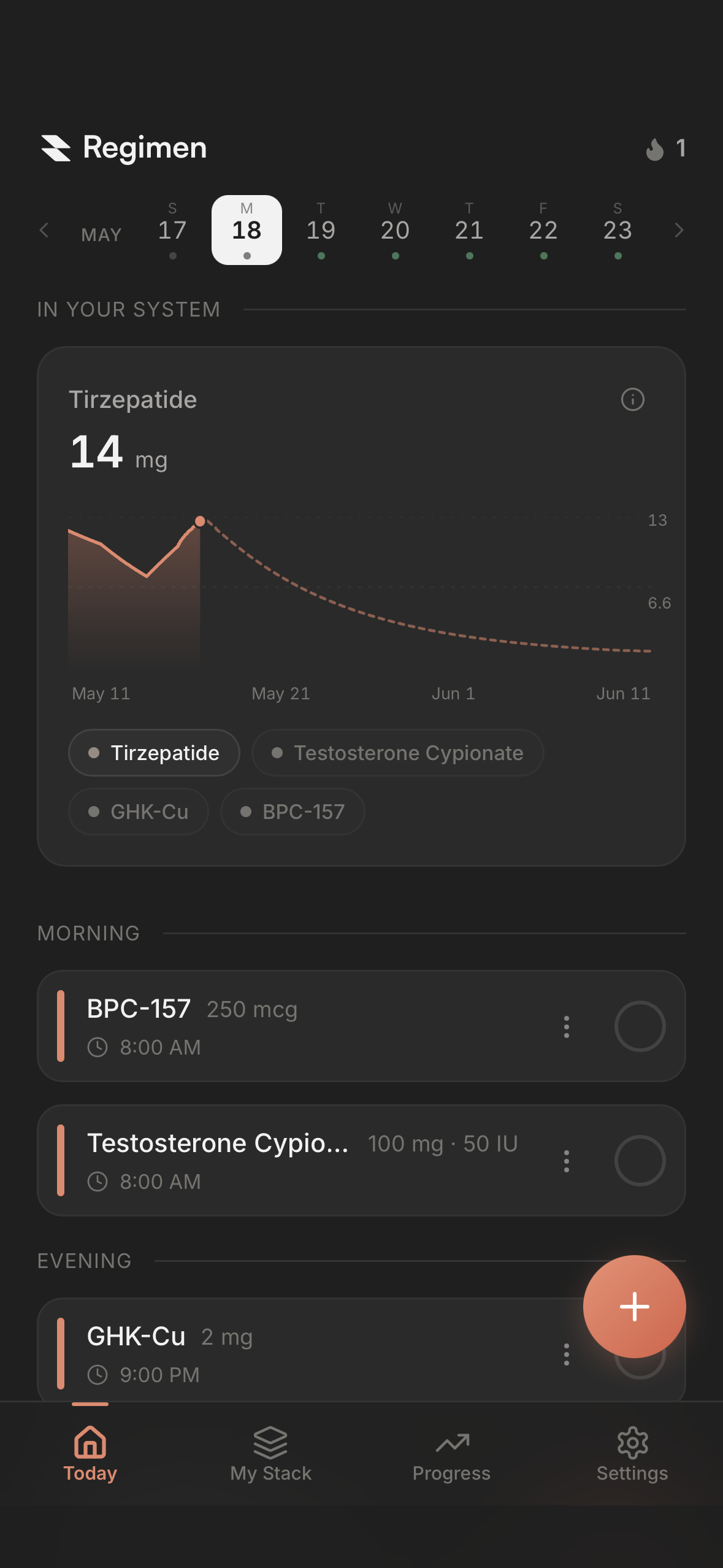
Regimen lets you log energy, mood, sleep, and libido over time and keep your lab results in one place. Clear data for your next doctor visit. Free for one compound.


Free to download. Free for your first compound.
Questions