More men are running GLP-1 medications and TRT at the same time than at any point in recent memory. Walk through any TRT-focused forum or community right now and you’ll see it: guys who’ve been on testosterone for years adding semaglutide or tirzepatide, guys who started a GLP-1 and discovered their testosterone crashed, guys trying to figure out how to manage both compounds without losing their gains or their mind.
Managing two compounds that both affect your hormones, your body composition, and your bloodwork is genuinely more complex than managing either one alone. This guide covers why the combination is so common, what actually happens when you run both, and what to watch on your labs.
Why This Combination Is So Common
There are two paths that tend to bring men to this combination, and they go in opposite directions.
The first path: men who’ve been on TRT for a while and gained weight during the years their testosterone was low, or during the early TRT period. Low testosterone is associated with increased body fat and reduced muscle mass. A lot of guys start TRT, feel better, but still carry extra weight. GLP-1 medications have become the practical solution for that, especially when diet and exercise alone weren’t enough.
The second path: men who start a GLP-1 for weight loss and find, somewhere around the 3-6 month mark, that their testosterone has dropped. They go get labs done and discover their T is lower than it was before. Some of these men had borderline-low T to begin with; the caloric deficit and rapid body composition change pushed them into a range where symptoms showed up. Adding TRT becomes the logical next step.
Either way, the result is the same: two compounds running simultaneously, each affecting the other’s terrain.
What GLP-1 Medications Actually Do to Testosterone
The interaction between GLP-1 agonists and testosterone isn’t direct. GLP-1 medications don’t suppress testosterone production the way exogenous high-dose androgens do. The connection is more indirect, and it runs through body composition.
Body fat produces estrogen through a process called aromatization (fat cells contain aromatase, the enzyme that converts testosterone to estradiol). More body fat generally means higher estrogen and higher SHBG, which can suppress free testosterone. As you lose fat on a GLP-1, that dynamic shifts.
Here’s where it gets counterintuitive: losing fat can actually improve testosterone levels over time. But aggressive caloric restriction in the short term can also temporarily suppress the hypothalamic-pituitary-gonadal (HPG) axis. The HPG axis is basically the command chain that tells your body to produce testosterone. Deep caloric deficits stress that system.
The result is that some men see testosterone dip in the first few months on a GLP-1 before it stabilizes or improves as they settle into a new body composition. If you’re already on TRT, your exogenous testosterone replaces what the HPG axis was producing, so this particular effect matters less. But it explains why men not on TRT often find their T lower after starting a GLP-1.
Community Insight
A common pattern in r/trt and r/Peptides: someone starts tirzepatide, drops 30+ lbs, gets labs done, and finds their total T fell even though they’re on the same TRT dose. The fat loss changes SHBG and free T. It’s not unusual. As body fat drops, SHBG often shifts, and that changes how much of your testosterone is actually free and active, even if total T looks the same.
What to Watch on Labs When Running Both
Running GLP-1 and TRT together doesn’t require a completely different lab panel. It requires paying closer attention to the same markers, because things can shift faster than they would on either compound alone.
Free Testosterone (Not Just Total)
As body fat drops, SHBG can shift. SHBG (sex hormone-binding globulin) is the protein that binds to testosterone in your blood and makes it unavailable for your cells to use. When SHBG changes, your free T changes even if your total T stays exactly the same. Men who feel off partway through a GLP-1 cut despite being on TRT often find their free T has slid outside their normal range. Check free T, not just total.
Estradiol
Fat loss reduces aromatization: less fat tissue means less conversion of testosterone to estradiol. If you were previously managing estradiol with an aromatase inhibitor (AI), dropping significant body fat might push your E2 lower than you want it. Estradiol too low causes joint pain, low libido, mood issues, and worse sleep. It’s worth getting E2 tested after meaningful weight loss milestones, not just on your regular schedule.
Hematocrit
GLP-1 medications suppress appetite and, in some people, cause reduced fluid intake. Dehydration concentrates the blood and can push hematocrit up, separate from the hematocrit increase testosterone causes by stimulating red blood cell production. When both effects layer together, some men see hematocrit climb faster than they’d expect on TRT alone. Stay well hydrated and test more frequently if your hematocrit was already trending higher before starting a GLP-1.
Weight and Body Composition
This is worth tracking as a lab-adjacent marker. Rapid weight loss changes everything about how your hormones behave. Logging your weight consistently gives you a timeline to correlate against lab changes, so when something shifts, you can usually trace it to a specific phase of the cut.
Injection Timing: Same Day or Different Days?
Both semaglutide (Ozempic/Wegovy) and tirzepatide (Mounjaro/Zepbound) are weekly subcutaneous injections. Most TRT protocols also involve weekly or twice-weekly injections. The question of whether to pin them on the same day or split them comes up constantly.
There’s no clinical evidence that it matters pharmacologically. GLP-1 medications and testosterone work through completely different mechanisms and different receptors. There’s no known interaction at the injection site or in the bloodstream that would make same-day administration better or worse.
What’s common in the community: some people pin everything on the same day (say, Sunday) to keep it simple and build a consistent weekly routine. Others split them (TRT on Monday, GLP-1 on Thursday) to avoid having one very needle-heavy day. Both approaches work. It comes down to what’s easier to stick to consistently.
The only practical consideration: if you’re rotating injection sites to avoid scar tissue buildup, more injections per day means more sites in use on that day. Some people find it easier to manage rotation when injections are spread across the week.
The Multi-Compound Tracking Problem
Here’s the real challenge with running two compounds at the same time: when something changes (your energy, your labs, your body composition), it’s much harder to figure out what caused it.
Did your free T drop because your GLP-1 dose went up? Because you lost 15 lbs and your SHBG shifted? Because your TRT dose needs adjusting? Without a clear record of what changed and when, you’re guessing.
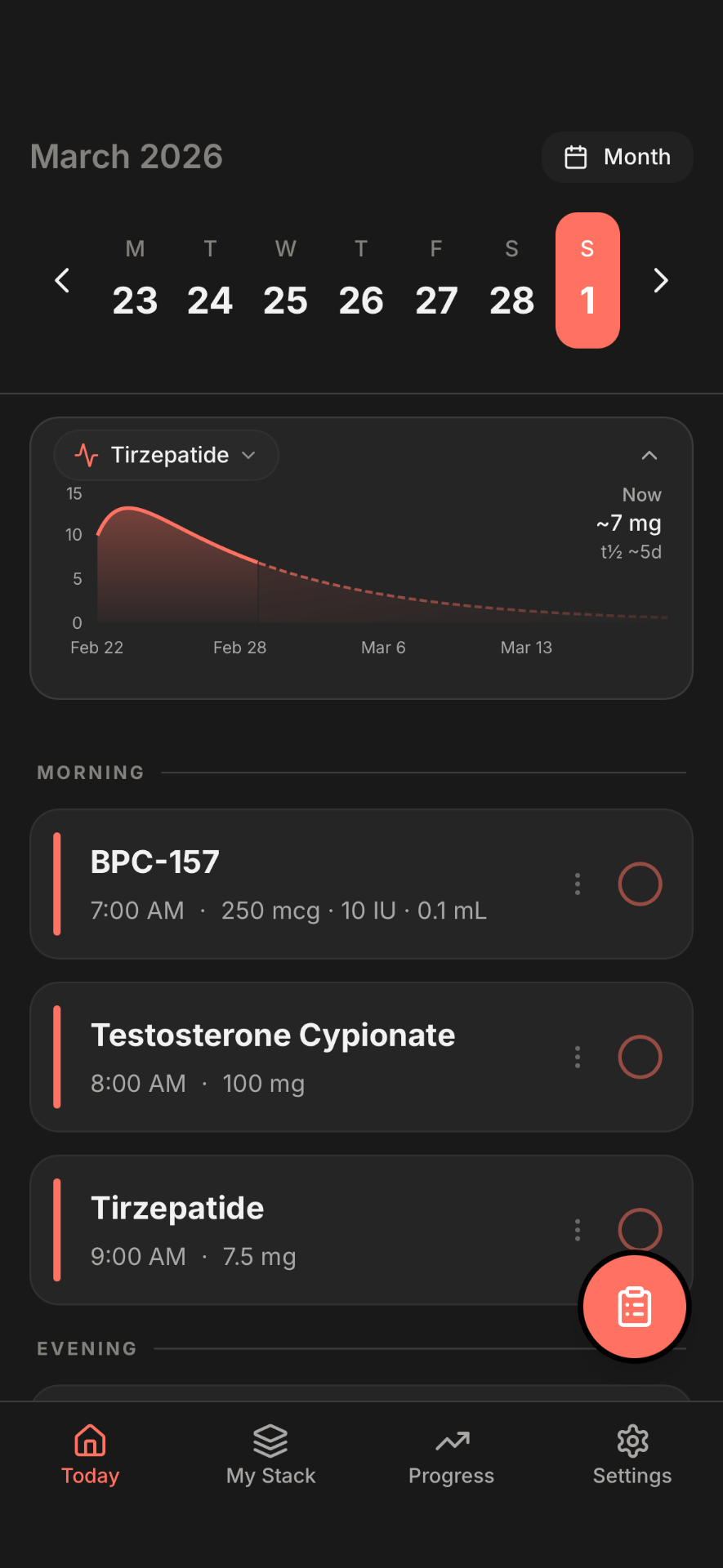
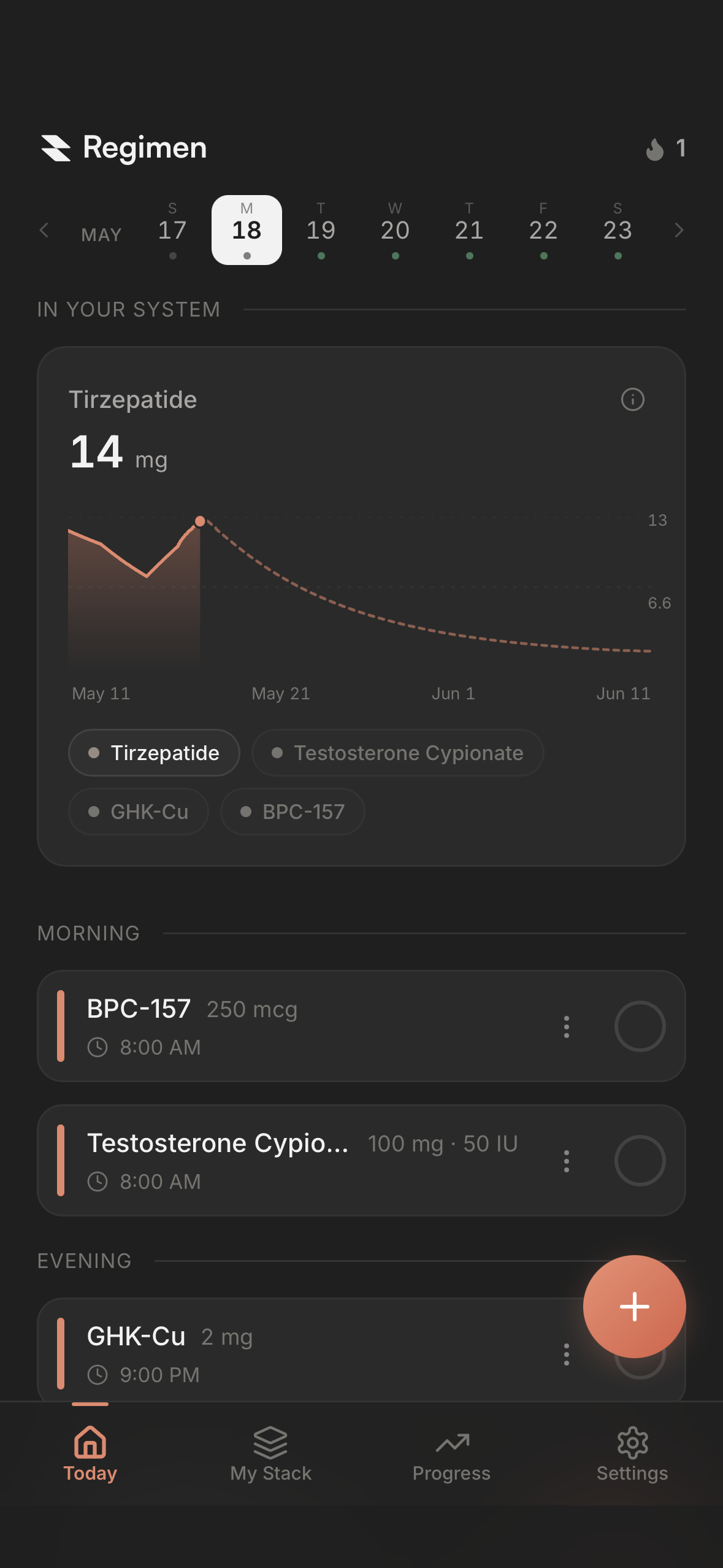
This is exactly the problem Regimen is built to solve. You can log both compounds in one place: each GLP-1 injection, each testosterone injection, with dates and doses, all stored in the same timeline as your lab results. When something changes on your next bloodwork panel, you can actually see what your protocol looked like in the weeks leading up to it.
That kind of visibility matters more with two compounds than with one. The more variables you’re managing, the more valuable a clean record becomes.
Track both compounds in one place with Regimen
Frequently Asked Questions
Does GLP-1 lower testosterone?
Not directly. GLP-1 medications don’t suppress testosterone production through any known direct mechanism. The connection is indirect: aggressive caloric restriction can temporarily stress the hormonal axis that drives testosterone production, and rapid body composition changes shift SHBG and free T. Men already on TRT are largely insulated from production-suppression, but should still watch free T and SHBG as body fat changes.
Should I adjust my TRT dose when I start a GLP-1?
Don’t adjust based on anticipation. Get labs done roughly 8-12 weeks after starting a GLP-1, or after a meaningful weight loss milestone, and let your numbers guide the conversation. SHBG can shift with fat loss, which changes free T independent of your TRT dose. Adjust with your doctor when the labs warrant it, not preemptively.
Can I inject GLP-1 and TRT on the same day?
Yes. There’s no known pharmacological reason to separate them. GLP-1 medications and testosterone cypionate work through completely different mechanisms. Combining them on the same injection day is common in the community. Use different injection sites.
How does fat loss affect testosterone levels?
Fat tissue contains aromatase, the enzyme that converts testosterone to estradiol. More fat usually means more estrogen production and higher SHBG, which can suppress free testosterone. Losing fat typically shifts this in a favorable direction over time, but SHBG doesn’t move in a straight line, so free T can fluctuate during an active cut.
What labs should I track when running both?
At minimum: total testosterone, free testosterone, SHBG, estradiol, and hematocrit. Add a CMP if you’re not already getting one. GLP-1 medications affect liver and kidney markers in some people. Frequency depends on how aggressively you’re losing weight.
Disclaimer: This article is for educational purposes only and is not medical advice. TRT and GLP-1 medications should be used under the supervision of a qualified healthcare provider. Dose adjustments and lab interpretations should always be discussed with your prescriber. Individual results may vary.
Ready to track your protocol?
- Smart reminders so you never miss a dose
- Track weight, photos, and progress over time
- Medication level curves for every compound
Can I inject both on the same day?
Yes. There’s no known pharmacological reason to separate them. GLP-1 medications (semaglutide, tirzepatide) and testosterone cypionate work through completely different mechanisms. Combining them on the same injection day is common in the community and hasn’t been associated with any specific problems. Use different injection sites, as you would for any two subcutaneous or intramuscular injections.