Semaglutide Reconstitution Calculator
Convert any compounded semaglutide vial into exact insulin syringe units. Works for every standard titration step from 0.25 mg up to 2.4 mg.
Peptide Reconstitution Calculator
Calculate your exact dose
Enter your vial details to calculate how many units to draw for your dose.
Common doses: Semaglutide (0.25-2.4mg), Tirzepatide (2.5-15mg)
Draw syringe to
99 units
(0.99 mL)
Concentration:
2,500 mcg/mL
Doses per vial:
2
Your reconstitution is set — now track your protocol.
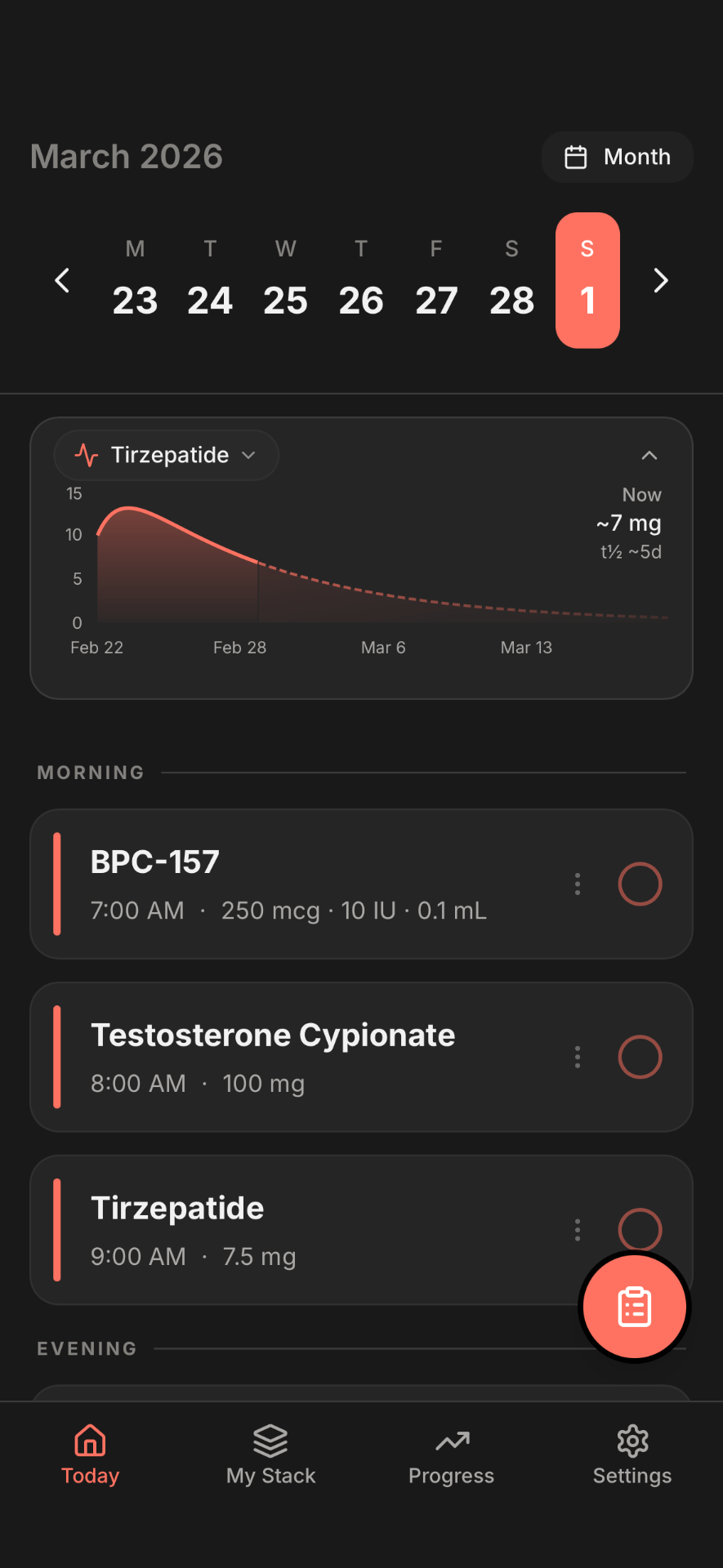
Regimen logs every dose of your peptide — 2.5mg at a time, 2 doses per vial. It reminds you when to inject, tracks your reconstitution dates, and manages multi-compound schedules.
- Injection reminders for each compound
- Track reconstitution dates and vial expiry
- Manage multiple peptides on different schedules
Free for one compound. No trial, no paywall.
For educational and research purposes only. This calculator provides estimates based on standard formulas.
Always verify calculations with your healthcare provider before use. We assume no liability for dosing errors, adverse events, or outcomes resulting from use of this tool.
Worked example: 5 mg semaglutide vial
Compounded semaglutide ships as a lyophilized (freeze-dried) powder. The most common vial sizes are 2 mg, 5 mg, and 10 mg. The 5 mg vial reconstituted with 2 mL of bacteriostatic water is the workhorse of the compounded market because the unit math is clean at every titration step a clinician is likely to prescribe.
With 5 mg in 2 mL, your concentration is 2.5 mg per mL. On a 100-unit insulin syringe (where 100 units equals 1 mL), every unit holds exactly 0.025 mg of semaglutide. That makes the titration ladder easy to read:
- 0.25 mg starting dose: 10 units. Gives 20 doses per vial.
- 0.5 mg: 20 units. Gives 10 doses per vial.
- 1.0 mg: 40 units. Gives 5 doses per vial.
- 1.7 mg: 68 units. Vial covers about 3 doses.
- 2.4 mg maintenance: 96 units. Vial covers 2 doses.
If you reach the 2.4 mg maintenance dose and your vial is filling 96 units of a 100-unit syringe, consider switching to a 5 mg vial in 1 mL (5 mg per mL). That cuts the draw in half (48 units for 2.4 mg) and reduces the chance of overshooting the syringe.
How to reconstitute semaglutide
Swab the rubber stopper with alcohol. Draw your chosen volume of bacteriostatic water into a clean syringe. Insert the needle into the semaglutide vial at an angle and inject the water slowly down the inside wall of the vial, not directly onto the powder. The semaglutide should dissolve on contact. Roll the vial gently between your hands. Never shake it. Shaking can shear and denature the peptide.
Once reconstituted, label the vial with the date and store it in the refrigerator. Semaglutide is stable for approximately 28 days under refrigeration when bacteriostatic water is used as the diluent. Some compounding pharmacies extend this window to 56 days based on their own stability testing. Discard immediately if the solution becomes cloudy or develops particulate.
Frequently asked questions
How do I reconstitute 5 mg semaglutide?
Add 2 mL of bacteriostatic water to a 5 mg vial. That gives you a concentration of 2.5 mg per mL. On a 100-unit insulin syringe, 1 unit equals 0.025 mg. A 0.25 mg starting dose is 10 units, 0.5 mg is 20 units, 1 mg is 40 units, and 2.4 mg is 96 units.
What's the unit math for a 0.25 mg starting dose?
With a 5 mg vial reconstituted to 2 mL of BAC water: concentration is 2.5 mg per mL, so 0.25 mg equals 0.10 mL, which is 10 units on a 100-unit insulin syringe. That gives you 20 starting-dose injections per vial.
How long does reconstituted semaglutide last?
Refrigerated between 36 to 46 F, reconstituted semaglutide is stable for approximately 28 days with bacteriostatic water as the diluent. Some compounding pharmacies extend this to 56 days based on stability testing. Discard if cloudy or after the labeled use-by date.
Can I reuse the same syringe for semaglutide?
No. Use a new sterile insulin syringe for every injection. Reusing a syringe risks contamination of the vial and bent or dulled needles, which makes subcutaneous injection more painful and less precise.
What concentration should I aim for?
2.5 mg per mL (5 mg vial in 2 mL) is the most common target because the unit math is clean across every titration step. If you want fewer units per dose, use less water (5 mg in 1 mL gives 5 mg per mL). If you want larger draws for easier reading, use more water.
Related: semaglutide half-life calculator and full reconstitution walkthrough.
How to use this calculator
Enter your vial size
Common sizes are 2 mg, 5 mg, and 10 mg
Enter BAC water volume
1 to 3 mL is standard; 2 mL produces clean unit math
Enter your target dose
0.25, 0.5, 1, 1.7, or 2.4 mg are common titration steps
Read the syringe units
Calculator returns exact units on a 100-unit insulin syringe
Log every semaglutide dose, not just the math
Regimen tracks each weekly injection with site rotation, PK curves, and health correlation.
- Built-in dose calculators
- Weekly injection reminders
- Body composition correlation
- Private, secure health data