In clinical research, an N-of-1 trial is a rigorous study design in which a single patient serves as their own control. Instead of comparing treatment effects across a population, it compares treatment effects within one individual across alternating periods. The data it generates answers a question that population studies fundamentally cannot: does this intervention work for this person?
People optimizing TRT, GLP-1, or peptide protocols are, whether they realize it or not, running N-of-1 experiments on themselves. Most of them are running them badly. Not because they lack intelligence or effort, but because they lack the methodology, the structure that turns a series of personal experiences into interpretable data.
What Makes an N-of-1 Design Rigorous
The core logic of an N-of-1 trial:
- Identify the question. Not “does TRT work” (you are already on it) but “does increasing my injection frequency from weekly to twice-weekly reduce my trough symptoms?”
- Define the outcome measure before you start. Specifically. “I will track energy (1-10 daily), mood (1-10 daily), and libido (1-10 daily) for 8 weeks at each frequency.”
- Change one variable at a time. This is the discipline. When you change dose and frequency and injection site at the same time, you have no experiment. You have a before/after with no attribution.
- Allow sufficient time for each condition to stabilize. For testosterone, this means at minimum 6-8 weeks at a stable protocol before drawing conclusions. For a GLP-1 trough experiment, it might mean 4-6 injection cycles.
- Review the data without cherry-picking. Your best week at the new protocol is not representative. Your worst week at the old protocol is not representative. You need the distribution across the full observation period.
The Specific Failure Modes
The multiple simultaneous change problem. Starting a GLP-1 in the same month you increase your TRT dose means you cannot attribute the improvements you observe to either compound specifically. The confounding is irreducible without redesigning the experiment.
The insufficient time problem. Declaring that a protocol change “didn’t work” after two weeks is common. For testosterone, you have not waited for full tissue response. For a GLP-1, you may not have reached therapeutic dose. Two weeks is not enough data to conclude anything except that the acute side effect profile is or is not tolerable.
The narrative displacement problem. Humans construct explanations for how they feel as they go. By week 4, your memory of how you felt at week 1 is already shaped by what happened in between. Prospective daily logging captures what you actually felt in the moment. Retrospective recall distorts it systematically.
The no-baseline problem. To detect a change, you need a baseline. If you did not log before making a change, you cannot quantify the delta. You can say “I feel better” but you cannot say “my energy scores improved by an average of 1.6 points” because you have nothing to compare against.
How to Apply This to Common Protocol Questions
Question: Does twice-weekly testosterone injection reduce trough symptoms compared to weekly?
- Baseline period: 8 weeks weekly, logging energy, mood, and libido daily, noting injection day
- Intervention period: Switch to twice-weekly at the same total dose; log identically for 8 weeks
- Analysis: Compare average scores, weekly pattern (day-of-week vs injection-day-position), and variance
Question: Is my GLP-1 trough affecting hunger and mood on days 5-6 of my injection cycle?
- Identify your injection day; log hunger and mood daily for 8+ injection cycles
- Look at day-by-day average scores within the cycle: day 1, day 2, through day 7
- A clear U-shaped curve (lower at day 1-3, rising at day 5-7) confirms trough sensitivity
Question: Is the peptide I added affecting my sleep quality?
- You need a baseline: what was your sleep quality score (logged daily) for 4 weeks before starting the peptide?
- Then: did your average sleep quality score change after starting it, controlling for nothing else changing?
- If you also changed your diet, training load, and melatonin dose in the same period, you no longer have an experiment
The Role of Objective Data
N-of-1 rigor improves significantly when objective data accompanies subjective check-ins. Resting heart rate, sleep duration, and step count add dimensions that subjective ratings can miss or distort. If your logged resting heart rate increased by 6 bpm after starting tirzepatide (tirz) and your subjective energy scores also declined, those two data points, together, tell you something about what the compound is doing physiologically that either alone would not. The subjective experience has an objective correlate. That is a stronger finding.
Why This Is Different From “Just Tracking”
Passive tracking, logging without a framework, generates data but often does not generate insight. You accumulate months of energy scores and do not know what to do with them. Logging without a question produces archives, not experiments.
The N-of-1 framing converts passive tracking into structured inquiry. You have a question. You have a measurement plan. You have a sufficient observation period. You review the data against the question. The outcome of a good N-of-1 review is not a definitive answer. Biology is never fully controlled outside a laboratory. The outcome is a probability estimate: the data is consistent with X or the data does not support X. That is enough to make a better-informed decision than you had before.
What Regimen Is Designed For
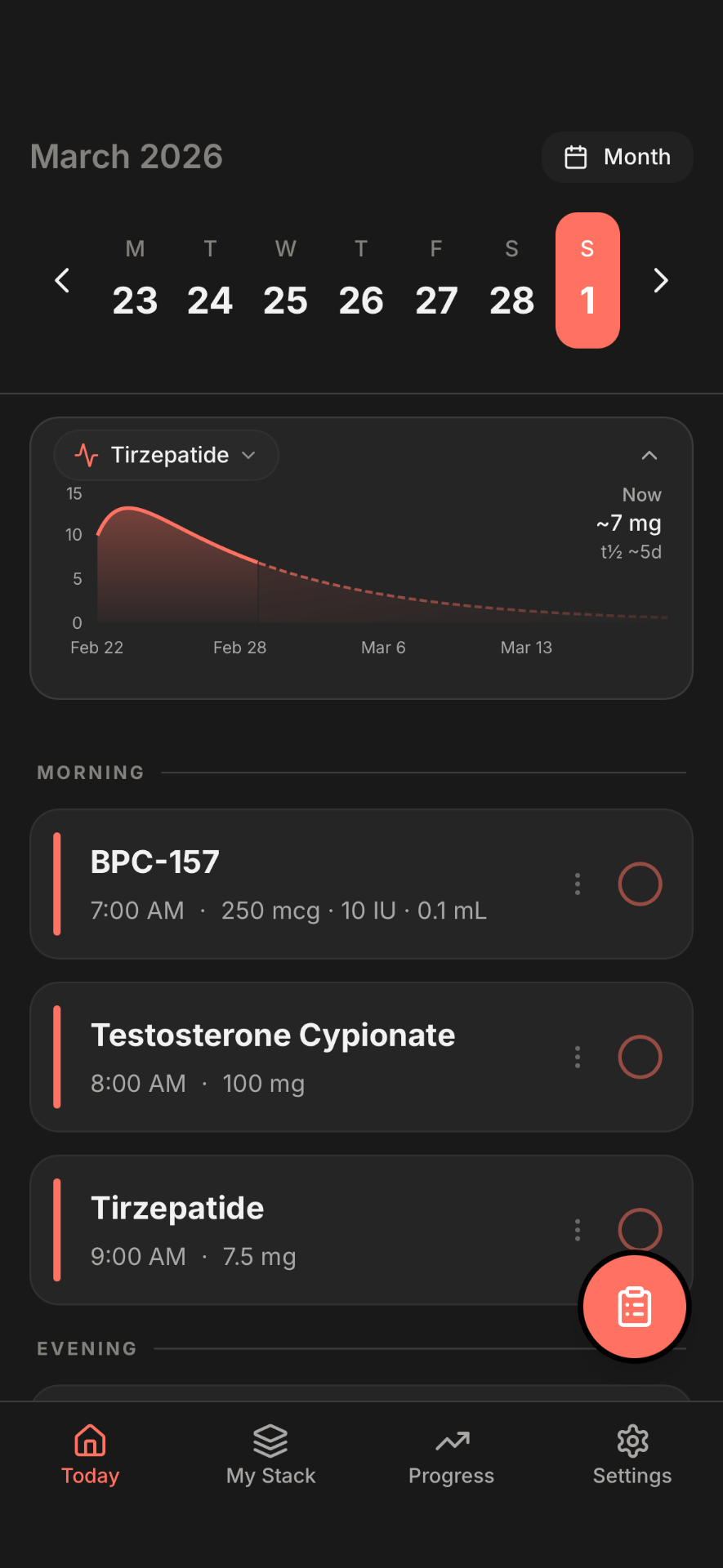
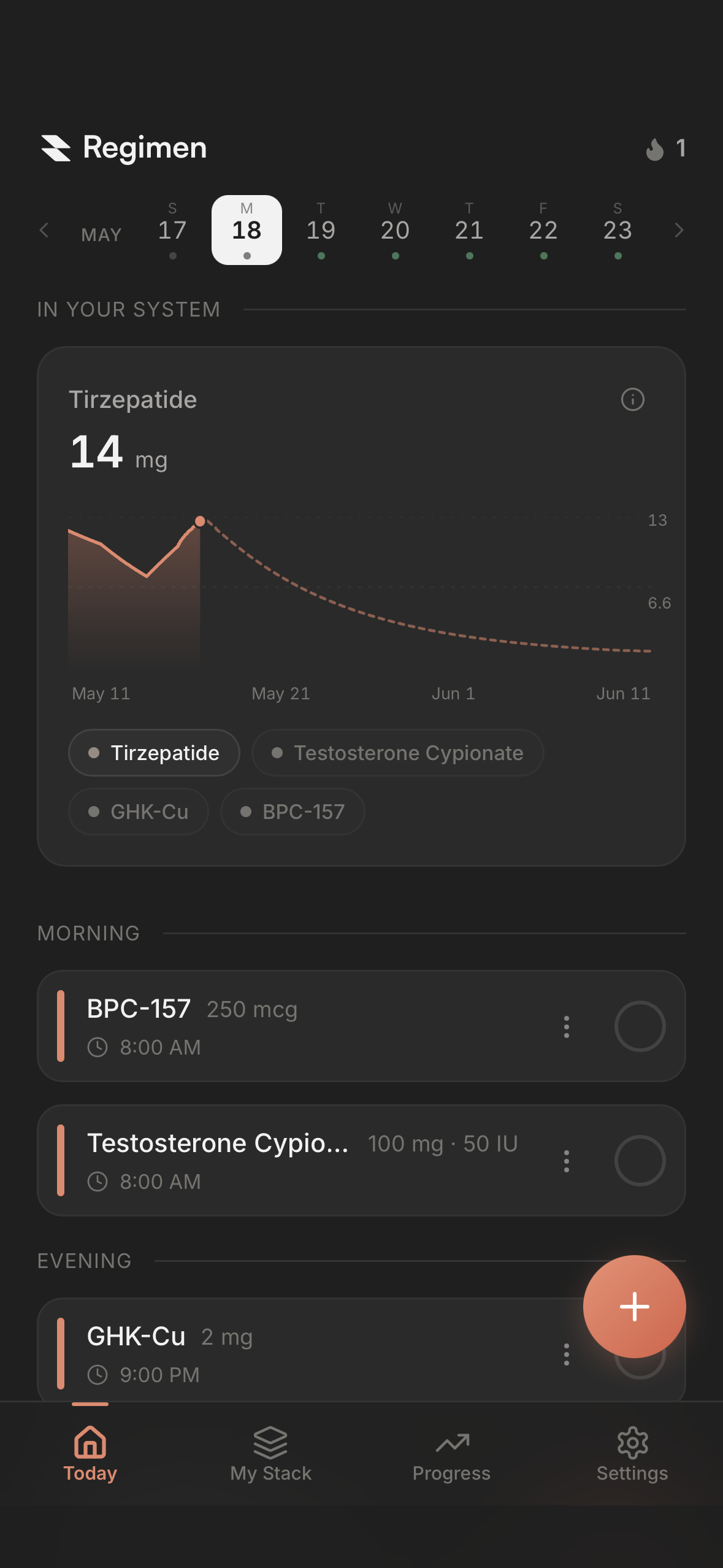
The combination of pharmacokinetic modeling, daily subjective check-ins, objective health data sync, and a pattern engine that surfaces correlations across your specific history is, explicitly, infrastructure for personal N-of-1 inquiry.
It does not guarantee rigorous methodology. That requires discipline on the user’s part: log consistently, change one thing at a time where possible, allow sufficient time. But it provides the data infrastructure that makes the methodology possible. The pattern engine does the detection work that manual review of spreadsheets would require hours to approximate. The goal is not just to store your data. The goal is to make it possible for you to learn from it.
Key Takeaways
- An N-of-1 experiment uses your own historical data as its own control. The only method that can determine what works for you specifically
- Rigor requires: a specific question, a defined outcome measure, one variable changed at a time, sufficient observation period, and unbiased data review
- Common failure modes: simultaneous variable changes, insufficient time, retrospective recall replacing prospective logging, no baseline
- Objective data (resting heart rate, sleep duration) and subjective check-ins together produce stronger signal than either alone
- Structured inquiry converts passive tracking into actionable insight
This article is for informational purposes only and does not constitute medical advice. Discuss all treatment decisions with your healthcare provider.
Ready to track your protocol?
- Smart reminders so you never miss a dose
- Track weight, photos, and progress over time
- Medication level curves for every compound