Most health tracking apps do one thing: store your data. Regimen does something additional: it analyzes it. The pattern engine is the underlying system that turns logged check-ins, doses, and timing into specific, personalized observations about what is happening in your protocol.
This article explains what the pattern engine does, what kinds of patterns it can detect, and why the architecture is designed the way it is.
The Problem It Solves
If you log your energy, mood, sleep, and hunger every day for eight weeks while tracking a compound, you have collected data. But the question is whether you can extract signal from it.
Humans are reasonably good at noticing obvious patterns. If every Tuesday you feel terrible and Tuesday is your injection day, you will probably notice. But humans are poor at detecting subtle, delayed, or cyclical patterns in noisy data. We are prone to recency bias (the last few days feel representative of the whole), confirmation bias (we notice data that fits our current hypothesis), and we struggle with multi-variable attribution. The pattern engine is designed to do the detection work that humans cannot reliably do on their own.
What the Pattern Engine Analyzes
The engine operates across several dimensions of data simultaneously:
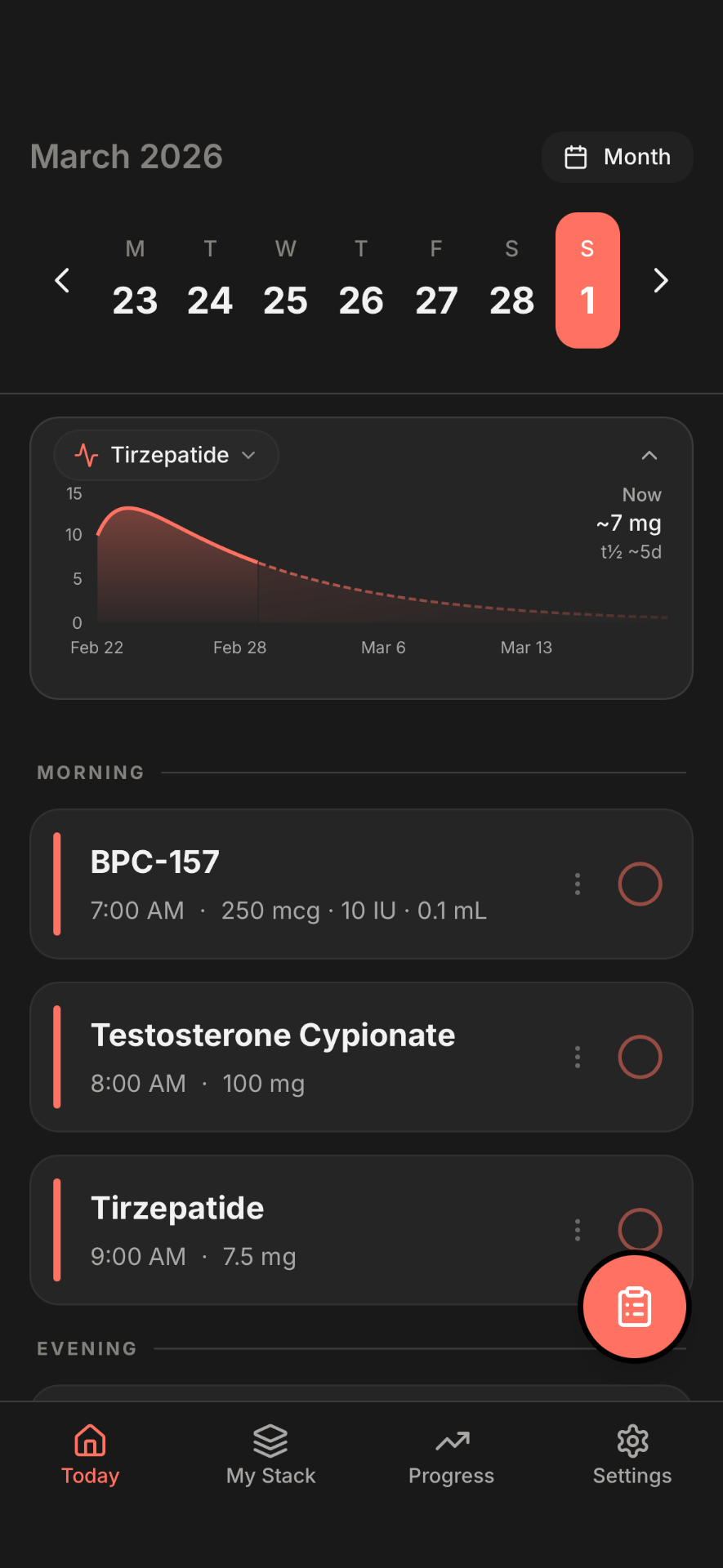
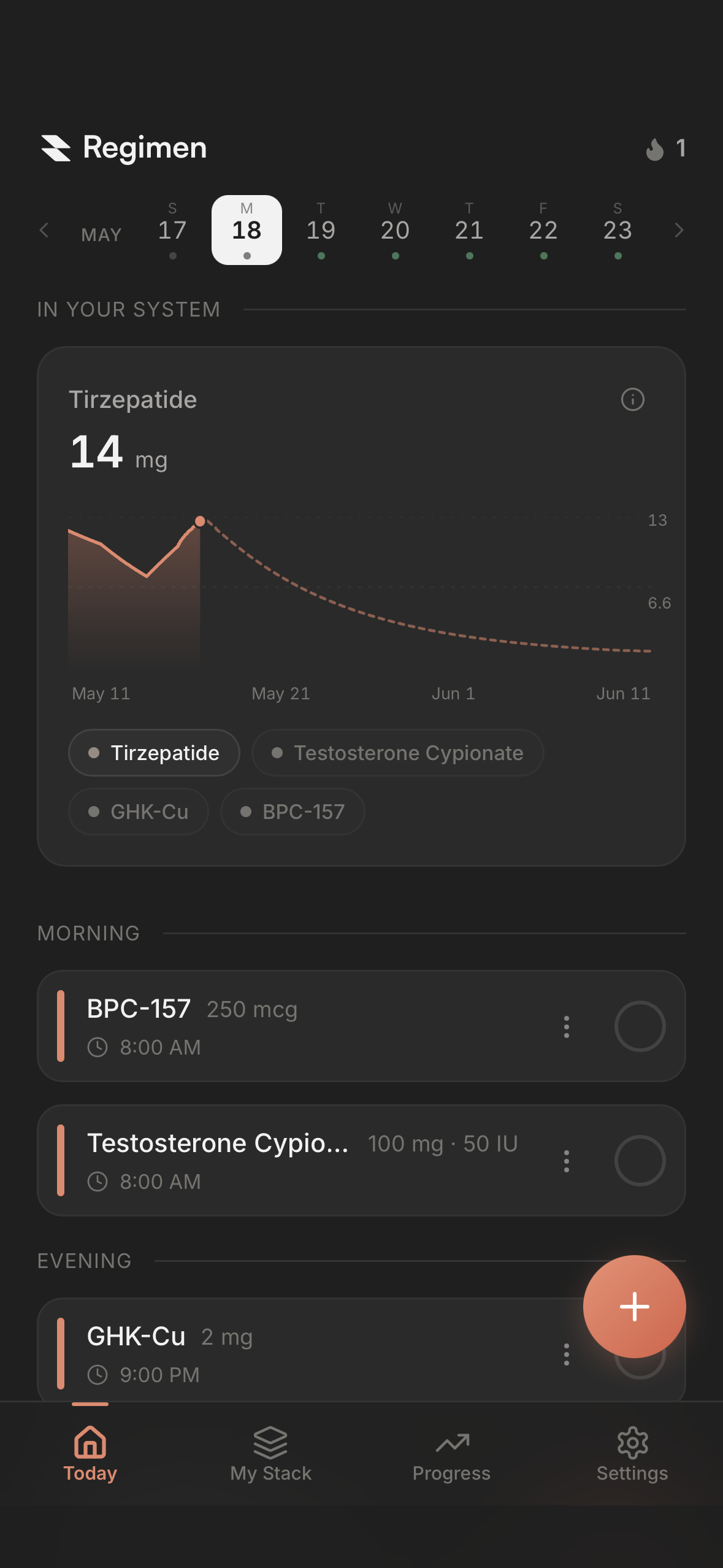
Pharmacokinetic (PK) timing: Regimen uses a Bateman-equation blood level simulation to model the approximate plasma concentration curve for each logged compound, based on dose, injection frequency, and compound-specific half-life. The pattern engine correlates subjective check-ins against the simulated PK curve, not just against calendar day. This means it can detect patterns like “energy dips consistently at trough” or “sleep quality degrades around injection-day peak” with precision that calendar-based analysis cannot achieve.
Within-cycle patterns: For compounds with clear dosing cycles (weekly injectables, twice-daily peptides, etc.), the engine looks for recurring patterns within the cycle. A trough-sensitive hunger pattern on a weekly GLP-1 shows up as a recurring signal at position day 5-7 of each injection cycle. A peak-sensitive sleep disruption shows up at position day 1-2.
Personal deviation detection: The engine knows your personal baseline for each logged dimension. A check-in that is two standard deviations below your personal energy baseline is flagged differently than one that is only slightly lower. This is personalized deviation detection, not comparison to population norms.
Event-linked patterns: When you log a protocol change, new dose, new compound, injection day change, the engine treats this as an event and looks for what changes in your check-in data before and after it. This makes it possible to isolate the effect of a specific change even in the context of an ongoing multi-compound protocol.
Stack disambiguation: For multi-compound users, the engine attempts to attribute check-in patterns to the most likely contributing compound based on timing, compound type, and known pharmacological profiles. It does not claim certainty. It surfaces the pattern and the likely attribution. The distinction matters.
What It Does Not Do
The pattern engine does not diagnose, prescribe, or advise. It surfaces observations: correlational patterns between what you log and how you feel.
It does not tell you to change your dose. It does not tell you a compound is working or not working in the sense of recommending a course of action. It observes that energy scores are consistently lower on days 5-7 of your injection cycle, or that sleep quality improved by 0.8 points on average in the 4 weeks following a dose adjustment. What to do with that observation is a clinical question. This distinction is intentional and important. The value of the pattern engine is in making your self-tracking data interpretable, not in replacing clinical judgment.
Why Personalization Is the Core Design Principle
Population-level correlations are useful for research but often misleading for individuals. The average GLP-1 user experiences a 5-7 bpm increase in resting heart rate. But if your resting heart rate is increasing 15 bpm, population averages are not your guide.
The pattern engine works against your own baseline, your own cycle, your own history. Two users on the same dose of the same compound may have entirely different pattern profiles. The engine surfaces the pattern that is true for you, not the pattern that is true on average. This is the core value proposition: not “here is what this compound does in the literature” but “here is what we are observing in your data over time.”
Connecting Objective and Subjective Data
Where available, the pattern engine integrates objective data, Apple Health and Google Health Connect sync brings in sleep duration, resting heart rate, step count, and other metrics, alongside subjective check-ins. This combination is more powerful than either alone.
A subjective “felt tired” check-in, combined with a logged resting heart rate that is 8 bpm above your personal baseline and 5 hours of sleep instead of your usual 7, tells a clearer story than any single data point. The pattern engine can surface: “on days where your sleep was under 6 hours, your energy scores averaged 2.1 points lower and your hunger scores averaged 1.8 points higher.” That is not a surprising finding. But having it confirmed in your own data, over your own protocol, is meaningfully different from knowing it abstractly.
Key Takeaways
- The pattern engine correlates subjective check-ins and objective metrics against PK-modeled blood level curves, not just calendar time
- It detects within-cycle, trough-sensitive, event-linked, personal deviation, and stack attribution patterns
- All outputs are observational. The engine surfaces correlations, not recommendations
- Personalization is foundational: patterns are derived from your own baseline, not population norms
- Objective data (heart rate, sleep) and subjective check-ins are analyzed together, which produces richer signal than either alone
This article is for informational purposes only and does not constitute medical advice. Discuss all treatment decisions with your healthcare provider.
Ready to track your protocol?
- Smart reminders so you never miss a dose
- Track weight, photos, and progress over time
- Medication level curves for every compound