HCG Reconstitution Calculator
Convert any HCG vial into exact insulin syringe units. Enter your vial IU, the bacteriostatic water you added, and your target dose, and this HCG dosage calculator shows exactly what to draw.
HCG mixing & dose
Reconstitution to insulin-syringe units and doses per vial.
Draw syringe to
10 units
(0.10 mL)
This calculator is for informational purposes only, so always double-check your result with a healthcare provider. We assume no liability for dosing errors.
Last updated September 2026 · Reviewed by the Regimen Team
The tool
How it works, what it tells you, what it doesn't.
HCG ships as a freeze-dried powder paired with a small ampule of diluent. For multi-dose use, most TRT and fertility protocols substitute the supplied diluent with bacteriostatic water, which contains 0.9 percent benzyl alcohol as a preservative. That preservative is what lets a single reconstituted vial last roughly 30 days under refrigeration. This calculator converts your vial IU and BAC water volume into the exact syringe units to draw for any dose.
How to use it
How to use this calculator
- 01
Enter vial size
5,000 IU and 10,000 IU are the most common HCG vial sizes
- 02
Enter BAC water volume
Typically 1 to 3 mL depending on how many doses you want per vial
- 03
Enter target dose
Common TRT-adjunct doses are 250 IU and 500 IU two to three times weekly
- 04
Read the syringe units
The calculator returns exact units on a 100-unit insulin syringe
How to reconstitute HCG
HCG ships as a freeze-dried powder paired with a small ampule of diluent. For multi-dose use, most TRT and fertility protocols substitute the supplied diluent with bacteriostatic water, which contains 0.9 percent benzyl alcohol as a preservative. That preservative is what lets a single reconstituted vial last roughly 30 days under refrigeration.
The reconstitution itself is straightforward. Swab the vial stopper with alcohol, draw your chosen volume of BAC water (1 to 3 mL is typical), and inject it slowly down the inside wall of the HCG vial. Do not aim the stream at the powder. Once the water is in, gently swirl the vial. Do not shake. HCG is a protein and aggressive agitation can denature it.
The amount of BAC water you add determines your concentration and how easy each dose is to draw. For a 5,000 IU vial reconstituted with 2 mL, your concentration is 2,500 IU per mL, which gives clean unit math: 250 IU equals 10 units on a 100-unit insulin syringe, and 500 IU equals 20 units. Larger volumes make each dose easier to measure but consume the vial faster.
Standard injection technique is subcutaneous in the lower abdomen or outer thigh using a 29 to 31 gauge, 1/2 inch needle. Rotate sites across each injection day to avoid scar tissue buildup. Always store reconstituted HCG in the refrigerator between 36 to 46 F, and discard if the solution becomes cloudy.
Worked example: 5,000 IU vial
Take a 5,000 IU vial and add 2 mL of bacteriostatic water. Your concentration is 5,000 divided by 2, or 2,500 IU per mL. On a 100-unit insulin syringe (where 100 units equals 1 mL), every unit holds 25 IU.
- 250 IU dose: draw 10 units (0.10 mL). Gives 20 doses per vial.
- 500 IU dose: draw 20 units (0.20 mL). Gives 10 doses per vial.
- 1,000 IU dose: draw 40 units (0.40 mL). Gives 5 doses per vial.
Adjust the BAC water volume if you prefer different unit math. Many people on 250 IU twice-weekly TRT-adjunct protocols use 2 mL because the 10-unit draw is easy to read on the syringe markings.
See also: Daily TRT insulin syringe dose guide and HCG dose calculator.
Get the app
Track your HCG protocol in the app
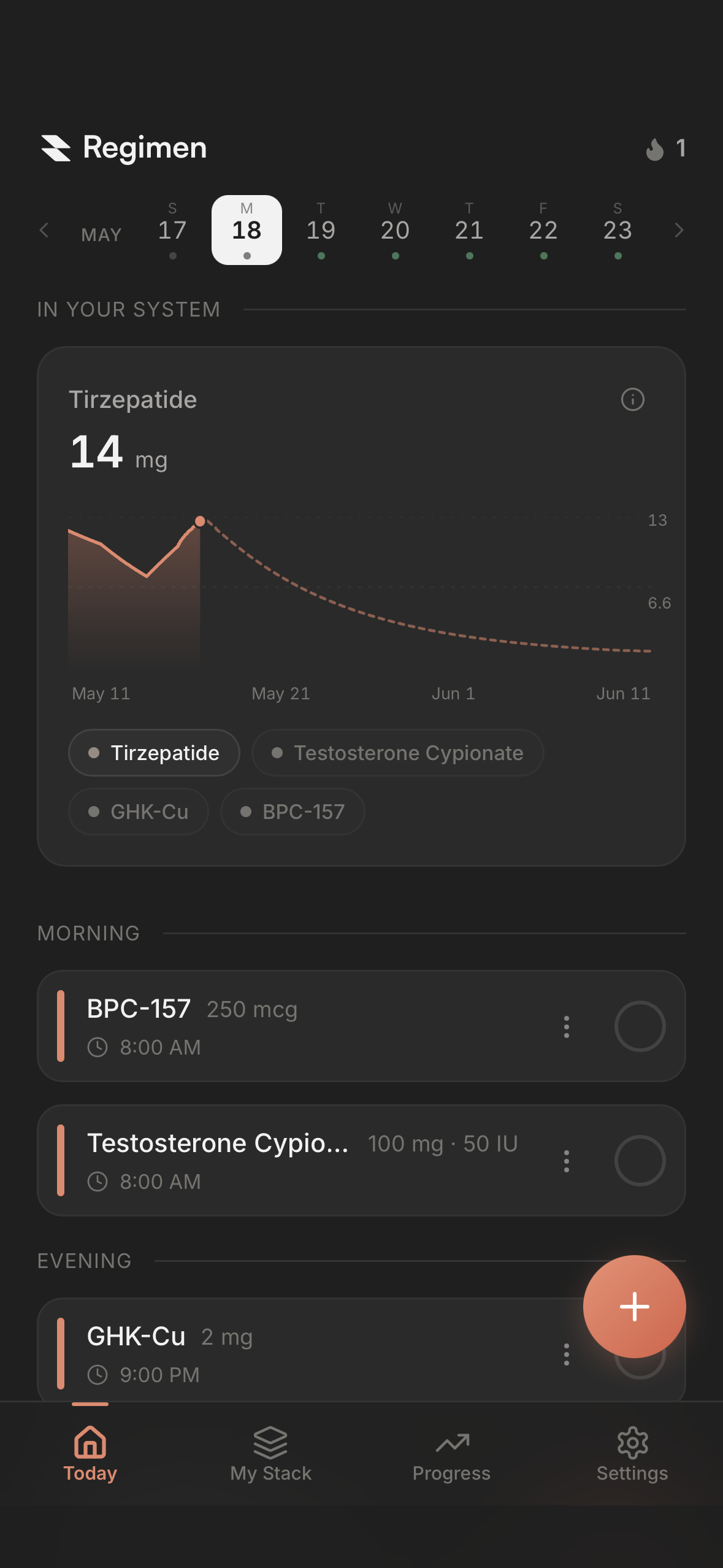
Regimen logs every HCG injection alongside your TRT compound, with reminders, site rotation, and PK visualization.
- Built-in dose calculators
- Smart injection reminders
- Track progress over time
- Private, secure health data


Free to download. Free for your first compound.
Questions