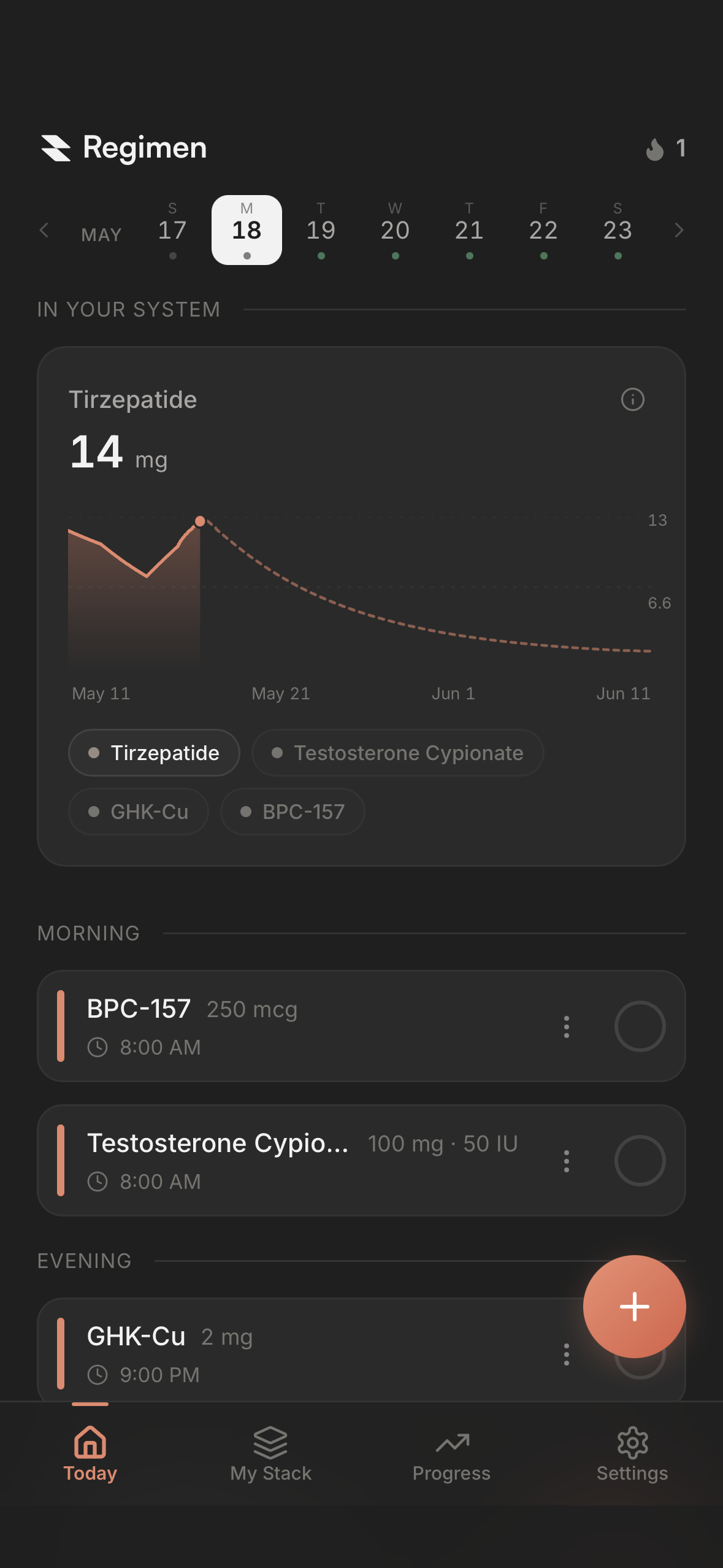
Regimen vs Smart Peptide Tracker: Privacy and Tracking Compared
Last updated May 25, 2026
Quick Answer
Smart Peptide Tracker is the better fit if you want a one-time purchase, prefer local-first data storage with no required account, and are primarily on Android. Regimen is the better fit if you are tracking multiple compounds simultaneously, want pattern detection across your whole protocol, or need a shareable health report for your provider. Both apps take privacy seriously. Neither sells your data.
How we evaluated
Pricing was pulled from each app’s App Store listing as of September 2026. Feature parity was verified against publicly available App Store descriptions and developer documentation in May 2026. App Store ratings and review counts reflect the US storefront as of May 25, 2026. Smart Peptide Tracker’s Premium unlock is a one-time purchase; the App Store listing shows multiple tier prices, so dollar amounts are intentionally not hardcoded in this comparison. Feature coverage based on publicly available app descriptions as of September 2026.
Feature Comparison
| Feature | Regimen | Smart Peptide Tracker |
|---|---|---|
| Platforms | iOS, iPadOS, Android | iOS, iPadOS, Android, macOS (M1+) |
| App Store rating | 4.8 stars | 4.7 stars |
| App Store review count | 234 combined (iOS + Android) | 67 (iOS) |
| Pricing model | Subscription | One-time Premium purchase |
| Free tier | Full features for 1 compound | Core features free; Premium unlocks analytics |
| Premium price | $7.99/mo, everything included | One-time unlock, plus paid add-ons |
| Account required | Yes (for cloud sync) | No account required to start |
| Default data architecture | Cloud sync with explicit governance | Local-first, cloud sync optional |
| Data monetization | None (subscription-funded) | None (one-time purchase) |
| Compound library | 200+ built-in plus custom | 100+ reference library |
| Multi-compound support | Unlimited on Premium | Yes, with custom blends |
| Reconstitution calculator | Yes (4 calculators total) | Yes (visual syringe indicator) |
| Lab / biomarker tracking | 50+ markers, dose timeline overlay | 80 biomarkers across 8 panels (Premium) |
| Apple Health | One-way sync (pulls in) | HealthKit (6 metrics) |
| Google Health Connect | Yes (Android) | Yes (Android) |
| Pattern detection | Cross-compound, built in | Stack Analyzer (6-dimension snapshot) |
| Injection site rotation | Yes | Not listed |
| Progress photos | Yes | Not listed |
| Shareable provider report | Yes | Not listed |
| Offline use | No (cloud-dependent) | Yes (works offline, syncs when connected) |
Where Smart Peptide Tracker has the edge
Local-first data architecture. Smart Peptide Tracker stores data on your device by default. No account is required to start. Cloud sync exists but is fully optional. PIN encryption, full import/export, and no third-party analytics beyond crash reporting. That architecture is documented in the App Store listing and is a deliberate choice, not a feature added after the fact. For users who want full control over where their health data lives, this matters more than any feature list.
One-time Premium purchase. No monthly charge, no renewal, no price increase, though some features are sold separately as add-ons. For people running a single compound or a fixed protocol for a defined period, the economics work in Smart Peptide Tracker’s favor compared to any subscription app. You pay once and the app is yours.
Stack Analyzer. Scores your full protocol across six dimensions (synergy, redundancy, side effects, practicality, goal alignment, evidence quality) and visualizes it as a radar chart. For people who like to stress-test a stack before adding a new compound, that is a genuinely useful design tool.
macOS support. Runs on Mac with Apple Silicon as an iOS app install. Useful for people who want to log from a laptop without needing a web app.
Where Regimen has the edge
Cross-compound pattern detection. Most people who track peptide protocols run a stack, not a single compound. The pattern detection looks across all compounds, lab markers, and health metrics simultaneously and surfaces correlations you would not catch by reviewing each log separately. Stack Analyzer evaluates how your protocol is designed; built-in pattern detection tells you what your current protocol is actually doing.
Compound library depth. Regimen covers 200+ built-in compounds and brands plus custom compound support. For people tracking less common peptides alongside the standard set, the broader library reduces the need to set up custom entries.
Lab tracking integrated with the dose timeline. Biomarker data plots directly on the dose timeline, so you can see whether a lab marker moved before or after a protocol change. Regimen also generates a shareable health report for provider conversations, which is a practical tool for clinical oversight.
Calculator coverage. Four calculators (reconstitution, dose, conversion, titration) versus a single reconstitution calculator. Both apps cover the core math; Regimen’s suite is broader.
Free tier on depth. Regimen is free for your first compound, with no time limit and no card: pattern detection, lab tracking, all four calculators, injection site rotation, progress photos, cycles, journal. You can fully evaluate the app before paying anything.
What r/Biohacking users said
In a recent r/Biohacking discussion comparing peptide tracker apps, the community kept coming back to one app.
easiest and most organized option I’ve used so far
u/Alainrob- · r/Biohacking · May 2026
See the discussion on r/Biohacking →
Which app should you use?
Choose Smart Peptide Tracker if you want your health data to default to local-only storage, you prefer paying once over a recurring subscription, you start without creating an account, or you want a protocol-design tool (Stack Analyzer) over a continuous pattern-detection engine.
Choose Regimen if you are running multiple compounds and want automatic cross-compound pattern detection built in, you want lab values plotted on the same timeline as your dose history with a shareable provider report, you need a broader compound library, or you want to fully evaluate the app’s depth on the free tier before paying.
Both apps were built by people who actually use peptide protocols and wanted better tools. That shows in the product quality. Neither choice involves sending your data to an ad network.
Frequently Asked Questions
Which app is more private, Regimen or Smart Peptide Tracker?
Both apps take privacy seriously, and neither sells or monetizes user data. The difference is architectural. Smart Peptide Tracker defaults to local-only storage: your data stays on your device unless you choose to enable cloud sync, no account is required to start, and there is no third-party analytics beyond crash reporting. Regimen does not sell, share, or monetize user data and is funded entirely by subscriptions, with full data export and deletion available. Cloud sync is used for cross-device access and backup. For users who want data to never leave their device, Smart Peptide Tracker's local-first default wins. For users who want cross-device access with transparent, subscription-funded data governance, Regimen is also a principled choice.
Is a one-time purchase better than a subscription for a peptide tracker?
It depends on how long you use the app and what you need. Smart Peptide Tracker's one-time Premium unlocks its core feature set permanently, though some capabilities are sold separately as paid add-ons, so the one-time price is not always the final price. Regimen's $7.99/month subscription funds continuous development: new compounds, updated calculators, the built-in pattern detection pattern engine, and ongoing lab tracking improvements. If you run a single compound for a fixed period, the one-time model is more economical. If you run multiple compounds long-term and want pattern detection across them, Regimen's subscription model delivers more value over time.
Which app works better on Android?
Both apps support Android natively with Google Health Connect integration. Smart Peptide Tracker has a strong reputation among Android users for its one-time purchase model and privacy-first design. Regimen also works well on Android with full feature parity to iOS. If the one-time purchase model is important and you are primarily on Android, Smart Peptide Tracker is the better fit. If multi-compound built-in pattern detection matters and you do not mind a subscription, Regimen is the Android choice.
Does Smart Peptide Tracker support multiple compounds?
Yes. Smart Peptide Tracker supports multi-compound logging including individual compounds, custom blends, and partially used vials. The Stack Analyzer (Premium) scores your full protocol stack across 6 dimensions. Regimen also supports multi-compound tracking, with unlimited compounds on Premium and the built-in pattern detection engine detecting patterns across all of them simultaneously.
Does Smart Peptide Tracker sync with Apple Health or Google Health Connect?
Yes. Smart Peptide Tracker syncs 6 health metrics (sleep, resting HR, HRV, body temperature, activity, and SpO2) via HealthKit on iOS and Health Connect on Android. Regimen also syncs with both Apple Health and Google Health Connect, covering weight, heart rate, sleep, blood pressure, and body composition.
What does Regimen have that Smart Peptide Tracker does not?
Regimen's built-in pattern detection engine detects patterns across multiple compounds and health markers simultaneously, which Smart Peptide Tracker does not have. Regimen offers a shareable health report for provider conversations. Regimen has 200+ compounds and brands with custom compound support and a broader compound library than Smart Peptide Tracker. Regimen's free tier gives full feature access for one compound with no expiry.
What does Smart Peptide Tracker have that Regimen does not?
Smart Peptide Tracker's one-time Premium purchase means no recurring subscription cost, though individual add-ons are sold separately. Its default local-only data storage appeals to users who want to stay fully offline. The Stack Analyzer's 6-dimension radar chart visualization is a distinct feature. No account is required to start using the app.
Related pages
Get the app
Try Regimen Free
One compound. Free for one compound, plus a 14-day trial. No credit card required.


Free to download. Free for your first compound.