Regimen vs PeptIQ: Peptide Tracker Comparison
PeptIQ and Regimen are the two most complete peptide trackers in 2026, and they answer the same question in opposite ways: is your protocol actually working? PeptIQ answers with a GPT-4 assistant that writes summaries. Regimen answers with Signals, a purpose-built engine that ties every dose to 50+ daily check-in markers, your bloodwork, and your Apple Health and Health Connect data, then learns your patterns over time. Both handle the basics well (schedules, reminders, half-life curves). The difference is what happens after you log a dose.
Last updated: May 2026
What Regimen shows you that a logger doesn't
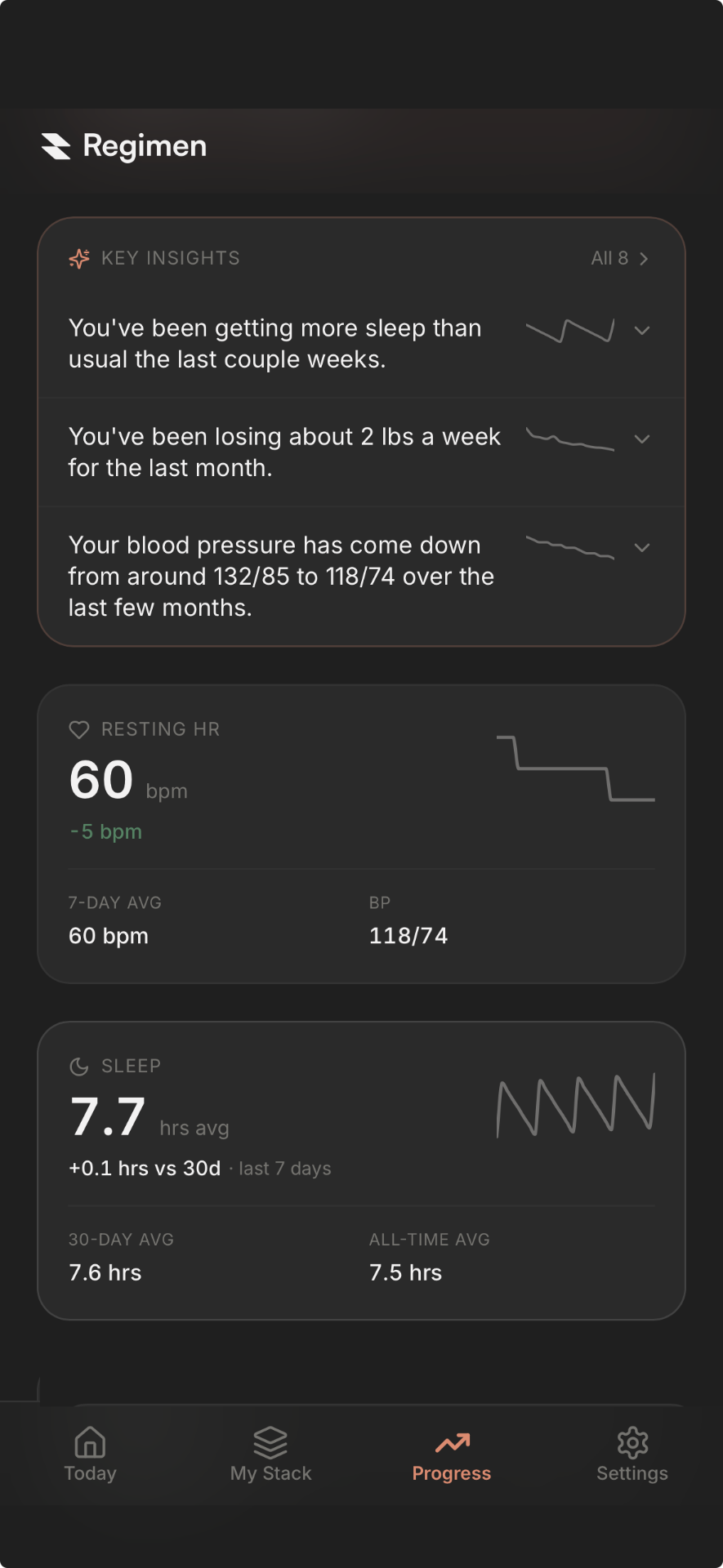
Most trackers stop at logging what you took. Signals connects your whole protocol to 50+ daily check-in markers, your manual bloodwork, and your health metrics, then surfaces whether a compound is improving your sleep, moving a biomarker, or driving a side effect you'd miss by hand. It is a purpose-built analytical engine, not a chatbot: it does the correlation and learns your history, so a new cycle is measured against your own baseline. PeptIQ's GPT-4 assistant generates written summaries; Signals does the math underneath them.
Feature Comparison
| Feature | Regimen | PeptIQ |
|---|---|---|
| Monthly price | $4.99/mo | $19.99/mo |
| Annual price | $39.99/yr | $99/yr |
| Compound library | 200+ compounds and brands | 100+ peptides |
| App Store rating | 4.9 stars (230+ reviews) | 4.3 stars (40 reviews) |
| Free tier | 1 compound, all features | Basic tracking only |
| Wearable integrations (Whoop, Oura) | No | Yes |
| Automatic bloodwork import | Manual entry | Yes |
Why Regimen wins for most users
Signals tells you what's actually working. Most trackers log a dose and stop. Signals connects your whole protocol to 50+ daily markers, your bloodwork, and your health metrics, then surfaces whether a compound is improving your sleep, moving a biomarker, or driving a side effect you'd miss by hand. PeptIQ's GPT-4 assistant generates summaries; Signals does the correlation.
It learns you over time. A new cycle is measured against your own history, not a generic baseline.
More signal in, more insight out. 50+ daily check-in markers, manual bloodwork with a biomarker overlay on your dose timeline, and a one-way pull from Apple Health and Health Connect (weight, body fat %, resting heart rate, sleep, blood pressure).
Feels like a daily check-in, not a data-entry form.
Price. $4.99/month is a quarter of PeptIQ's $19.99 ($39.99/yr vs ~$99). Same depth, less money.
Where PeptIQ is strong
Wearable integrations. PeptIQ connects directly to Whoop and Oura Ring, pulling recovery scores, strain, readiness, and HRV into the same view as injection logs. For users who already wear a Whoop or Oura, this is a genuine advantage. Regimen syncs with Apple Health and Google Health Connect but does not have direct Whoop or Oura integrations in 2026.
Bloodwork sync. PeptIQ integrates with Function Health, Quest, LabCorp, SuperHuman, and FHIR-compatible portals. If your workflow involves regular bloodwork and you want dose logs and labs in one view, PeptIQ handles this natively. Regimen currently requires manual entry for lab values.
Web app. PeptIQ runs in a browser at app.peptiq.io. For users who prefer desktop, this is an option Regimen does not offer. Regimen is iOS and Android only.
Which app should you use?
Choose PeptIQ if you already use a Whoop or Oura Ring and want wearable data alongside your injection logs, or if you need direct bloodwork integration with Quest, LabCorp, or Function Health as part of a clinical or provider-guided workflow. The web app is also useful if you prefer managing protocols from a laptop.
Choose Regimen if you are tracking multiple compounds, especially GLP-1 medications, TRT, and peptides simultaneously, and want the broadest compound library at the lowest price. At $4.99/month versus $19.99/month, Regimen is the practical choice for most biohackers who do not require Whoop or bloodwork integration.
Frequently Asked Questions
Is PeptIQ free?
PeptIQ has a free tier with basic tracking features. Advanced features including the half-life tracker, AI vial scanner, and smart reminders require a premium subscription at $19.99/month or $99/year.
How much does Regimen cost compared to PeptIQ?
Regimen Premium is $4.99/month or $39.99/year. PeptIQ Premium is $19.99/month or $99/year. Regimen is approximately 4x less expensive on a monthly basis.
Does Regimen work with Whoop?
Not currently. Regimen syncs with Apple Health and Google Health Connect but does not have a direct Whoop or Oura Ring integration. PeptIQ supports both Whoop and Oura.
Does PeptIQ have more compounds than Regimen?
No. PeptIQ covers 100+ peptide profiles. Regimen covers 200+ compounds and brands including peptides, GLP-1 medications, TRT compounds, and research chemicals.
Which peptide tracker has better App Store reviews?
Regimen has a 4.9-star rating across 234 combined App Store and Google Play ratings. PeptIQ has a 4.3-star rating across 40 reviews (as of May 2026).
Can I use PeptIQ on a desktop browser?
Yes. PeptIQ has a web app at app.peptiq.io. Regimen is currently iOS and Android only.
Try Regimen Free
One compound. Every feature unlocked. No credit card required.